

What Your Kid's Gaming Habits Reveal About Their Personality
TL;DR: The way your kid plays games—whether they're building elaborate worlds, speedrunning challenges, or role-playing elaborate narratives—reveals surprisingly accurate insights about their personality, learning style, and social preferences. This isn't about labeling kids or limiting them to boxes, but understanding what draws them to certain experiences can help you support their interests, choose better games, and have more meaningful conversations about their digital life.
Your 10-year-old spends three hours meticulously organizing their Minecraft inventory by color. Your 13-year-old rage-quits Fortnite after every loss but queues up again immediately. Your 8-year-old creates elaborate backstories for every Roblox avatar they design.
These aren't just random gaming behaviors—they're windows into how your kids think, problem-solve, and interact with the world.
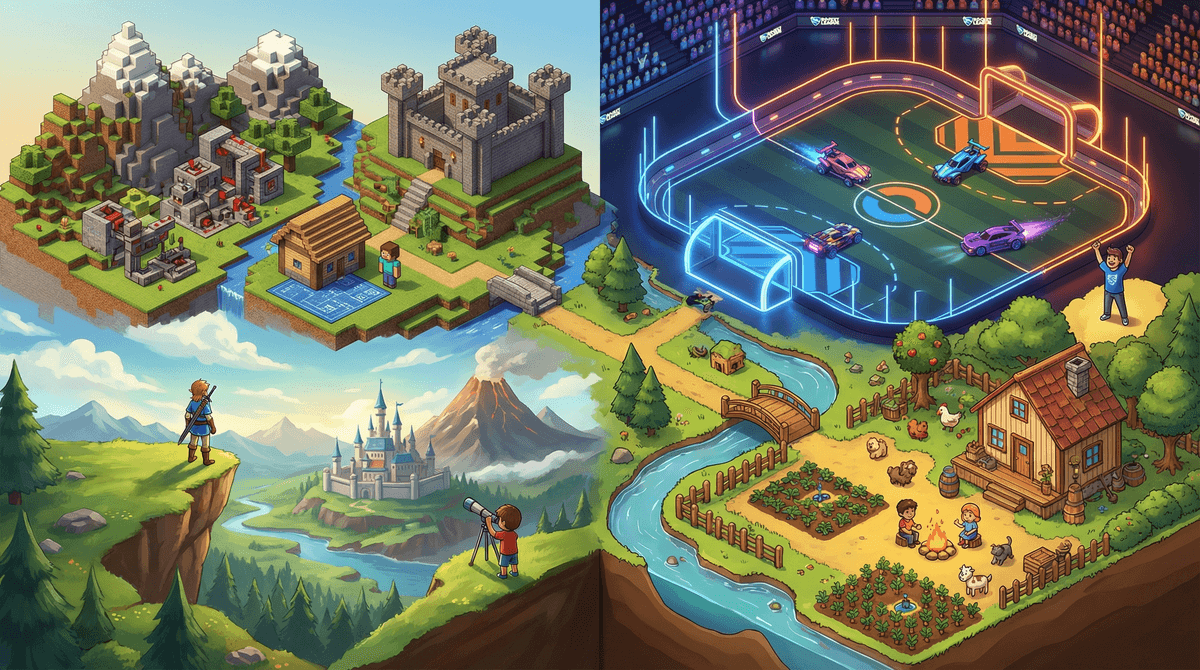
Games they love: Minecraft, Terraria, Dragon Quest Builders, The Sims
Builders are the kids who spend hours creating elaborate structures, organizing systems, and perfecting every detail. They're not rushing to "beat" the game—they're treating it like a canvas.
What this reveals: These kids tend to be planners and systems-thinkers. They enjoy having control over their environment and seeing tangible results from their efforts. They often have strong spatial reasoning skills and may be drawn to architecture, engineering, or design. The satisfaction comes from the creation itself, not external validation.
In real life: These are often the kids who love Lego, organize their rooms by category, or spend hours on detailed art projects. They might struggle with activities that feel chaotic or unstructured.
How to support them: Encourage their creativity with games that offer even more building tools, like Dreams or Little Big Planet. Connect their gaming to real-world skills—3D modeling software, coding classes, or actual building projects. When they want to show you their creations, take the time to look. They're not just showing you a game; they're showing you how they think.
Games they love: Fortnite, Rocket League, Super Smash Bros, Valorant
Competitors are focused on winning, improving, and climbing ranks. They track their stats, watch pro players on YouTube, and analyze what went wrong after every loss (sometimes loudly).
What this reveals: These kids are goal-oriented and motivated by measurable achievement. They have strong resilience—the ability to fail repeatedly and keep trying is actually a valuable life skill, even when it looks like frustration in the moment. They're often natural athletes or drawn to competitive academics.
In real life: These might be your kids who love sports, spelling bees, or any activity with clear winners and losers. They might struggle with activities where success is subjective or progress is slow.
The challenge: The line between healthy competition and toxic frustration is real. If your competitive gamer is raging at teammates, breaking controllers, or spiraling after losses, that's worth addressing. Check out how to handle gaming rage for practical strategies.
How to support them: Help them develop a growth mindset about improvement rather than just winning. Introduce them to games with ranked modes that reward incremental progress. Consider whether they'd benefit from structured team sports or competitive activities outside gaming. And honestly? Sometimes they just need to hear that losing is part of getting better, not a personal failure.
Games they love: Zelda: Breath of the Wild, Subnautica, Outer Wilds, No Man's Sky
Explorers ignore the main quest to see what's over that hill. They collect everything, talk to every NPC, and find secrets the developers didn't think anyone would discover. They're playing the game "wrong" on purpose because the journey matters more than the destination.
What this reveals: These kids are intrinsically motivated and curious. They don't need external rewards to stay engaged—the discovery itself is the reward. They often have strong observation skills and enjoy learning for its own sake. They're comfortable with ambiguity and don't need constant direction.
In real life: These might be the kids who get lost in museums, ask endless "what if" questions, or teach themselves random skills from YouTube. They might struggle with rigid curricula or activities that feel too prescribed.
How to support them: Give them games with even more freedom and discovery, like Minecraft in survival mode or Genshin Impact. Connect their gaming to real-world exploration—hiking, science museums, or travel. When they want to tell you about some obscure game detail they discovered, listen. They're showing you how they learn.
Games they love: Animal Crossing, Stardew Valley, Life is Strange, Undertale
Storytellers create elaborate narratives around their gameplay. They name every character, develop relationships with NPCs, and make decisions based on role-playing rather than optimization. They're not playing a game; they're living in a world.
What this reveals: These kids have strong narrative thinking and empathy. They're drawn to understanding characters' motivations and creating meaning from experiences. They often have rich inner lives and strong emotional intelligence. They might be future writers, actors, or counselors.
In real life: These are often the kids who love reading, create elaborate imaginary worlds, or get deeply invested in characters' emotional arcs in movies. They might struggle with purely mechanical or abstract activities.
How to support them: Introduce them to narrative-rich games like Spiritfarer, A Short Hike, or Kentucky Route Zero. Encourage them to write their own stories or create content about their gaming experiences. Consider tabletop RPGs like Dungeons & Dragons where storytelling is the whole point.
Games they love: Roblox, Among Us, Minecraft (multiplayer), Fortnite (for the squad, not the wins)
Socializers don't really care what game they're playing as long as their friends are there. The game is just the context for hanging out. They're coordinating Discord calls, planning group sessions, and talking more than playing.
What this reveals: These kids are relationship-oriented and collaborative. They value shared experiences over individual achievement. They often have strong communication skills and emotional awareness. They might be natural leaders or mediators.
In real life: These are the kids who need constant playdates, text their friends constantly, and struggle with solo activities. They might have difficulty with independent work or activities that isolate them from peers.
The challenge: For socializers, losing access to gaming can feel like losing access to their entire social circle. This is real, especially post-pandemic. But they also need to develop the ability to be alone sometimes and have in-person social skills. Check out online friends vs. IRL friends for how to think about this balance.
How to support them: Prioritize games with strong co-op elements like It Takes Two, Overcooked, or Phasmophobia. Help them balance online and offline socializing. Consider whether they'd benefit from team activities like theater, group sports, or clubs.
Games they love: Factorio, Civilization, Satisfactory, Chess
Optimizers are min-maxing everything. They're watching guides, calculating damage-per-second, and redesigning their entire approach because they found a 2% more efficient method. They want to understand the systems and master them completely.
What this reveals: These kids are analytical thinkers who enjoy solving complex problems. They're drawn to understanding how things work at a deep level. They often excel in math, science, or programming. They value efficiency and elegance in solutions.
In real life: These might be the kids who love puzzles, ask detailed questions about how things work, or get frustrated when systems seem arbitrary or illogical. They might struggle with activities that feel inefficient or poorly designed.
How to support them: Introduce them to even more complex strategy games, programming, or actual game design. Games like Kerbal Space Program or Baba Is You reward this type of thinking. Consider coding classes or robotics clubs. When they want to explain their optimization strategy, try to follow along—they're showing you how they problem-solve.
Games they love: Pokémon, Hollow Knight, Zelda games, Stardew Valley
Collectors need to find every item, complete every quest, and unlock every achievement. They're checking wikis, keeping spreadsheets, and won't move to a new game until this one is 100% complete.
What this reveals: These kids find satisfaction in completion and mastery. They're thorough, persistent, and detail-oriented. They often have strong memory skills and enjoy categorization. They value seeing things through to the end.
In real life: These might be the kids who organize collections, finish every book they start, or get stressed by incomplete projects. They might struggle with open-ended activities or knowing when "good enough" is actually good enough.
The challenge: Completionism can slide into anxiety or perfectionism. If your kid is stressed about missing collectibles or can't enjoy games without 100% completion, that's worth discussing. Sometimes done is better than perfect.
How to support them: Introduce them to games that reward completion without making it stressful, like A Short Hike or Unpacking. Help them develop the skill of knowing when to move on. Consider whether they'd benefit from collection-based hobbies like trading cards, stamps, or rocks—something they can complete and hold.
Here's the thing: your kid isn't just one type. Most players are a mix, and preferences change over time. Your builder might become a competitor, or your socializer might discover they love optimization.
But understanding these patterns helps you:
Choose better games: If your explorer is bored with linear games, try open-world adventures. If your socializer is struggling, maybe they need more co-op options rather than solo experiences.
Have better conversations: Instead of "how was gaming?" try "what did you build today?" or "did you figure out that strategy you were working on?" Show you understand what they're actually doing.
Identify potential issues: A competitor who's becoming toxic, a socializer who can't function alone, or a completionist who's spiraling into anxiety—these are patterns worth addressing before they become problems.
Connect to other interests: Gaming preferences often map to other activities. Builders might love engineering camps. Storytellers might enjoy creative writing workshops. Optimizers might thrive in robotics clubs.
Understand their resistance: When your kid refuses to play certain games, it might not be stubbornness—it might be a genuine mismatch with their play style. Your builder isn't going to enjoy a fast-paced competitive shooter, and that's okay.
Ages 5-8: Play styles are still forming, and kids this age often enjoy multiple types of play within the same session. They might build in Minecraft for 10 minutes, then switch to chaotic exploration. That's developmentally normal.
Ages 9-12: This is when distinct preferences start emerging. Kids begin gravitating toward specific genres and play styles. They're also more aware of what their friends are playing, which can influence their choices.
Ages 13+: Preferences are usually pretty established by now, though they can still evolve. Teens are also more likely to play games that don't match their natural style because of social pressure or because they're deliberately challenging themselves.
Gaming habits aren't just about the games—they're about how your kid approaches challenges, processes information, and finds satisfaction. A builder isn't better than a competitor. An explorer isn't more valuable than a socializer.
But understanding these patterns gives you a vocabulary for talking about gaming beyond "how much screen time is too much?" It helps you see the skills they're developing, the needs they're meeting, and the person they're becoming.
The next time your kid wants to show you their game, pay attention not just to what they're playing, but how they're playing it. You might learn something surprising about who they are.
-
Observe without judgment: Watch your kid play for 15 minutes without commenting. What are they actually doing? What seems to give them satisfaction?
-
Ask better questions: Instead of "did you win?" try "what were you working on today?" or "what's your strategy for that challenge?"
-
Expand their horizons: If they're stuck in one game, suggest alternatives that match their play style. Check out games like Minecraft or cozy games for kids for ideas.
-
Connect to other activities: Help them see how their gaming preferences connect to other interests. Builders might love Lego robotics. Storytellers might enjoy creative writing. Competitors might thrive in esports clubs.
-
Balance is still important: Understanding your kid's play style doesn't mean unlimited gaming. It means being more intentional about which games and how much time makes sense for your family. Use Screenwise to understand how your family's gaming habits compare to your community and get personalized recommendations that actually match your kid's interests.