

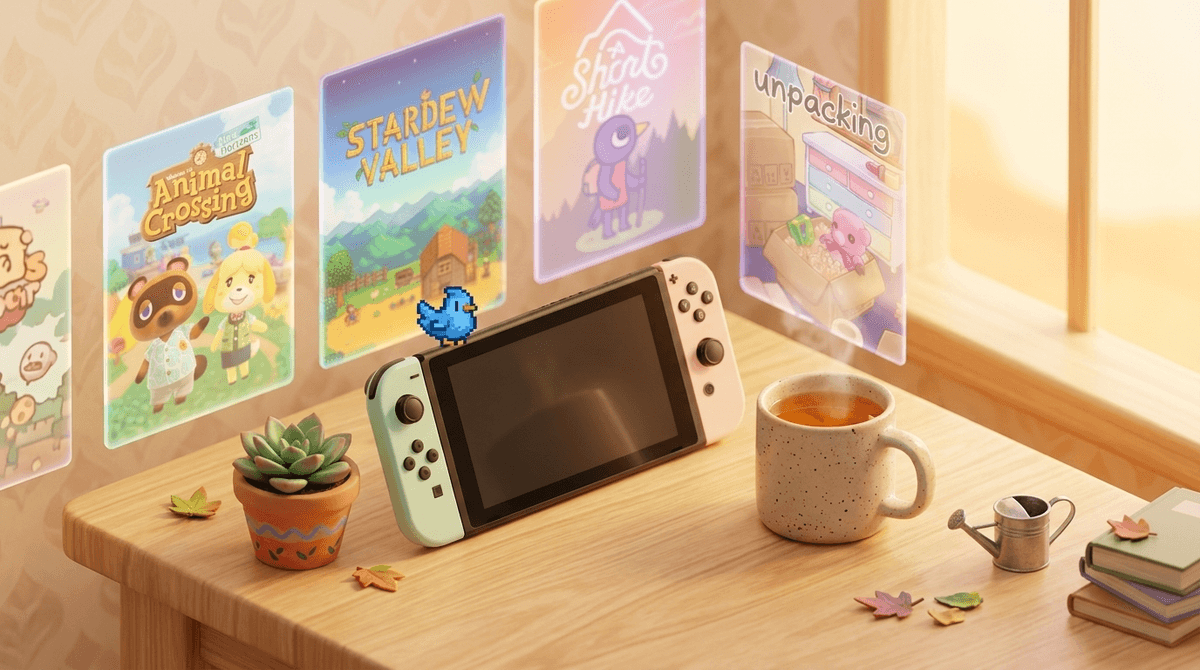
TL;DR: The Quick List If your kid is currently vibrating from the high-stress adrenaline of Fortnite or the chaotic energy of Roblox, cozy games are the antidote. They prioritize relaxation, creativity, and low-stakes exploration over "getting gud" or avoiding a "Game Over" screen.
Top Recommendations:
- Best for Creative Minds: Animal Crossing: New Horizons
- Best for Little Activists: Alba: A Wildlife Adventure
- Best for Zen Focus: Unpacking
- Best for Budding Entrepreneurs: Stardew Valley
- Best for Short Attention Spans: A Short Hike
If you haven't spent much time on "Cozy Games TikTok" or "Cozy Gamers YouTube," you might be wondering if this is just a marketing buzzword. It’s not. "Cozy" is a vibe.
Technically, these are low-stress games that usually lack "fail states." That means you can't really "die" or lose progress in a way that feels punishing. There are no timers counting down, no other players screaming at you in voice chat, and no jump-scares. Think of it like the digital equivalent of a warm blanket and a cup of tea.
For kids, these games shift the focus from competition to completion and collection. Instead of trying to be the last one standing, they’re trying to find the last rare fish for their museum or the perfect wallpaper for their virtual bedroom.
We talk a lot at Screenwise about the "dopamine loop." Games like Brawl Stars or Call of Duty are designed to keep kids in a state of high arousal. Their heart rates go up, their cortisol spikes, and when they finally put the controller down, they often experience a "crash" that manifests as a massive tantrum or general irritability.
Cozy games operate on a different frequency. They encourage "slow gaming." Because there’s no immediate rush, kids can engage their prefrontal cortex—the part of the brain responsible for planning and organization—without the constant "fight or flight" response triggered by battle royales. It’s a way to use screens for decompression rather than just overstimulation.
See the physiological effects of high-stress gaming
Ages 6+ This is the heavyweight champion of the genre. Your child moves to a deserted island, befriends animal neighbors, and slowly builds a community. It’s essentially a digital dollhouse with a functioning economy.
- The "Parent" Perk: It runs on real-time. If it’s 8:00 PM in real life, it’s 8:00 PM on the island. The shops "close" at night, which provides a natural, built-in boundary for ending screen time.
- The No-BS Take: The dialogue can be a bit text-heavy, so if your kid isn't a confident reader yet, you’ll be doing some voice acting. Also, beware of "island envy" if they start looking at what professional creators have built on Pinterest.
Ages 10+ Stardew Valley is a farming simulator, but that description is doing it a disservice. It’s a masterclass in resource management and community building. Your kid inherits a grandfather’s old farm and has to clear the land, plant crops, and interact with the townspeople.
- Why it's great: It teaches the value of delayed gratification. You plant a pumpkin, you water it every day, and you wait. You can't "buy" your way to a better farm with real money (thank god).
- The "Parent" Perk: It’s a great way to talk about entrepreneurship and money management.
Ages 7+ This is a "zen" puzzle game where you literally just unpack boxes and put items away in a room. It sounds like a chore, but it’s incredibly satisfying. There’s a subtle story told through the items—you see the character grow from a child in a nursery to a college student in a dorm, and so on.
- The No-BS Take: It’s a short game. Your kid might finish it in 3-4 hours. It’s a "quality over quantity" experience, but if you’re looking for something that will keep them occupied for months, this isn't it.
Ages 6+ In Alba: A Wildlife Adventure, you play as a young girl visiting her grandparents on a Mediterranean island. You spend your time taking photos of animals, cleaning up trash, and saving the local nature reserve from a corrupt hotel development.
- Why we love it: It’s one of the few games that feels genuinely wholesome without being "preachy" or boring. It empowers kids to feel like they can make a difference in their environment.
Ages 7+ You play as a bird named Claire who is hiking up a mountain to get cell phone reception. That’s it. Along the way, you can fish, chat with other hikers, or just glide around. It’s beautiful, non-violent, and deeply peaceful.
Sometimes you can't get them away from the big platforms, but you can steer them toward "cozier" modes within those platforms.
- Instead of Fortnite Battle Royale, try Lego Fortnite. It’s a survival-crafting mode that feels much more like Minecraft and much less like a sweat-fest.
- Instead of Minecraft Survival Mode, switch them to Peaceful Mode or Creative Mode. No creepers blowing up their hard work, just building.
- For the younger ones, skip the "games" and try Toca Life World. It’s an open-ended digital playground that lets them tell their own stories without any "winning" or "losing."
While "cozy" usually implies "safe," there are a few things to keep an eye on:
1. The "One More Day" Trap
Cozy games, especially farming sims like Stardew Valley, often save progress only when the character "goes to sleep" at the end of an in-game day. This can lead to the "just one more day" syndrome.
- The Fix: Check how long an "in-game day" lasts (usually 10-15 minutes) and set your boundaries based on those cycles rather than a strict timer.
2. Microtransactions in "Cozy" Clothing
Some modern cozy games, like Disney Dreamlight Valley, use a "freemium" model. They look cozy and cute, but they are packed with "Moonstones" (premium currency) and limited-time offers.
- The No-BS Take: Disney Dreamlight Valley is a great game, but the monetization is aggressive. If your kid is prone to "I need that virtual dress right now" meltdowns, stick to Animal Crossing.
3. Online Interaction
Most cozy games are single-player, but some have "visiting" features. In Animal Crossing, players can visit each other's islands via a "Dodo Code."
- The Fix: Ensure they aren't sharing these codes on public forums like Discord or Reddit. Keep island visits restricted to real-life friends.
Learn more about setting up Nintendo Switch parental controls
Here’s the reality: if your kid is used to the high-octane chaos of Roblox or Skibidi Toilet memes, they might find cozy games "boring" at first.
That’s actually okay.
Our kids' brains are often over-indexed on high-stimulation content. Introducing a cozy game is like introducing a slow-paced book after a week of watching Michael Bay movies. There’s an adjustment period.
How to talk about it: Instead of saying "Play this because it's better for you," try "I heard this game is super chill and the music is great. Want to see if we can build a cool garden together?"
Many of these games—especially Animal Crossing and Stardew Valley—have "couch co-op" modes where you can play together. It’s a low-pressure way to bond and model what "healthy" gaming looks like.
Cozy games aren't just a "softer" version of gaming; they are a legitimate tool for digital wellness. They provide a space for kids to practice mindfulness, organization, and empathy without the pressure of competition.
If your household feels like a constant battleground over screen-time-induced irritability, it might be time to trade the battle bus for a watering can.
- Check the console: Most of these are available on the Nintendo Switch, which is the unofficial home of cozy gaming.
- Start with a "Short" experience: If you’re not sure they’ll like the genre, try A Short Hike. It’s inexpensive and can be finished in one sitting.
- Audit the "Cozy" apps: If they play on an iPad, look into Toca Life World or Sago Mini World for a similar low-stress vibe.
Check out our full guide on the best Nintendo Switch games for kids
Find cozy game recommendations based on your kid's interests