

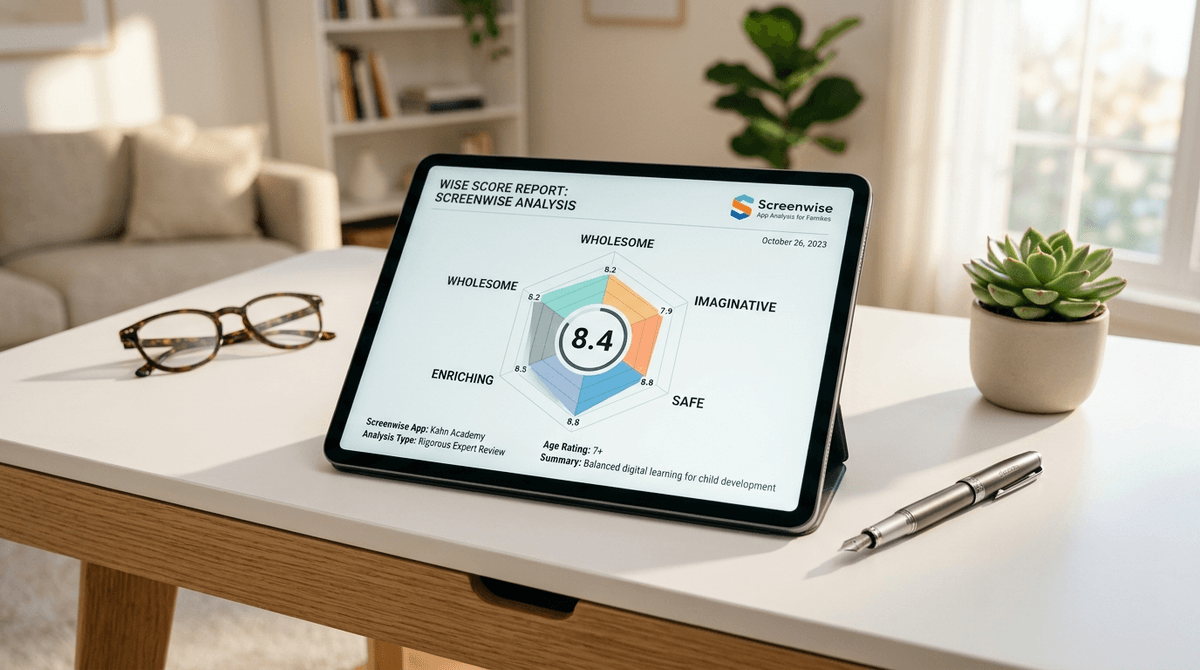
Screenwise rates media using a combination of AI analysis, external rating data from trusted sources, community survey data from real families, and expert review. Every item is scored across four WISE dimensions (Wholesome, Imaginative, Safe, Enriching) on a 0-25 scale each, producing an overall 0-100 score. Our methodology is designed to be transparent, reproducible, and continuously improving.
When you're making decisions about what your kid watches, plays, or reads, you deserve to know how the recommendation was made. A black-box "age 10+" rating doesn't tell you anything about why — or whether the people making that call share your values.
We believe in showing our work.
External Ratings and Metadata
We aggregate data from multiple trusted sources to build a complete picture of each media item:
- Movies and TV: TMDB (The Movie Database), OMDB, MDBList, Letterboxd, Rotten Tomatoes, Metacritic, IMDb
- Video Games: IGDB (Internet Game Database), Metacritic, app store ratings
- Books: Amazon ratings, Goodreads data
- Apps: App Store and Google Play ratings
- YouTube, Podcasts, TikTok: Platform-specific metrics and community data
No single source tells the whole story. By combining multiple perspectives, we get a more accurate picture than any one rating system provides.
Community Survey Data
This is what makes Screenwise fundamentally different. Through our family survey, we collect anonymized data about what real families are doing — what their kids watch and play, at what ages, with what rules and boundaries.
This data powers our community benchmarks. When we tell you "65% of 3rd graders at schools like yours play Roblox," that's real data from real families, not a guess.
AI Analysis
We use AI (primarily Google Gemini and Anthropic Claude) to analyze each media item across the four WISE dimensions. The AI considers the content itself, external ratings and reviews, age-appropriateness factors, online safety features, and educational and developmental value.
AI analysis is supplemented with web search for current information — important for games and platforms that update frequently.
Expert Review
AI scores are audited for accuracy. When scores seem off — and they sometimes do — we investigate and correct. We also flag items where the AI might lack sufficient context, like niche indie games or very new releases.
Step 1: Data Collection
When a media item enters our system (through our automated import pipeline or manual addition), we fetch metadata and ratings from all available external sources.
Step 2: AI Scoring
The AI analyzes all available data and produces scores for each WISE dimension (0-25), along with confidence levels and reasoning. It also generates parent-facing copy: a one-liner summary, key things to watch for, conversation starters, and an age-fit assessment.
Step 3: Quality Audit
Scores are checked against known benchmarks. A children's show that scores low on Safe, or a mature-rated game that scores high, gets flagged for review. We run automated content audits to catch inconsistencies.
Step 4: Continuous Updates
Scores are recalculated when new data becomes available — game updates, new seasons of shows, emerging safety concerns, or shifts in community data.
Strengths:
- Multi-dimensional scoring captures nuance that single ratings miss
- Community data provides context no other rating system offers
- Continuous updates keep scores current
- Personalization means recommendations actually fit your family
Limitations we're transparent about:
- AI analysis can miss cultural nuance or very recent content
- Community data is strongest for popular titles and may be thin for niche content
- We cover a growing but not exhaustive catalog — if we don't have something, we say so
- Personalization requires taking the survey; without it, you get base scores only
If you think a score is wrong, we want to know. Parent feedback directly informs our audit process. We'd rather fix a wrong score than defend it — because a wrong score is bad advice to a parent about their kid.
Q: Is Screenwise's rating system automated or human-reviewed?
Both. AI generates initial scores using multiple data sources. Those scores are then audited through automated quality checks and human review. When discrepancies are found, humans make the final call.
Q: How does Screenwise handle media that updates frequently, like Roblox or Fortnite?
We recalculate scores when significant updates occur. For platform-style media (Roblox, Minecraft servers, YouTube channels), we focus on the core platform safety and features rather than individual user-created content, and we note the distinction clearly.
Q: Can I trust AI-generated ratings?
Our AI scoring is one input among many — it's combined with external ratings from established sources, community data from real families, and human auditing. We don't ship a score we can't defend, and we're transparent when confidence is lower for a particular item.
Q: How is Screenwise funded? Does that affect ratings?
Screenwise is funded through premium subscriptions. We do not accept payment from media companies, game studios, or streaming platforms for ratings or placement. Our ratings are independent.
We believe parents deserve to know how recommendations are made. Our methodology combines the best available data, AI analysis, community context, and human oversight to produce ratings that are accurate, transparent, and genuinely useful for real families making real decisions.
Browse all Screenwise ratings or learn how WISE scores work.