

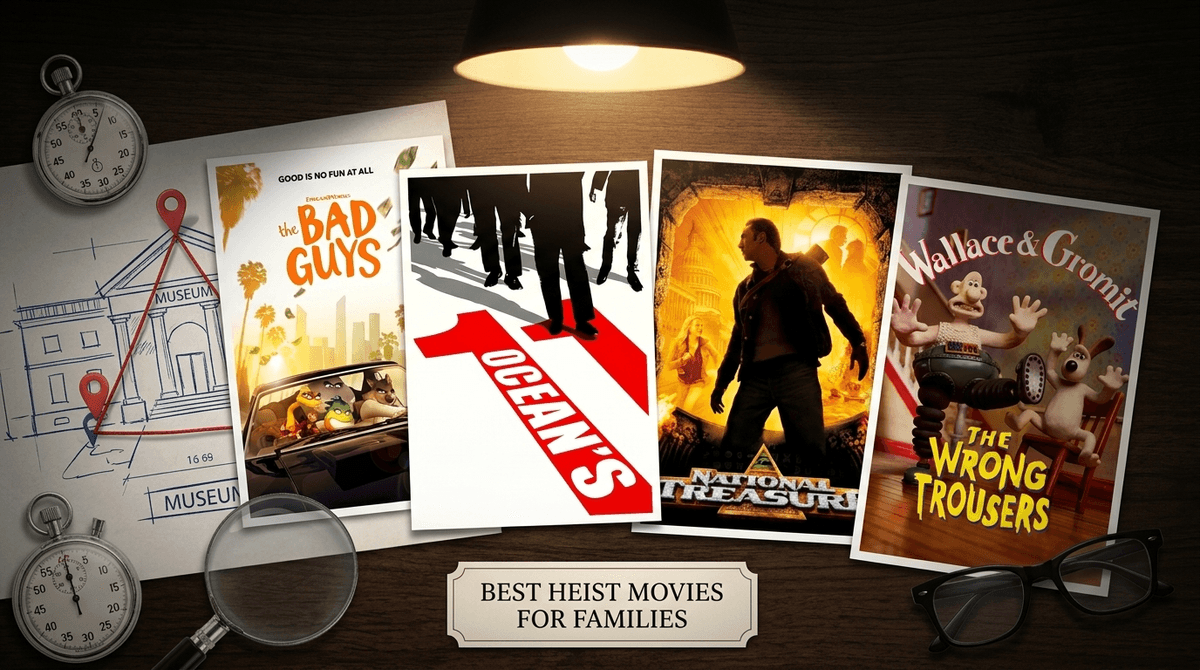
TL;DR: A heist is a puzzle with a deadline. Your kid has to hold the plan in their head, notice the thing that goes wrong, and catch the switch at the end. That's more thinking than almost anything else you'll put on a Friday night, and the genre scales by age from a claymation penguin stealing a diamond to Danny Ocean emptying three casinos. Violence is the easy part to check. The part worth planning for is that the movie wants your kid on the thieves' side, and that turns out to be the good part.
Jump to your kid's age:
- Ages 5–8: The Wrong Trousers, The Bad Guys
- Ages 9–12: Carmen Sandiego, National Treasure
- Ages 13+: Ocean's Eleven, The Sting
Every heist movie runs the same trick. It gives you a crew with a skill each, a target that seems impossible, a plan explained in detail, and then it breaks the plan. By the twenty-minute mark your kid has quietly signed on with people committing a felony.
Parents notice this and go one of two ways. Some skip the genre. Some say nothing and hope it doesn't come up. There's a third option that takes one sentence at the credits: who got hurt in that?
It's a real question with a different answer each time. Nobody loses anything in The Wrong Trousers except a penguin who had it coming. In Ocean's Eleven the mark is a casino owner the film works hard to make you dislike, which is the writers doing your kid's moral homework for them, and worth pointing out. In The Italian Job somebody dies in the first fifteen minutes and the rest is revenge. Same genre, three different deals.
Kids who watch a few of these start spotting the setup on their own: oh, they made the guy a jerk so we'd be fine with it. That's media literacy arriving by the side door, and it beats any lecture you could give about it.
At this age you want the heist grammar — the crew, the blueprints, the ticking clock — with nothing real at stake.
The best heist film ever made is thirty minutes long, has no dialogue from its villain, and stars a dog. Feathers McGraw rents Wallace's spare room, hijacks a pair of robotic techno-trousers, and walks a sleeping Wallace through a museum diamond theft. Gromit works it out. It ends with a model train chase that people still study shot by shot.
What makes it work: Every beat of the heist form is here in miniature: the inside man, the gadget, the complication, the chase, at a pace a five-year-old can follow. And it's funny for you, which matters at the fourth rewatch.
Watch-out: Feathers McGraw is silent and stares, and for some four- and five-year-olds that lands as properly creepy. He's a penguin in a rubber glove. He's also the scariest thing in this whole guide.
Age sweet spot: 4–10, and every adult in the room.
DreamWorks made Ocean's Eleven for second graders and it works. Mr. Wolf's crew, a snake and a shark and a piranha and a tarantula, fake going straight as a con, and then the con starts working on them. Split screens, a jazz score, a getaway car, all of it played straight.
What makes it work: The theme has teeth. These animals are treated as criminals because of what they look like, so they behave like criminals, and the movie is honest that going good is a skill you practice rather than a switch you flip. Kids who felt typecast by a teacher or a sibling sit up during this one.
Watch-out: Cartoon car chases and a couple of jump-scare gags. Nothing bloody. PG.
Age sweet spot: 6–11. If it lands, The Bad Guys 2 is more of the same, and the Aaron Blabey books behind it are a reliable hook for a reluctant reader.
Kermit and Fozzie are twin reporters sent to London to cover a jewel theft. Miss Piggy gets mistaken for a fashion designer. There is a full song-and-dance number in a swimming pool. The break-in itself is a real break-in, guards and lasers and all, performed by felt.
What makes it work: The Muppets play heist as farce, so the tension never tips into fear, and the jokes are pitched at two levels, one for your kid and one for you. Rated G, and it earns it.
Age sweet spot: 5–10.
Gru's plan is to steal the moon. His cover is adopting three girls to sell cookies at his rival's front door. Then the cover becomes the point.
What makes it work: A heist movie that loses to a family on purpose, and the one on this list a four-year-old can follow all the way through.
Watch-out: Gru is a villain for the first act, including some mild menace toward the girls before he thaws. The sequels thin out fast: Despicable Me 2 is fine, 3 and 4 are minion delivery vehicles.
Age sweet spot: 4–9.
Now your kid can hold a longer plan and tolerate a genuine threat, as long as the camera stays out of the consequences.
Netflix's version makes Carmen a thief who robs the thieves: she steals V.I.L.E.'s targets out from under them before they can. Each episode is a self-contained caper in a different city, with the geography and history folded into the plot instead of taped on top.
What makes it work: Twenty-two minutes per heist means one before homework is a real option. And it's the rare show where the educational content survives being cool.
Age sweet spot: 8–13.
Nicolas Cage steals the Declaration of Independence in order to protect it, using a pair of Ben Franklin's glasses to read invisible ink on the back. The premise is ridiculous. The movie knows.
What makes it work: It's a puzzle box, riddles and ciphers and a map hidden in plain sight, and kids this age will pause it to argue about the next clue. Nine- and ten-year-olds who like this one tend to go looking for more history on their own, which is not something you can say about most PG action movies.
Watch-out: PG, with brief gunplay and a couple of tense chases. One character falls to his death early on, off-camera.
Age sweet spot: 9–13. Book of Secrets is a step down in the same shape.
It's a breakout rather than a heist, which is the same movie run backwards. Woody assembles a crew, assigns roles, runs a plan through a daycare with a surveillance monkey and a perimeter, and the plan goes wrong at exactly the right moment.
What makes it work: The most structurally rigorous caper Pixar has made, and your kid has probably already seen it, which makes it a free lesson in what the genre is doing. Watch it once for the story and once for the plan.
Watch-out: The incinerator sequence frightens kids, including kids well past the age you'd expect. Know it's coming.
Age sweet spot: 6–12.
Hayao Miyazaki's first feature. Gentleman thief Lupin III cleans out a casino, discovers the money is counterfeit, and goes after the country printing it. Rooftop chases, a flooded dungeon, a finale inside a clock tower.
What makes it work: The most beautiful thing on this list, and the action is hand-animated in a way modern kids have mostly not seen. A good entry point for a kid who's aged out of Ghibli's gentler films but isn't ready for a live-action thriller.
Watch-out: It's a 1970s cartoon rogue. There's smoking, some cheerful leering, and a young woman who mostly needs rescuing. Worth a sentence about when it was made.
Age sweet spot: 9–14.
Eleven people, three casinos, one vault, and a plan the film explains twice: once as a lie and once as the truth. Steven Soderbergh's remake is the cleanest example of the form anybody has shot.
What makes it work: Watch it with a teenager who thinks they can see twists coming, because they can't see this one, and the reveal is fair. Every piece was on screen. The cast is having an obvious good time, which is contagious.
Watch-out: PG-13 and mild for it. Some language, a staged shooting inside the vault that isn't real, a divorce subplot, and a general glamour around gambling and casinos that's worth naming out loud.
Age sweet spot: 12–16. Twelve is a mess, Thirteen recovers, Eight is a decent Met Gala caper with the same DNA.
Newman and Redford run a long con on a mob boss in 1930s Chicago, with Scott Joplin ragtime over the top and chapter cards between the acts. It won Best Picture and it earns the structure lesson: the movie tells you it's conning you, and cons you anyway.
What makes it work: Rated PG, which surprises people. If a teenager wants to understand how plots get built, this is the one. The whole film is scaffolding you can see.
Watch-out: A murder in the first act, period smoking and drinking throughout, a brief brothel scene. It's also slow by 2020s standards for the first twenty minutes. Tell them to hang on.
Age sweet spot: 13+.
A crew of thieves and grifters takes jobs against people the law can't touch, a predatory landlord or a pharma executive, and gives the money back. It's the revival of the 2008 series, and it goes down easy one episode at a time.
What makes it work: The moral arithmetic is handed to you, which sounds like a weakness and is the appeal for a 13-year-old: they get to enjoy the crime without the argument. Good bridge between the kid stuff above and the real capers.
Age sweet spot: 12–17.
Gold bars out of a Venice canal, a betrayal, and then Mini Coopers through the storm drains of Los Angeles. The chase is the reason to watch it.
Watch-out: This is the lowest-scoring pick here on Screenwise's wholesome measure, and the reason is the opening: a crew member murders his partner for the gold, and the rest of the movie is payback. Fine for most teens, wrong for a sensitive twelve-year-old.
Age sweet spot: 13+.
Con artistry rather than a heist proper: a teenager forges checks, impersonates a pilot and a doctor, and stays ahead of the FBI agent chasing him. It's Spielberg at his lightest, and it's a film about a kid coming apart after his parents' divorce.
Watch-out: PG-13 with real teeth on this one. A call-girl scene, cigarettes and drinking, and a sustained sadness underneath the caper. For 15 and up, and better if you watch it with them.
Age sweet spot: 15+.
Money Heist comes up constantly because the red jumpsuits and Dalí masks are everywhere, including in your kid's group chat. It's TV-MA, it's violent, and it carries one of the lowest safety scores in the Screenwise catalog. The masks are a costume. The show is not for them.
Tower Heist looks like the family-friendly option on the shelf: Ben Stiller, an ensemble, a PG-13 rating. It's a dull movie with a lot of swearing. Watch Logan Lucky instead if you want a comic heist for older teens.
The Pink Panther (2006) is the one parents grab because the title sounds safe. It's lazy, the jokes are broad, and there's nothing in it for a kid to think about. The 1964 original series still plays.
And a teenager will eventually ask for Baby Driver, because the soundtrack is famous and the first ten minutes are on every highlight reel. It's rated R and the back half gets brutal. Know what you're agreeing to.
The thing that turns a heist movie from a watch into an activity: pause it once, right after the crew explains the plan, and ask what's going to go wrong. Every heist movie breaks its own plan, so the question always has an answer, and a kid who guesses right will not let you forget it.
Two more that work with almost no effort:
- At the end, ask who paid for this: the mark, an insurance company, a stranger. Different answer every film.
- Ask which crew member they'd be. Kids pick the gadget person or the driver. The interesting follow-up is why nobody picks the planner.
Bottom line: Start with The Wrong Trousers at any age under ten, The Bad Guys if you want a feature, and Ocean's Eleven the first Friday your kid can handle a PG-13. The genre rewards paying attention more than almost anything else you can put on, and it hands you a conversation for free.
More for family movie night: