

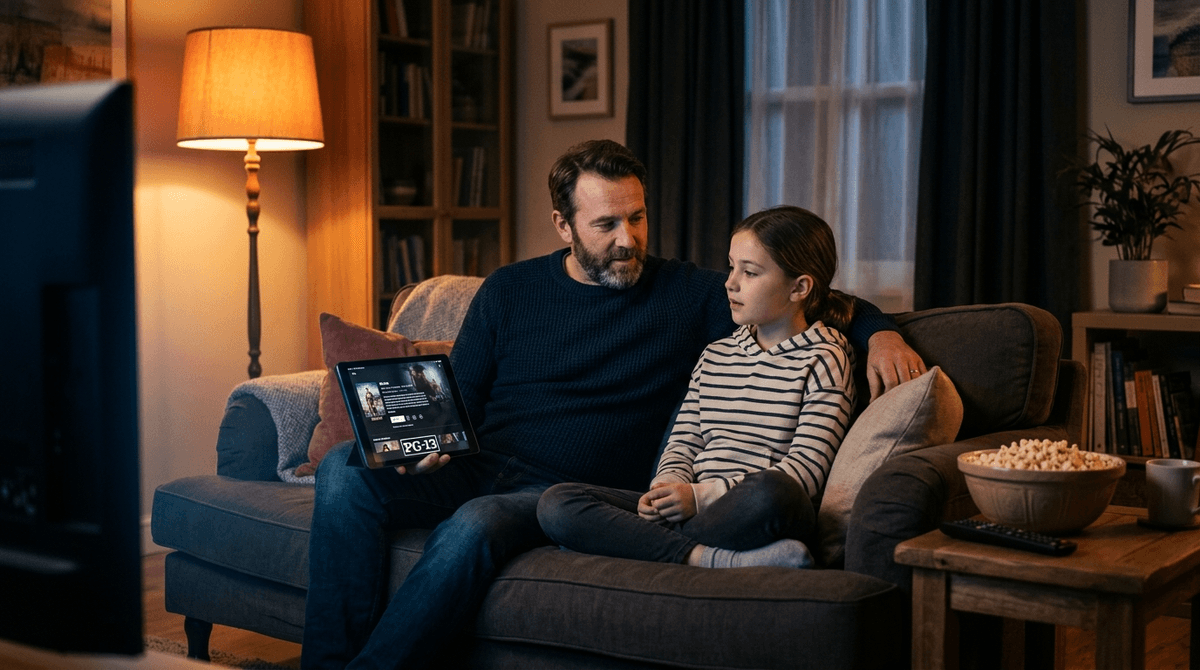
When Is Your Child Ready for PG-13 Movies?
The PG-13 rating is a suggestion, not a law—and honestly, it's pretty inconsistent. Some PG-13 movies are basically intense PG (The Goonies would get PG-13 today), while others push hard against an R rating. The real question isn't "are they 13?" but "can they handle THIS specific movie's content?"
The MPAA's descriptor boxes (the text explaining WHY something is rated PG-13) are your best friend here. Use them, watch trailers together, and know your kid's specific sensitivities around violence, language, scary imagery, and mature themes.
Quick framework: Most kids can handle some PG-13 content by ages 10-11, but it varies wildly by movie and kid. A tween who devours Percy Jackson might be fine with fantasy action violence but completely rattled by realistic war scenes or jump scares.
PG-13 was created in 1984 after parents lost their minds over Indiana Jones and the Temple of Doom (that heart-ripping scene, you know the one). It means "Parents Strongly Cautioned—Some Material May Be Inappropriate for Children Under 13."
Here's what can appear in a PG-13 movie:
- Violence: Can be intense, but not "realistic and extreme or persistent"
- Language: One use of the F-word (as long as it's not sexual), plus other profanity
- Nudity: Brief, non-sexual nudity is allowed
- Drug use: Can be present but not glorified
- Scary/intense scenes: Pretty much anything goes here
- Sexual content: Innuendo and brief scenes, but nothing explicit
The problem? These guidelines are wildly subjective. The Dark Knight is PG-13. So is Mean Girls. These are not the same experience.
Every movie rating comes with a descriptor explaining exactly why it got that rating. This is the most useful tool you have—way more helpful than the rating itself.
Examples:
Spider-Man: No Way Home: "Rated PG-13 for sequences of action/violence, some language and brief suggestive comments"
A Quiet Place: "Rated PG-13 for terror and some bloody images"
The Hunger Games: "Rated PG-13 for intense violent thematic material and disturbing images—all involving teens"
See how different those are? The first is superhero action. The second is sustained terror. The third involves kids killing kids.
Find these descriptors on:
- IMDb (right under the title)
- Common Sense Media (which also gives you age recommendations from other parents)
- The movie poster/streaming service page
- Just Google "movie title rating"

This is where you have to be honest about what actually bothers YOUR kid, not what you think should bother them at their age.
Violence Spectrum
Some kids are totally fine with fantasy/cartoon violence (Marvel movies, Star Wars) but disturbed by realistic violence or gore. Others are the opposite—they can handle war movies but get stressed by horror-adjacent jump scares.
Questions to consider:
- How did they handle the Snap scene in Avengers: Infinity War?
- Do they get nightmares from intense scenes, or are they pretty resilient?
- Can they distinguish fantasy violence from real-world consequences?
Language
Here's the thing about movie language: it's often less frequent but more intense than what they're already hearing at school. Most middle schoolers have heard every word in the book by now, but there's a difference between overhearing it and watching adults use it casually on screen.
Some parents care a lot about this. Some don't. Both are fine—just know where you stand before you hit play on a comedy where every other line is a creative use of profanity.
Scary/Intense Imagery
This is the sleeper category that gets overlooked. A movie can be PG-13 for "intense sequences" and give your kid nightmares for weeks, even if there's zero blood or language.
Jaws is PG. It traumatized a generation. Jurassic Park is PG-13 and still freaks out some 10-year-olds. Meanwhile, some kids watch A Quiet Place and think it's awesome.
Red flags for sensitive kids:
- "Terror" or "intense sequences" in the descriptor
- Horror-adjacent genres (even if marketed as action/thriller)
- Jump scares and sustained tension
- Realistic danger to kids/families
Mature Themes
This is where PG-13 gets really tricky. A movie might be rated PG-13 for "thematic elements" which could mean anything from divorce to genocide to existential dread.
Inside Out is PG but deals with depression. The Hunger Games is about authoritarian governments forcing children into gladiatorial death matches. Everything Everywhere All at Once is rated R, but many parents let their teens watch it for its themes about family and identity despite some violence and language.
Sometimes these themes are exactly what you WANT your kid to engage with. Sometimes they're not ready. You know your kid.
These are generalizations—your mileage will absolutely vary.
Ages 8-10: Very Selective PG-13
Most kids this age aren't ready for true PG-13 content, but there are exceptions:
- Mild action/adventure: Early Marvel movies, The Goonies, Night at the Museum
- Fantasy with mild peril: Harry Potter and the Prisoner of Azkaban and beyond (note: these get progressively darker)
- Sports/inspirational films: Remember the Titans, Hidden Figures
Skip: Horror, intense thrillers, anything with realistic violence or heavy themes, most teen comedies
Ages 10-12: Expanding the Range
This is when many kids start genuinely enjoying PG-13 content and can process more complex themes:
- Superhero movies: Most Marvel and DC films work here
- Adventure/sci-fi: Jurassic World, Star Wars sequels, Ready Player One
- Coming-of-age: The Karate Kid, Akeelah and the Bee
- Historical drama: Hidden Figures, October Sky
Proceed with caution: Horror (even "mild" horror), war movies, anything with sexual content beyond kissing, dark thrillers
Ages 13+: Most PG-13 Is Fair Game
By actual-13, most kids can handle most PG-13 content, though you'll still want to check descriptors for:
- Extreme violence/gore: Some PG-13 movies push the limits (The Dark Knight has some genuinely disturbing imagery)
- Sexual content: Teen comedies can be raunchy even at PG-13
- Substance use: If your teen is struggling with peer pressure around drugs/alcohol, maybe skip the party movies for now
- Psychological intensity: Some thrillers are just a lot
Honestly? The best way to know if your kid is ready is to watch it yourself first or watch it together the first time.
I know, I know—you don't have time to pre-screen every movie. But for the questionable ones, it's worth it. And watching together means you can:
- Gauge their real-time reactions
- Pause for questions or to explain context
- Have conversations about what you're seeing
- Fast-forward through the one scene that's too much
Common Sense Media is also invaluable here—they break down every category (violence, language, sex, consumerism, positive messages) and give you both a "suggested age" and what parents and kids actually thought.
Yeah, this is real. By 5th-6th grade, kids are absolutely watching PG-13 movies at friends' houses and sleepovers. You can't control every viewing experience, and honestly, trying to will just make them sneaky.
Better approach:
- Set your family's baseline for what's okay at home
- Talk about why certain content isn't right for your family yet (not because it's "bad" but because of specific content)
- Give them language to decline at friends' houses without sounding babyish: "My parents are weird about horror movies" is a totally acceptable excuse
- Accept that they'll see stuff anyway and make yourself the safe person to talk about it afterward
The goal isn't perfect content control—it's raising a kid who can think critically about media and knows they can come to you when something bothers them.
PG-13 is a range, not a standard. The rating tells you almost nothing without the descriptor box. A 10-year-old might be totally fine with Spider-Man: Homecoming but not ready for The Hunger Games, even though both are PG-13.
Your decision-making framework:
- Read the descriptor box
- Check Common Sense Media or IMDb parent reviews
- Consider your specific kid's sensitivities (violence, scary, language, themes)
- Watch together the first time if you're unsure
- Make it a conversation, not a decree
And remember: you can always turn it off. If you start a movie and it's too much, that's valuable information. "Hey, I didn't realize this would be so intense—let's switch to something else" teaches your kid that it's okay to opt out of content that doesn't feel right.
Check if specific movies are appropriate for your child or explore age-appropriate alternatives to popular PG-13 films.