

Best Murder Mysteries for Family Movie Night: Age-by-Age Guide
TL;DR: Murder mysteries can be fantastic family viewing—they teach critical thinking, logic, and how to pay attention to details. But there's a massive range between Scooby-Doo and Se7en. Here's what actually works for different ages, from elementary schoolers to teens ready for the real deal.
Jump to your age group:
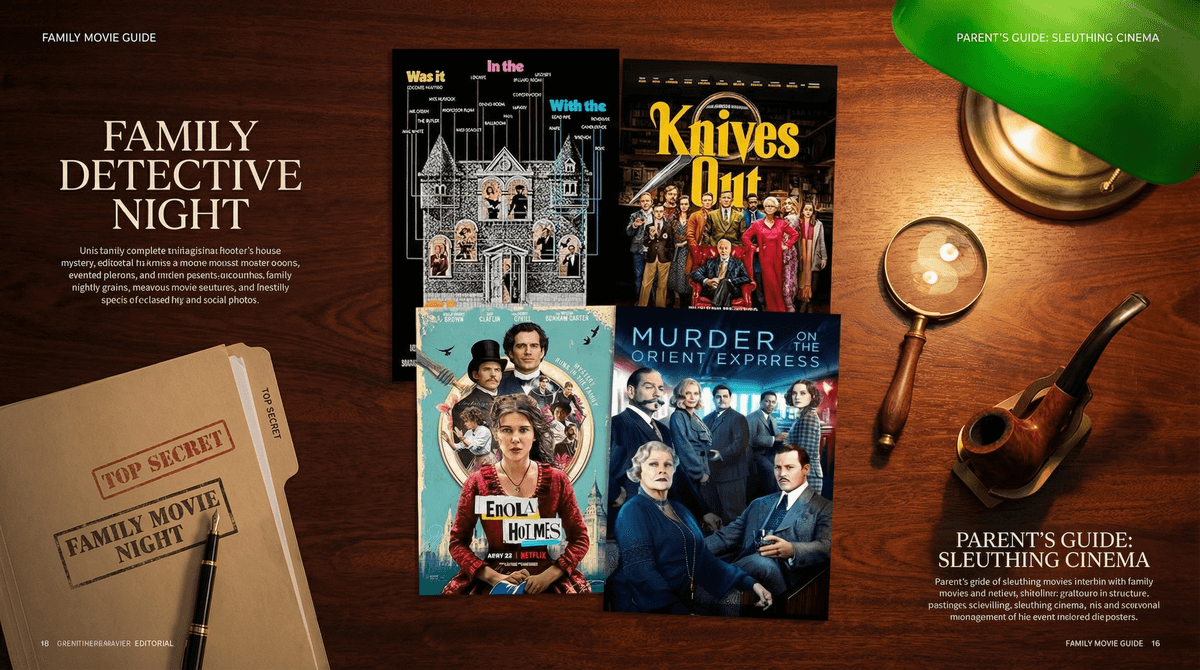
- Elementary (6-10): Clue, Enola Holmes
- Middle School (11-13): Knives Out, Murder on the Orient Express
- High School (14+): Glass Onion, The Usual Suspects
Screenwise Parents
See allBefore we dive in: murder mysteries are one of the few genres where you can genuinely make a case that watching is educational. They require active viewing—kids have to track clues, remember details, evaluate motives, and think logically. It's like a puzzle that happens to involve a dead body.
The key is matching the tone and graphic content to your kid's maturity level. A cozy mystery where the murder happens off-screen and everyone's wearing fabulous outfits? Very different from a gritty crime thriller with autopsy scenes.
This is the gold standard for introducing younger kids to murder mysteries. Based on the board game, it's pure camp—Tim Curry chewing scenery, rapid-fire dialogue, physical comedy, and three different endings. The murders are completely cartoonish (no blood, no gore), and the whole thing plays like a theatrical farce.
What makes it work: The tone is so over-the-top silly that kids never feel scared. Plus, it's genuinely funny for adults, which means you won't be suffering through another kids' movie. My litmus test: if your kid can handle the flying monkeys in Wizard of Oz, they can handle Clue.
Age sweet spot: 7-12
Millie Bobby Brown as Sherlock's rebellious teenage sister, breaking the fourth wall and solving mysteries in Victorian England. These are adventure movies first, mysteries second—lots of action, chase scenes, and girl-power messaging. The crimes involve some darker themes (missing persons, exploitation), but nothing graphic.
What makes it work: Enola talks directly to the camera, which helps younger viewers follow along. The mysteries are solvable if you're paying attention, and there's enough humor and action that it never feels heavy.
Age sweet spot: 8-13
Disney's Sherlock Holmes but with mice. Legitimately clever mystery plotting, a genuinely menacing villain (Ratigan, voiced by Vincent Price), and some surprisingly dark moments. This one can actually be a bit intense for sensitive younger kids—there's a scene in a toy shop that gets creepy, and the climax is genuinely suspenseful.
What makes it work: It's animated, which provides emotional distance, but it doesn't talk down to kids. The mystery has real stakes and requires actual deduction.
Age sweet spot: 7-11
This is the age where kids can handle more sophisticated plotting and some darker themes, but you still want to avoid graphic violence or truly disturbing content.
Rian Johnson's modern masterpiece. A wealthy mystery writer dies under suspicious circumstances, and detective Benoit Blanc (Daniel Craig doing a wild Southern accent) investigates. The whole thing is clever, twisty, funny, and features a genuinely likeable protagonist in Marta, the nurse who physically cannot lie.
The catch: It's PG-13 for language and thematic elements. There's some strong language (not constant, but it's there), discussion of immigration status, and themes of family greed. The actual murder/death scenes are not graphic.
What makes it work: The structure is brilliant—you learn what happened early on, then watch how it all unravels. It's a masterclass in plotting that will make kids want to figure out how the writer constructed it. Plus, it's genuinely funny and the "eat the rich" themes land well with this age group.
Age sweet spot: 12+, though 11-year-olds who can handle some language will be fine
Kenneth Branagh's lush adaptation of the Agatha Christie classic. A murder on a train, a snowbound investigation, an all-star cast in gorgeous period costumes. The 2017 version is more visually dynamic than the 1974 version, which makes it more engaging for modern kids.
What makes it work: It's a pure puzzle mystery—no gore, no graphic violence, just people in fancy clothes lying to a detective with an absurd mustache. The solution involves some heavy moral questions about justice and revenge, which makes for great post-movie discussion.
Age sweet spot: 11-15
A murder mystery about a murder mystery—someone's killing people connected to Agatha Christie's play "The Mousetrap" in 1950s London. It's meta, funny, and features Sam Rockwell and Saoirse Ronan as mismatched detectives.
What makes it work: It's self-aware without being annoying about it, the humor is dry and British, and it's a good introduction to the conventions of the genre (because the movie explicitly talks about them). Also, it's genuinely a good mystery with a satisfying solution.
Age sweet spot: 12+
Teens who love mysteries can handle sophisticated plotting, moral ambiguity, and more intense content. These are the films that will make them lifelong mystery fans.
The Knives Out sequel, set on a tech billionaire's private Greek island during the pandemic. Even more ambitious than the first, with a structure that completely recontextualizes everything midway through. Daniel Craig returns as Benoit Blanc, and the cast (including Janelle Monáe, Kathryn Hahn, and Edward Norton) is clearly having a blast.
Content notes: Similar to Knives Out—PG-13 for language and thematic elements. There's a fairly intense scene involving a fire, and themes around COVID denialism and tech bro culture.
What makes it work: It's a mystery about how people convince themselves of their own brilliance. The social commentary is sharp, the plotting is intricate, and there's a scene with a glass sculpture that will have everyone gasping.
Age sweet spot: 13+
The twist ending that launched a thousand Reddit threads. A group of criminals brought together for a heist, a legendary crime lord called Keyser Söze, and a narrative structure that makes you question everything you've seen.
Content notes: Rated R for violence and language. There's gun violence (not gratuitous, but present), strong language throughout, and some intense scenes. The themes involve organized crime and some dark subject matter.
What makes it work: This is the movie that teaches you to watch carefully, to question unreliable narrators, and to appreciate how a story can be constructed to mislead you. The ending is genuinely shocking, even now. But it's definitely for older teens—probably 15+.
Age sweet spot: 15-17
A high school noir—imagine a 1940s detective story but set in a modern California high school. Joseph Gordon-Levitt as a loner investigating his ex-girlfriend's disappearance, speaking in rapid-fire hardboiled dialogue while navigating cliques and cafeterias.
Content notes: Rated R for violence, drug content, and language. This one earns its rating—there's drug use, violence, and some genuinely dark themes around teen exploitation.
What makes it work: It's stylistically unique, the dialogue is incredible, and it takes both the mystery genre and high school social dynamics completely seriously. But it's intense and definitely not for younger teens.
Age sweet spot: 16+
Robert Altman's upstairs-downstairs murder mystery set at an English country estate in the 1930s. It's essentially Downton Abbey meets Agatha Christie, with an ensemble cast and overlapping dialogue that rewards multiple viewings.
What makes it work: The mystery is almost secondary to the social commentary about class, privilege, and the master-servant relationship. It's slower-paced than modern mysteries, which means it's for teens who can appreciate character development and atmosphere.
Age sweet spot: 14+
Every parent asks: what about the classic Agatha Christie adaptations? Here's the breakdown:
Best for families: The David Suchet Poirot series (1989-2013). These are made-for-TV movies, so they're generally less graphic than theatrical releases. Suchet is definitive as Poirot, and the production values are excellent. Most are appropriate for ages 11+, though some episodes deal with heavier themes.
Miss Marple: The Joan Hickson series (1984-1992) is considered the gold standard, though it's slower-paced than modern kids are used to. The recent adaptations tend to add more darkness and graphic content than the originals.
Death on the Nile: The 2022 Kenneth Branagh version is more intense than Orient Express—there's a fairly graphic shooting scene and some sexual content. I'd say 13+ at minimum, possibly 14+.
Here's where I'm going to be blunt: true crime documentaries are not the same as murder mysteries, and they're generally not appropriate for the ages we're discussing here.
The difference is stakes and tone. Fictional mysteries are puzzles with narrative closure. True crime involves real victims, real families, and often disturbing details about actual violence. Even "lighter" true crime (like some episodes of Unsolved Mysteries) can be genuinely upsetting in ways that fiction isn't.
If your teen is interested in true crime, that's a separate conversation about media literacy, empathy for victims, and understanding the difference between entertainment and tragedy. Here's more on navigating true crime with teens .
.
Elementary (6-10):
- Cartoonish or off-screen violence only
- Clear good guys and bad guys
- Mystery solving should feel like a game
- Comic relief is essential
- Happy endings are non-negotiable
Middle School (11-13):
- Can handle some moral ambiguity
- Violence can be implied but shouldn't be graphic
- Complex plotting is good—their brains can track it
- Some language is probably fine, depending on your family
- Themes can be darker but resolution should feel just
High School (14+):
- Can handle R-rated content with context
- Moral ambiguity and unreliable narrators are fair game
- Violence can be more realistic but shouldn't be gratuitous
- Complex themes about justice, revenge, class, corruption
- Endings don't need to be happy but should feel earned
The whole point of family movie night is the "together" part. Here's how to make murder mysteries work as a shared experience:
Before watching:
- Set expectations about content (especially if there's language or intense scenes)
- Explain the basic setup—who's the detective, what's the crime
- For younger kids, frame it explicitly as a puzzle to solve
During:
- Pause for questions if needed (especially with complex plots)
- Point out clues if younger kids are missing them
- For older kids, resist the urge to explain everything—let them figure it out
After:
- Talk about the solution—did they see it coming?
- Discuss the moral questions (especially for films like Orient Express)
- For teens, talk about how the story was constructed—what misdirected you?
Some famous mysteries just don't work for family viewing:
Se7en - Absolutely not. Genuinely disturbing, graphic violence, and the ending will haunt you. This is not a fun puzzle mystery.
Chinatown - Classic noir, but it involves sexual assault and incest. Hard pass for family viewing.
Silence of the Lambs - Brilliant film, but it's a serial killer thriller, not a cozy mystery. The violence and psychological horror are intense. Maybe for a mature 17-year-old, but not family movie night.
Gone Girl - Psychologically complex but deeply dark, with sexual content and violence. Not for teens.
Murder mysteries are one of the best genres for family viewing across a wide age range—they're engaging, they require active watching, and they lead to great discussions. The key is matching the tone and content to your kid's maturity level.
Start with Clue for elementary ages, graduate to Knives Out for middle school, and by high school you can tackle Glass Onion or even The Usual Suspects.
The beauty of the genre is that you can always find something that works—whether you want silly fun, sophisticated plotting, or sharp social commentary. And unlike most family viewing, these are movies you'll actually want to watch again yourself.
If your kids loved these:
- Check out mystery books for kids to keep the detective work going
- Try logic puzzle games for the same problem-solving skills
- Explore mystery and adventure shows for tweens if you want to go episodic
Want more movie recommendations?