

Look, the gaming aisle is overwhelming. Your kid wants "that game everyone's playing," you're staring at a wall of ESRB ratings that may or may not mean anything, and you're pretty sure half these games are designed to turn children into gambling addicts. Fun times.
Here's the thing: there are genuinely great games out there for kids. Games that teach problem-solving, spark creativity, build reading skills, and yes—are actually fun without being exploitative garbage. But finding them requires knowing what to look for and having a framework that works for your actual family, not some theoretical perfect one.
This isn't a listicle of "10 Educational Games Your Kids Will Hate." This is about building your own bullshit detector and knowing how to match games to your kid's interests, your family's values, and your tolerance for in-app purchases.
Gaming isn't going anywhere. By middle school, roughly 90% of kids are playing video games regularly. The question isn't whether your kid will game—it's what they'll play and how you'll navigate it together.
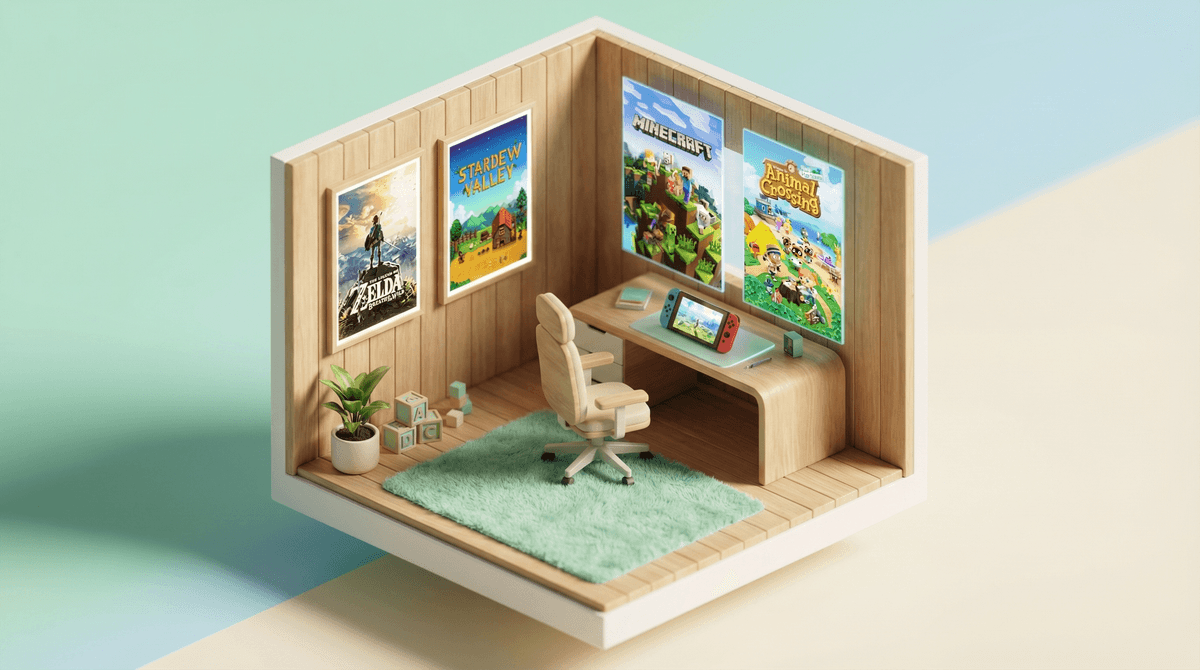
Good games can legitimately be good for kids. Minecraft has taught more kids about spatial reasoning and resource management than any worksheet ever will. Stardew Valley is teaching time management and delayed gratification. Zelda: Breath of the Wild is basically a masterclass in exploration and experimentation.
But terrible games can be genuinely harmful—not in the "video games cause violence" moral panic way, but in the "this is literally designed to manipulate children into spending money" way. The difference matters.
1. What's the actual gameplay loop?
Strip away the marketing and ask: what is my kid actually doing in this game?
- Are they solving puzzles? (Portal 2, The Witness)
- Building and creating? (Minecraft, Terraria)
- Following a story? (Undertale, Spiritfarer)
- Competing with others? (Rocket League, Splatoon 3)
- Opening loot boxes and watching timers count down? (Red flag)
If the core loop is "wait for energy to refill" or "open random rewards," that's not a game—that's a Skinner box with cute graphics.
2. What's the monetization model?
This is where things get real. There are basically four models:
One-time purchase (you pay once, you own it): Generally the safest bet. Examples: most Nintendo games, Hollow Knight, Celeste.
Subscription (like Game Pass or Apple Arcade): Can be great value, but watch for the "I want to keep playing but we're canceling" drama.
Free-to-play with cosmetics (like Fortnite): Your kid can play for free, but will beg for skins. Requires boundary-setting, but not inherently predatory.
Free-to-play with pay-to-win mechanics: Absolute garbage. If you can spend money to get gameplay advantages, run away. Learn more about predatory monetization .
.
3. What's the social component?
Is this a solo experience, or will your kid be interacting with strangers online?
Single-player games are the easiest to manage—no chat, no toxicity, no worrying about who they're talking to. Great for younger kids or as a starting point.
Local multiplayer (same couch, multiple controllers) is fantastic for family gaming. Mario Kart, Overcooked, It Takes Two.
Online multiplayer requires more oversight. Voice chat can be disabled in most games, but text chat is harder to monitor. Roblox parental controls are essential if you're going this route.
4. Does it match your kid's actual interests?
The best game is one your kid will actually play. If they're into dinosaurs, Ark: Survival Evolved might work (though check age ratings). Love animals? Slime Rancher is delightful. Into mythology? Hades is incredible (for teens).
Don't force "educational" games if your kid just wants to have fun. A game that teaches through engaging gameplay is infinitely better than one that feels like homework.
5. What's your tolerance for frustration?
Some games are brutally difficult (Dark Souls, Cuphead). Others have adjustable difficulty. Know your kid—and know yourself. If you can't handle the sounds of controller-throwing rage, maybe skip the rage-game genre.
Ages 4-7: Animal Crossing: New Horizons, Kirby and the Forgotten Land, LEGO games (any of them, honestly—they're all solid).
Ages 8-11: Minecraft, Splatoon 3, Mario Odyssey, Stardew Valley.
Ages 12-14: Zelda: Breath of the Wild, Hollow Knight, Rocket League, Portal 2.
Ages 15+: Hades, The Last of Us, Red Dead Redemption 2, Celeste.
These are starting points, not rules. Some 10-year-olds are ready for more complex games, some 14-year-olds aren't ready for intense violence. You know your kid.
Loot boxes and gacha mechanics: These are literally gambling mechanics. If a game has randomized paid rewards, think very carefully about whether you want to introduce that.
Energy systems: "Wait 4 hours or pay to continue playing" is manipulation, not game design.
Aggressive push notifications: If a game is constantly pinging your kid to come back, it's prioritizing engagement over fun.
Predatory chat features: Games that push kids toward unmoderated chat with strangers without robust safety features.
"Whale hunting": Games designed to extract maximum money from a small percentage of players. Learn about whale hunting tactics.
The best game for your kid is one that matches their interests, respects their time and your wallet, and doesn't treat them like a walking credit card.
Start with one-time purchase games when possible. Use parental controls for anything online. Talk to your kid about what makes games fun versus what makes them frustrating or manipulative. And remember: you're allowed to say no to games that don't meet your family's standards, even if "everyone else is playing it."
The goal isn't to find perfect games (they don't exist). The goal is to find good-enough games that bring joy without exploitation.
- Check what your kid's friends are playing—not to copy them, but to understand the social landscape
- Look up any game on Common Sense Media or search for it on Screenwise before buying
- Set up parental controls on whatever platform you're using (Nintendo Switch, PlayStation, Xbox, PC)
- Consider starting a family game night with local multiplayer games
- Explore alternatives to popular games if you're not comfortable with what everyone else is playing
And hey—if you need help evaluating a specific game, that's literally what we're here for. No judgment, just information.