

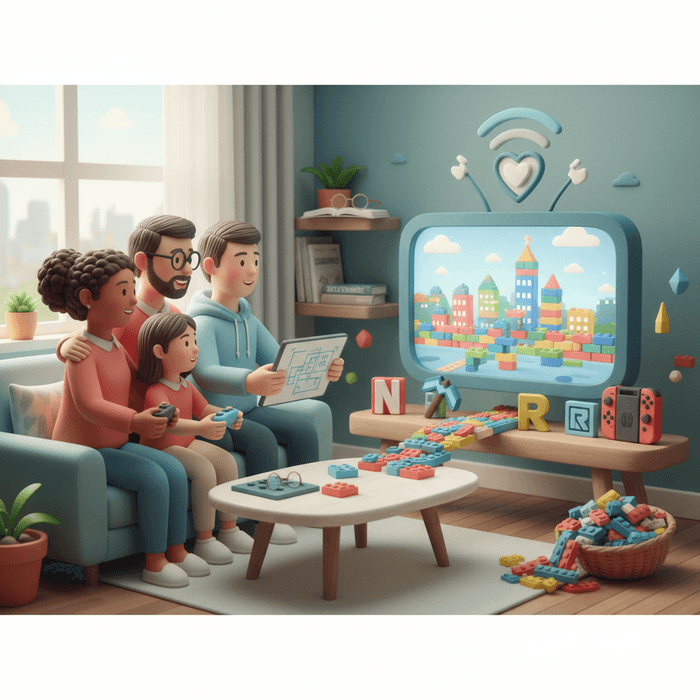
TL;DR: Modern LEGO games have evolved far beyond the simple "smash-and-collect" loop of the 2010s. From the creative engineering of LEGO Bricktales to the massive social ecosystem of LEGO Fortnite, these titles offer some of the best "low-brain-rot" digital experiences available. They are generally safe, high-quality, and actually encourage the kind of spatial reasoning we hope they're getting from the physical bins.
Top Recommendations:
- Best for Creative Problem Solving: LEGO Bricktales
- Best for Social Play: LEGO Fortnite
- Best for Movie Fans: LEGO Star Wars: The Skywalker Saga
- Best for Racing: LEGO 2K Drive
If your last memory of a LEGO video game was playing Star Wars on the Nintendo Wii, things look a little different now. For about fifteen years, "LEGO game" meant one thing: a linear story where you smashed plastic objects to collect "studs" (currency) and solved very simple puzzles.
Today, the "LEGO game" umbrella has split into three distinct categories:
- The Cinematic Epics: Huge, open-world versions of movies (Star Wars, Marvel, Harry Potter).
- The Sandbox Builders: Games like LEGO Fortnite that are essentially "Minecraft with better graphics."
- The Physics Puzzlers: Niche titles like LEGO Bricktales that actually require you to build functional structures (bridges, cranes) brick-by-brick.
If you’ve heard your kid describe a weird YouTube short as "so Ohio" or "Skibidi," you know the feeling of watching their brain turn into mush in real-time. LEGO games are often the perfect antidote to that.
Kids gravitate toward these because they offer IP Familiarity—they already love Spider-Man or Star Wars—and the humor is genuinely funny. It’s that "Pixar style" of writing where there are jokes for the kids and slightly more sophisticated slapstick for the parents watching from the couch.
More importantly, it gives them a sense of digital agency. In a game like LEGO 2K Drive, they aren't just driving a car; they are building the car from 1,000 individual pieces. That transition from "consumer" to "creator" is where the real developmental value lives.
This is the "Gold Standard." It covers all nine main movies. It’s massive, beautiful, and can be played entirely in "couch co-op" (two people on one TV). It’s the ultimate "safe" entry point for kids aged 7+. Check out our guide on the best Star Wars media for kids
Don't let the "Fortnite" name scare you. This isn't a battle royale where people are sniping your kid from a bush. It’s a survival-crafting game. Think of it as a much prettier, LEGO-themed Minecraft. You build villages, recruit NPCs, and explore. Note: It is technically "inside" the Fortnite app, so you’ll need to navigate the Fortnite menus to find it. Learn how to set up parental controls for LEGO Fortnite
If you want a game that actually feels like playing with real LEGOs, this is it. It’s a puzzle game where you are given a bucket of bricks and a goal (e.g., "Build a bridge that can support this robot"). If your bridge is poorly designed, it collapses. It’s fantastic for spatial reasoning and patience. Ages: 9+ (the building can be a bit finicky for younger hands).
Think Mario Kart but with a deep vehicle customization tool. It’s an open-world racing game. It’s bright, fast, and the "brain rot" factor is very low, though it does have some "battle pass" style microtransactions that you should keep an eye on.
A newer entry that takes a "grown-up" game (Horizon Zero Dawn) and turns it into a family-friendly LEGO romp. It’s great for parents who want to share their gaming interests with their kids without the heavy themes of the original series.
LEGO games are almost universally rated E for Everyone or E10+.
- Ages 5-7: Stick to the "Classic" style games like LEGO Marvel Super Heroes. They have "invincibility" options so kids don't get frustrated when they "die" (they just explode into bricks and immediately respawn).
- Ages 8-12: This is the sweet spot for LEGO Fortnite and LEGO 2K Drive. They are old enough to handle the complex menus and social features.
- Ages 13+: Honestly? Even teens find LEGO Star Wars relaxing. It’s "cozy gaming" at its finest.
Parents often ask: Is LEGO Fortnite basically just Roblox?
Not exactly. Roblox is a wild-west platform where anyone can make a game. LEGO Fortnite is a curated experience built by professional developers at Epic Games and The LEGO Group.
The Risks:
- Chat: Like any online game, if they are playing in "Public" worlds, they can hear other people. You can (and should) turn this off in the settings.
- Microtransactions: LEGO games are generally better than most, but LEGO 2K Drive and LEGO Fortnite both have "Stores" where you can buy digital sets or outfits using real money.
- Time Management: Because these games are "open-ended" (especially the building ones), there isn't a natural "stopping point" like a movie. You’ll need to be the one to set the timer.
Let's be real: smashing a LEGO Stormtrooper isn't teaching them Calculus. However, compared to the mindless scrolling of TikTok or the chaotic sensory overload of some YouTube channels, LEGO games are "high-quality screen time."
They encourage:
- Iterative Design: "My bridge broke, let me add a support beam."
- Reading Comprehension: Most of these games have text-based instructions or subtitles.
- Collaboration: Playing co-op requires communication—"You pull that lever while I jump on this platform."
If you’re worried about the "draining the bank account" aspect, stick to the standalone titles like LEGO Star Wars. You buy it once, you own the whole thing. No "V-Bucks" or "Robux" required.
LEGO games are one of the few areas of the digital world where the brand actually lives up to its reputation. They are polished, generally wholesome, and respect the player's intelligence.
If your kid is asking for "more screen time," steering them toward a LEGO title is a solid "intentional parent" move. It’s a bridge between the physical toys they love and the digital world they’re inevitably going to inhabit.
- Audit the "Store": If they are playing LEGO Fortnite, sit down with them and look at the "Item Shop." Explain that those are real dollars.
- Try Co-op: Pick up a controller. The controls in LEGO Star Wars are simple enough that even "non-gamer" parents can figure it out in five minutes.
- Bridge to Physical: If they build something cool in LEGO Bricktales, challenge them to recreate a version of it with their actual bricks on the living room floor.
Check out our full guide on managing gaming and screen time
Find age-appropriate game recommendations