

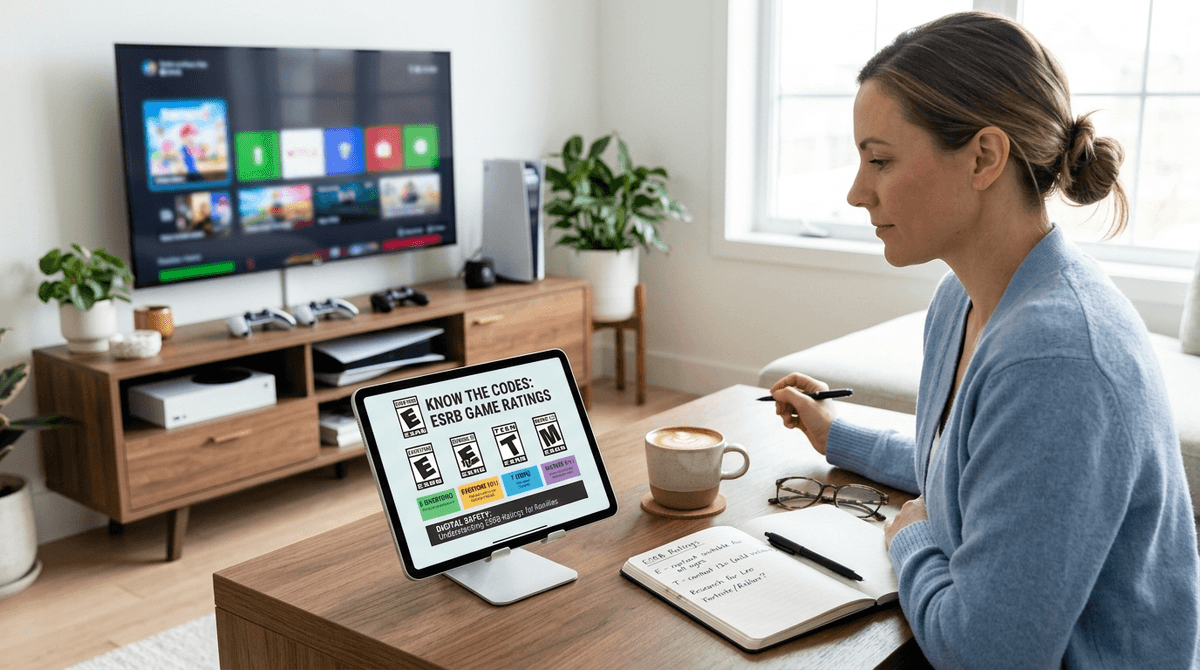
TL;DR: The ESRB rating is more than just a letter on a box. To actually protect your kid’s brain and your bank account, you need to look at the Content Descriptors (what’s in the game) and Interactive Elements (who they’re talking to and how much money they’re spending).
Quick links to common games and their ratings context:
- Minecraft (E10+): The gold standard, but the "Interactive Elements" mean they are playing with strangers.
- Roblox (E10+ / Teen): The rating varies by "experience," and the in-game spending is the real boss fight.
- Fortnite (Teen): Violence is cartoonish, but the social pressure and "item shop" are intense.
- The Legend of Zelda: Tears of the Kingdom (E10+): Fantasy violence that’s actually meaningful and artistic.
- Stardew Valley (E10+): High "WISE" score for creativity, despite some mild pixelated "booze" references.
The Entertainment Software Rating Board (ESRB) is the self-regulatory body that assigns age and content ratings to consumer video games in North America. Think of it as the "Nutrition Facts" label for gaming. Just like you might check a cereal box for sugar content, the ESRB tells you if a game contains "Blood and Gore," "Strong Language," or the dreaded "In-Game Purchases (Includes Random Items)"—which is industry-speak for gambling-adjacent loot boxes.
Most parents see a "T for Teen" rating and think, "My 11-year-old is mature, they can handle it." And maybe they can! But the ESRB letter is only the tip of the iceberg.
In a world where kids are calling everything "Ohio" (meaning weird or cringey) and watching Skibidi Toilet on repeat, their threshold for "weird" is high. However, their threshold for predatory monetization and unmoderated voice chat with a 30-year-old in a basement is still zero. The ESRB ratings help you distinguish between "this game has scary monsters" and "this game is designed to drain your debit card."
Ages 6+ These games are generally "safe," but don't assume they are "baby games."
- Examples: Super Mario Odyssey, Rocket League, and Animal Crossing: New Horizons.
- The Catch: Even an E-rated game like Rocket League has "Users Interact," meaning your kid can see some colorful language in the chat if you don't turn it off.
Ages 10+ This is the "tween" sweet spot. It usually means more fantasy violence or mild suggestive themes.
- Examples: Minecraft, Splatoon 3, and Plants vs. Zombies.
- The Catch: This is where "Cartoon Violence" starts to involve more combat. It’s not Call of Duty, but it’s definitely not Bluey: The Videogame.
Ages 13+ Expect some "damn" or "hell," more realistic violence (but usually no dismemberment), and suggestive content (think: characters in revealing outfits).
- Examples: Fortnite, The Sims 4, and Marvel's Spider-Man 2.
- The Catch: The Sims 4 is rated T for "Crude Humor" and "Sexual Themes" (the "WooHoo" factor), while Fortnite is T for "Violence." These are very different types of "mature."
Ages 17+ Intense violence, blood and gore, strong language, and drug use.
- Examples: Grand Theft Auto V, Call of Duty: Modern Warfare III, and Diablo IV.
- The No-BS Take: If your 4th grader is playing GTA V, they aren't just "playing a car game." They are interacting with a world built on satire of sex work, drug deals, and extreme cynicism. It’s high-quality media for adults, but total brain rot for a 10-year-old.
Below the letter, you’ll see phrases like "Mild Blood" or "Suggestive Themes." Here is the cheat sheet for what those actually mean in 2026:
- Fantasy Violence: Think Zelda. Swords, magic, monsters disappearing in a puff of smoke. No internal organs on the floor.
- Suggestive Themes: This is often the "cringe" factor. It could be a character making a joke that goes over a kid's head, or it could be characters in Genshin Impact wearing outfits that make you go, "Is that necessary?"
- Crude Humor: Fart jokes, bathroom humor, and the general vibe of a middle school locker room.
- Use of Alcohol/Tobacco: Often found in RPGs like Hogwarts Legacy (butterbeer-style drinks) or Sea of Thieves where you can drink grog.
Check out our guide on understanding game content descriptors
This is the most important part of the label for the modern parent. These are the elements that the ESRB doesn't include in the age rating because they depend on human behavior, not the game's code.
Users Interact
This means there is voice or text chat. In Roblox or Among Us, this is where the real risks live. You can have an E-rated game with an M-rated chat room. Learn how to manage chat settings on consoles
In-Game Purchases (Includes Random Items)
This is the ESRB's way of saying "Loot Boxes." If you see this, the game is likely using "Gacha" mechanics or "Blind Bags." Games like Genshin Impact or FIFA (FC 25) are notorious for this. It’s essentially teaching kids the dopamine hit of gambling before they can even drive.
Shares Location
Mostly for mobile apps like [Pokémon GO](https://screenwiseapp.com/media/pokemon-go-game or Pikmin Bloom.
Ages 5-8: The "Gated Garden" Phase
Stick to E for Everyone. Focus on games that are local-multiplayer (you and them on the couch) rather than online.
- Recommendation: Toca Life World is great for creativity, but watch the "In-App Purchases." For consoles, Super Mario Party Jamboree is a blast.
- Safety Tip: Turn off the internet connection on the Nintendo Switch if they are playing alone.
Ages 9-12: The "Social Pressure" Phase
This is when they want to play what their friends are playing. Usually, that means Minecraft and Roblox.
- Recommendation: Ratchet & Clank: Rift Apart is a stunning E10+ game that feels like a Pixar movie but plays like a high-octane shooter.
- Safety Tip: This is the time to have the "Real Money" talk. Learn more about how Robux is in fact real money.
Ages 13+: The "Independence" Phase
They will play Teen games. You should focus on the type of Teen game. Is it a narrative masterpiece like The Legend of Zelda: Breath of the Wild, or is it a "live service" game designed to keep them playing 40 hours a week like Destiny 2?
Roblox is the ultimate ESRB outlier. Because it’s a platform with millions of user-generated games, the ESRB can’t rate the whole thing as one entity. Recently, Roblox updated their own internal "Age Recommendations" (All Ages, 9+, 13+, 17+).
If your kid is playing "Experiences" on Roblox, ignore the box rating and look at the individual game’s maturity level. Some "horror" games on Roblox are genuinely traumatizing for younger kids, despite the blocky graphics.
See if the Roblox game Doors is too scary for an 8-year-old
Instead of saying "You can't play this because the box says so," try these conversation starters:
- "The rating says 'In-Game Purchases.' How does this game try to get you to spend money? Do you think that’s fair?"
- "I see this game is rated Teen for 'Violence.' Is it the kind where you're protecting people, or just causing chaos?"
- "Why do you think Grand Theft Auto is rated for 17-year-olds? What do you think is in there that they don't want 10-year-olds seeing?" (This invites them to think critically rather than just feeling restricted).
The ESRB is a tool, not a rulebook. It’s the starting point for your research.
At Screenwise, we see the data: about 75% of 12-year-olds are playing games rated Teen, and nearly 20% have played an M-rated game. You aren't a "bad parent" if you let your kid play slightly above their age bracket, provided you've done the work to understand what they are seeing.
Next Steps:
- Check the back of the next game your kid asks for.
- Look for the Interactive Elements section specifically.
- Take the Screenwise survey to see how your family’s gaming habits compare to other intentional parents in your community.
- If you’re still unsure, get a parent review of Brawl Stars.