

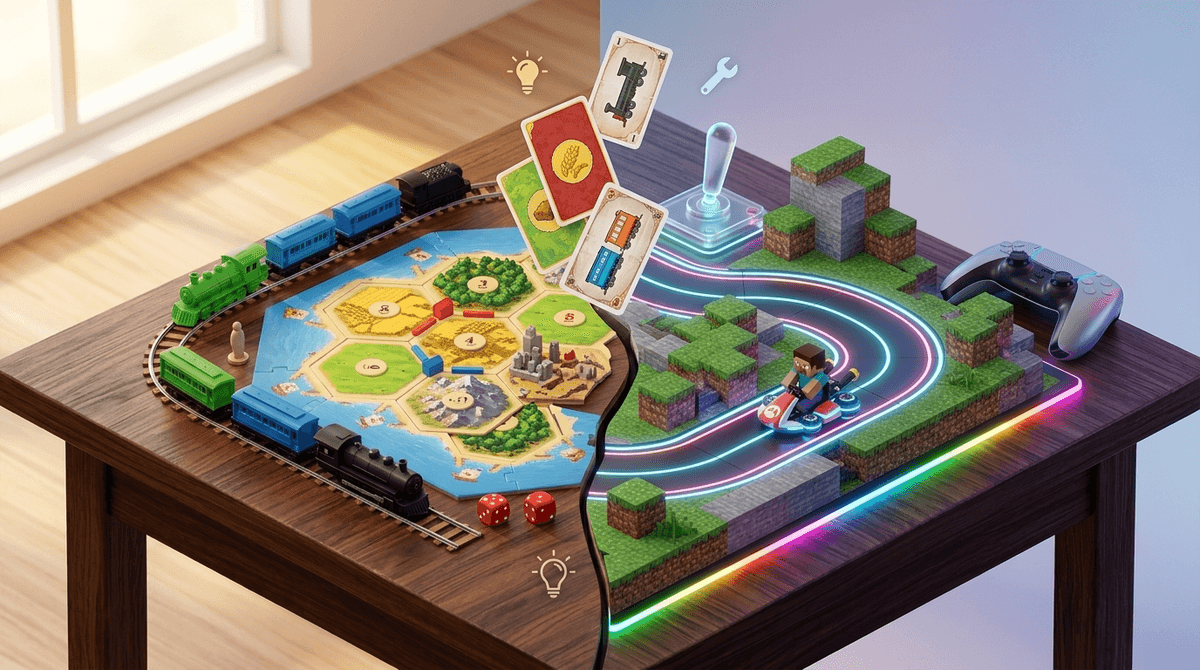
TL;DR: You don’t have to choose between the tactile charm of a board game and the high-octane engagement of a video game. The "sweet spot" is using board games for deep social connection and emotional regulation (learning how to lose without throwing a fit) and using high-quality video games for spatial reasoning and digital literacy.
Quick Links to Top Recommendations:
- Best Intro Strategy Board Game: Catan
- Best Creative Sandbox: Minecraft
- Best Family Chaos (Card Game): Exploding Kittens
- Best "Cozy" Digital Escape: Stardew Valley
- Best Gateway to Complex Logic: Wingspan
Let’s be real: the "screen time" debate is exhausting. One minute you’re reading a study about how Roblox is basically a digital sweatshop for kids, and the next, you’re hearing that Minecraft is the greatest educational tool since the library. Then you look at the dusty box of Monopoly in the closet and wonder if you’re failing as a parent because your kid would rather watch a "Skibidi Toilet" meme for the tenth time than trade Park Place.
If your kid is calling everything "Ohio" (which, for the uninitiated, is just Gen Alpha slang for "weird" or "cringe") and spending their life savings on Robux, you aren’t alone. We’re all trying to find that balance between the "cardboard" world we grew up in and the "controller" world they’re inheriting.
The truth is, both board games and video games offer massive benefits, but they scratch different developmental itches. Here is how to navigate both without losing your mind—or your retirement fund.
There is something irreplaceable about sitting across a table from someone. In a world where kids are increasingly digital-first, board games provide a "low-tech" sanctuary.
1. Hard-Coded Social Skills
When you play Codenames, you have to read the room. You have to look at your teammates' faces, interpret their silence, and navigate the tension. You can’t "mute" a sibling at the dinner table. Board games force kids to practice the "soft skills" that digital environments often bypass: eye contact, physical turn-taking, and the high-stakes art of not flipping the table when you lose at Uno.
2. Slowing Down the Dopamine Loop
Video games are designed to keep the dopamine hits coming fast. Board games are slower. They require patience. Setting up a game of Ticket to Ride takes time. Planning a move in Catan takes thought. This "slow play" helps kids develop a longer attention span, which is the ultimate antidote to the 15-second-video-scroll brain.
Let’s drop the "all screens are bad" narrative. It’s 2025. If your kid is building complex logic gates in Minecraft, they aren't rotting their brain; they’re learning systems engineering.
1. Spatial Reasoning and Problem Solving
Games like The Legend of Zelda: Tears of the Kingdom or even Super Mario Odyssey require intense spatial awareness and multi-step problem-solving. In many ways, video games are more rigorous than board games because the "rules" are enforced by the code—you can’t "house rule" your way out of a difficult boss fight.
2. The New "Water Cooler"
For kids today, Roblox or Fortnite is the mall. It’s where they hang out, talk about their day, and build shared memories. Preventing a kid from playing these games entirely can sometimes be a social death sentence in middle school. The goal isn't to ban them, but to curate what they play.
Check out our guide on navigating Roblox safety
The "Gateway" Board Games (Ages 8-12)
If your kids think board games are boring, it’s probably because you’re still trying to make them play Monopoly. Stop. Modern board games are incredible.
- Ticket to Ride: Simple, visual, and satisfying. It’s about building train routes across North America.
- Exploding Kittens: It’s fast, hilarious, and features "Tacocat." It has the chaotic energy of a YouTube video but in card form.
- Sushi Go!: A great "pick and pass" card game that teaches basic probability and strategy in under 15 minutes.
The "High-Value" Video Games (Ages 7+)
Move away from the "skinner box" games that just want your money and toward games that offer genuine creative or emotional value.
- Stardew Valley: A farming sim that teaches work ethic, community building, and resource management. It is the ultimate "cozy" game.
- Animal Crossing: New Horizons: Great for younger kids to learn about debt (thanks, Tom Nook), design, and social interaction.
- Toca Life World: For the younger set (ages 5-9), this is basically a digital dollhouse. No winning, no losing, just storytelling.
The "Bridge" Games (Hybrid Experiences)
These are games that feel like board games but live on a screen, or vice versa.
- Mario Kart 8 Deluxe: The gold standard for family gaming. It’s competitive but has "smart steering" for the little ones so they don't get frustrated.
- Among Us: It’s essentially a digital version of the classic party game "Mafia" or "Werewolf." It’s all about social deduction and lying to your parents (in a fun way!).
You’ll often hear parents say, "My kid is learning to code in Roblox!" or "They’re learning about the economy!"
The No-BS Take: While Roblox Studio is a legitimate game development tool, 99% of kids are not using it. They are playing games designed by adults to extract Robux from their accounts. If your kid is just "trading" items in Adopt Me!, they aren't learning entrepreneurship; they’re learning how to be a consumer in a predatory ecosystem.
If you want them to learn "entrepreneurship" through gaming, try a board game like Catan, where they have to negotiate trades with actual humans, or a game like Wingspan, which requires complex resource management and long-term planning.
Grades K-2: Tactile First
At this age, the physical sensation of rolling dice and moving a piece is huge for fine motor skills. Stick to games like Outfoxed! (a cooperative whodunit) or Hoot Owl Hoot!. For screens, keep it to creative "sandbox" apps like Sago Mini World.
Grades 3-5: The Strategy Shift
This is the prime age for Minecraft and Pokemon TCG. They are starting to understand deeper rules and can handle the "sting" of losing a bit better. This is a great time to introduce "Euro-style" board games like Carcassonne.
Middle School: Social Gaming
They want to be where their friends are. This usually means Fortnite or Discord. The key here is "side-by-side" parenting. Don't just ban the game; sit and watch them play. Ask them what "Ohio" means in the context of the game. If you want to pull them back to the table, try "hidden traitor" games like The Resistance—middle schoolers love the drama of secret identities.
There is no "winner" in the Cardboard vs. Controller battle.
Board games are for the "we"—building connection, learning patience, and looking each other in the eye. Video games are for the "how"—navigating complex systems, developing digital fluency, and engaging in modern social spaces.
The most successful "Screenwise" families don't treat these as enemies. They have a "Friday Night Board Game" tradition to anchor the week in physical presence, but they also aren't afraid to jump into a Mario Kart tournament on a rainy Saturday afternoon.
- Audit your closet: If you only own Monopoly and Life, go buy Ticket to Ride or Catan today. It will change your family's view of board games.
- Play their game: This week, ask your kid to teach you how to play their favorite video game for 20 minutes. Don't judge the "brain rot"—just play.
- Set the "Bank": If you're worried about the bank account draining, set a hard monthly limit on digital currency (Robux/V-Bucks) and stick to it. No exceptions.
Check out our full guide on setting healthy gaming boundaries
Find a game recommendation for your 10-year-old