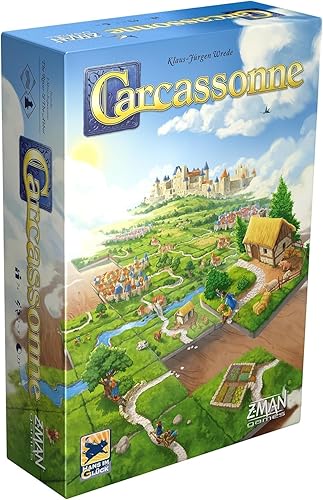
Carcassonne

Carcassonne

Board Game

Games & Accessories, Board Games

WISE
88%

WISE Score

7.4

Board Game Geek

Build a medieval French landscape one tile at a time—the gateway game that's still worth the hype 25 years later.

Amazon4.8
Board Game Geek7.4
Common Sense Media

Where to Play

Our reviews and ratings are 100% unbiased, but as an Amazon Associate, Screenwise earns an affiliate fee if you buy a book or game by clicking one of our links. We don't get any credit if you just Google it instead :)

Screenwise Verdict

Carcassonne is one of those rare games that earned its classic status honestly. It's been around since 2000, and it still works—not because of nostalgia, but because the core loop of 'draw tile, place tile, claim territory' is satisfying every single time.

The medieval theme is pleasant without being preachy, the strategy is real without being overwhelming, and the 30-45 minute runtime means you can actually play it on a Tuesday night without sacrificing bedtime. Parent reviews consistently call it an 'excellent gateway game,' and they're right.

Is it the most imaginative, story-rich experience? No. But as a tool for teaching strategic thinking, spatial reasoning, and how to lose gracefully when someone steals your monastery at the last second? It's pretty much perfect. If you're building a family board game collection, this belongs in it.
Age Fit

The 7+ rating is accurate—first graders can grasp the mechanics, and it remains engaging through middle school and beyond. Adults genuinely enjoy it too, making it a rare true 'family game' that doesn't bore parents. There's also a 'My First Carcassonne' version for younger kids if you want to start earlier.

WISE Breakdown
Wholesome
88

A collaborative-competitive tile-laying game that naturally encourages turn-taking, spatial reasoning, and gracious play. The medieval theme is gentle and non-violent—you're building cities and roads, not conquering armies. The mechanics reward thoughtful planning over aggressive blocking, though there's enough strategic tension to keep it interesting. Parent reviews consistently praise it as a 'great family game' that works across age ranges without feeling condescending to adults.

Imaginative
85

The core mechanic—drawing a random tile and deciding where to place it to build a medieval landscape—is genuinely creative. Every game creates a unique map, and players must visualize how their roads, cities, and monasteries will connect and score. The 'map addition' mechanism invites spatial problem-solving and pattern recognition. It's not open-ended creativity like drawing or storytelling, but it scratches a similar itch: building something from nothing, tile by tile.

Safe
95

Board games don't get much safer than this. No mature themes, no gambling mechanics, no toxic social dynamics. The competitive element is present but mild—you're claiming territory, not destroying opponents' pieces. BGG weight of 1.89 means it's accessible without being frustratingly simple. The only minor consideration is that 'kill steal' mechanism (claiming someone else's city or road at the last second), which can create brief tension, but that's the kind of healthy strategic friction that makes board games fun.

Enriching
82

Teaches genuine skills: spatial reasoning, planning ahead, probability assessment (which tiles are left?), and graceful competition. The 7+ age rating is spot-on—it's complex enough to challenge grade-schoolers while remaining accessible. With 137,000 BGG ratings and a 7.4 score, plus a Spiel des Jahres win, it's proven staying power since 2000. The 30-45 minute playtime is perfect for sustained focus without overstaying its welcome. It's not deeply thematic or narrative-rich, but as a strategic thinking exercise wrapped in a pleasant medieval aesthetic, it delivers.

Parent Info

Why It Might Be Great

  • Perfect complexity sweet spot: simple enough for a 7-year-old to learn, interesting enough that adults won't zone out
  • Every game creates a different map, so it doesn't get stale after a few plays
  • Teaches spatial reasoning and strategic thinking without feeling like homework
  • Short enough (30-45 min) that you can actually finish a game on a school night
  • Spiel des Jahres winner with 137K ratings on BGG—this is a proven classic, not a flash-in-the-pan trend

What to Watch For

  • The 'claiming someone else's city' mechanic can spark brief sibling rivalry moments, but that's honestly part of learning to play strategically
  • Younger kids (under 7) might struggle with the scoring system—consider playing cooperatively or just building for fun first
  • If your family prefers deeply thematic, story-driven games, this is more abstract puzzle than narrative adventure

Conversation Starters

  • "Should we work together to build this giant city, or are you going to try to steal it from me at the last second?"
  • "What do you think medieval France actually looked like? Were the roads really this twisty?"
  • "If you could add one more tile type to this game, what would it be—castles? Forests? Dragon lairs?"

Ask Anything

Get a personalized guide on any topic