Our reviews and ratings are 100% unbiased. As an Amazon Associate, Screenwise earns from qualifying purchases, so if you buy a book or game through one of our links, we may earn a commission. We don't get any credit if you just Google it instead :)
Screenwise Verdict
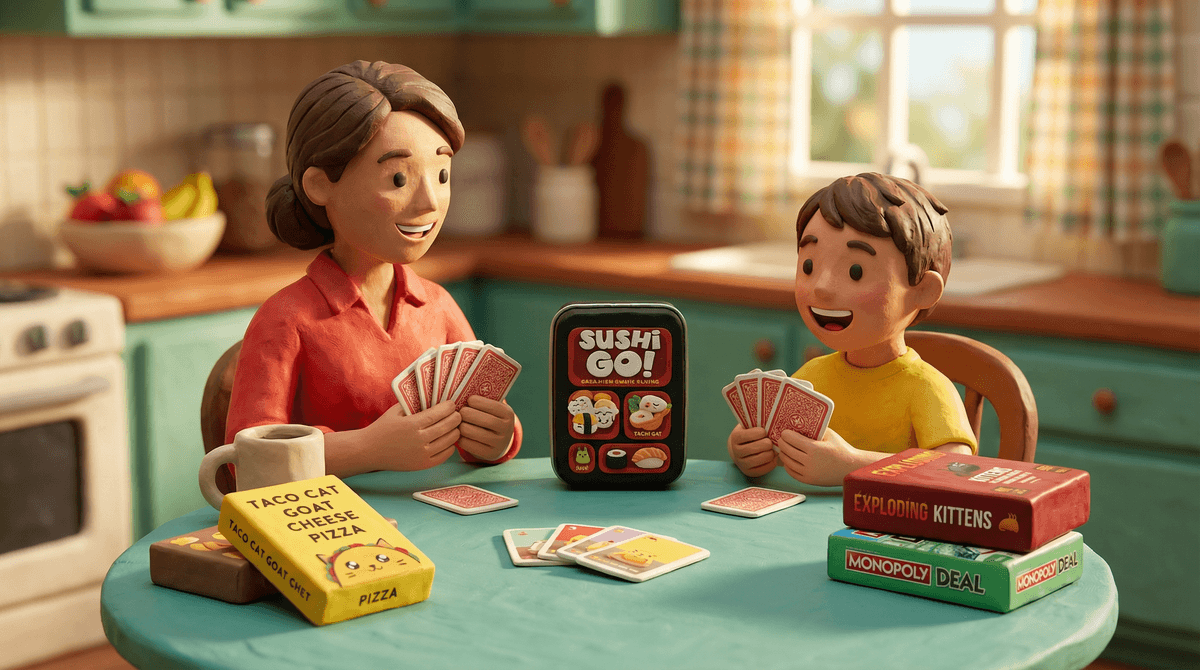
This is what a gateway game should be: fast enough that nobody loses patience, strategic enough that it's not just random luck, and charming enough that everyone wants to play again immediately.
The genius is in the card drafting—you're simultaneously building your own collection while trying to figure out what everyone else is going for. Do you take that third sashimi to complete your set, or grab the pudding before your sister does? It's surprisingly thinky for something that looks like it belongs in a preschool.
With 95,000+ BGG owners and a 7.0 rating, this is a proven family favorite. The 15-minute play time is clutch—you can squeeze in a game before dinner or play best-of-three without anyone checking the clock. And unlike games that talk down to kids, this one actually respects their intelligence while remaining accessible.
Not going to change your life, but it's a rock-solid addition to any family game shelf. The kind of game that gets played weekly rather than sitting in the closet.
Officially 8+ and that feels right—younger kids can play with help but won't grasp the strategic layer. The sweet spot is probably 8-14 for kids, though adults genuinely enjoy it too as a quick filler game. It's not going to replace Wingspan for serious gamers, but it's a solid family staple.
WISE Breakdown
Wholesome
92
Adorable sushi-themed artwork with zero conflict beyond friendly competition. The game actively encourages players to pay attention to what others are collecting, which builds social awareness. Fast 15-minute rounds prevent frustration or dragging attention spans. Multiple reviews highlight how it brings different ages together without excluding anyone—Parent Geeks noted it 'challenged all its players, but never excluded anyone based on age or skill.' The theme is lighthearted and the mechanics reward both cooperation awareness and strategic thinking without any mean-spirited 'gotcha' moments.
Imaginative
73
Card drafting is a clever mechanism that requires visualizing what's coming around the table and anticipating others' strategies. The sushi theme is charming and accessible, though not particularly original. The game invites tactical creativity—do you go for the safe tempura set or gamble on sashimi? Dipping nigiri in wasabi to triple value is a fun twist. However, it's ultimately an optimization puzzle within fixed parameters rather than open-ended creative expression. One reviewer noted 'strategy is surprisingly deep' despite simple appearance, which shows there's mental engagement beyond surface level.
Safe
96
Board games don't get much safer than this. No mature themes, no problematic content, no toxic social dynamics. The simultaneous selection mechanism means no one is singled out or attacked—you're all just grabbing cards as they pass. At 1.16 complexity on BGG, it's genuinely accessible without being condescending. 95,000+ community owners and consistent positive parent reviews show no red flags. The only minor consideration is that competitive kids might get frustrated if they don't understand the scoring combos, but that's standard learning curve stuff, not a safety concern.
Enriching
81
Teaches legitimate strategic thinking: set collection, risk assessment, reading opponents, and basic multiplication (wasabi triples nigiri value). The Impactus review specifically calls out how it teaches 'multiplication, forethought and strategic focus, all while reading the other players.' Card drafting is a sophisticated mechanism that builds pattern recognition and forward planning. The 15-minute play time means kids can iterate and improve quickly. It won multiple awards including Parents' Choice Recommended and Best Australian Game. However, it's not deeply educational beyond those game theory concepts—it's primarily entertainment that happens to build thinking skills.
Parent Info
✓
Why It Might Be Great
Plays in 15 minutes, so no one melts down from fatigue and you can actually play multiple rounds on a school night
The 'pass cards around the table' mechanism is brilliantly simple but teaches real strategic thinking—what you take affects what your neighbor gets
Works beautifully across ages: 8-year-olds can play with teens and adults without anyone being bored or overwhelmed
Adorable sushi art makes it approachable for kids who might be intimidated by 'serious' strategy games
Teaches multiplication naturally (wasabi triples your nigiri!) plus risk assessment and pattern recognition without feeling like homework
⚠
What to Watch For
Competitive kids might need a round or two to understand the scoring combos—first game can feel confusing
The 'reading other players' aspect means younger kids might struggle against strategic older siblings initially
If your family hates any competition whatsoever, this might not be your vibe (though it's about as gentle as competitive games get)
Conversation Starters
"Why did you grab that tempura instead of the sashimi? What were you hoping would come around next?"
"Did you notice what sushi I was collecting? Were you trying to block me or focus on your own strategy?"
"If you could design a new sushi card for this game, what would it be and how would it score points?"