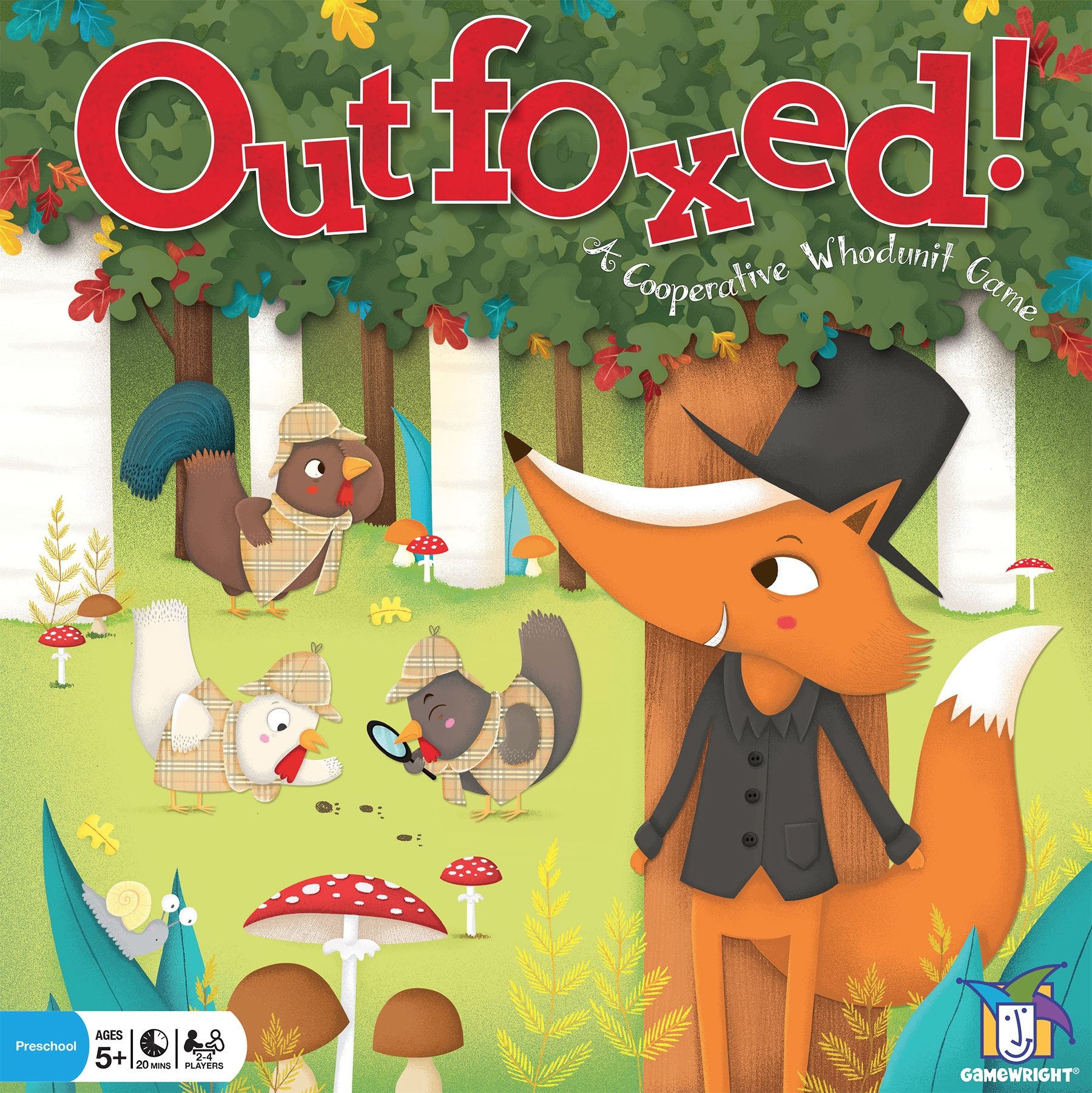
The Gateway Game for Early Logic
Most board games aimed at four- and five-year-olds rely entirely on mindless luck: roll a die, count spaces, move forward, repeat until someone cries. Outfoxed! throws that formula out the window and introduces actual decision-making. On a turn, players declare whether they want to search for clues or reveal suspects, then roll three dice with two chances to reroll. If you fail to match your declared action, the fox moves three steps closer to freedom.
That simple risk-reward mechanic introduces probability without punishing young kids too severely. But the core engine is the clue scanner. When you land on a clue space, you pick an evidence token (like a monocle, umbrella, or flower), drop it into the physical scanner with the hidden fox card, and open the slider. If green shows through, the culprit is wearing that item. If red shows through, they are not.
Green light = Guilty fox wears it (eliminate anyone bare-headed)
Red light   = Guilty fox does not wear it (eliminate anyone wearing it)
Watching a five-year-old connect that a red marker on a top hat means every fox wearing a top hat is innocent is one of the best moments in early gaming. They aren't guessing; they're parsing negative evidence.
Where It Hits Its Ceiling
The game does one thing exceptionally well, but it does not grow with your family. Once a child hits seven or eight, the puzzle is solved. The board state becomes transparent, and there is almost no variance in optimal strategy: find two clues, flip two suspects, eliminate half the board, win. Keep it in heavy rotation through kindergarten and first grade, then pass it along to a younger cousin once your kid starts asking for Codenames or Ticket to Ride.