

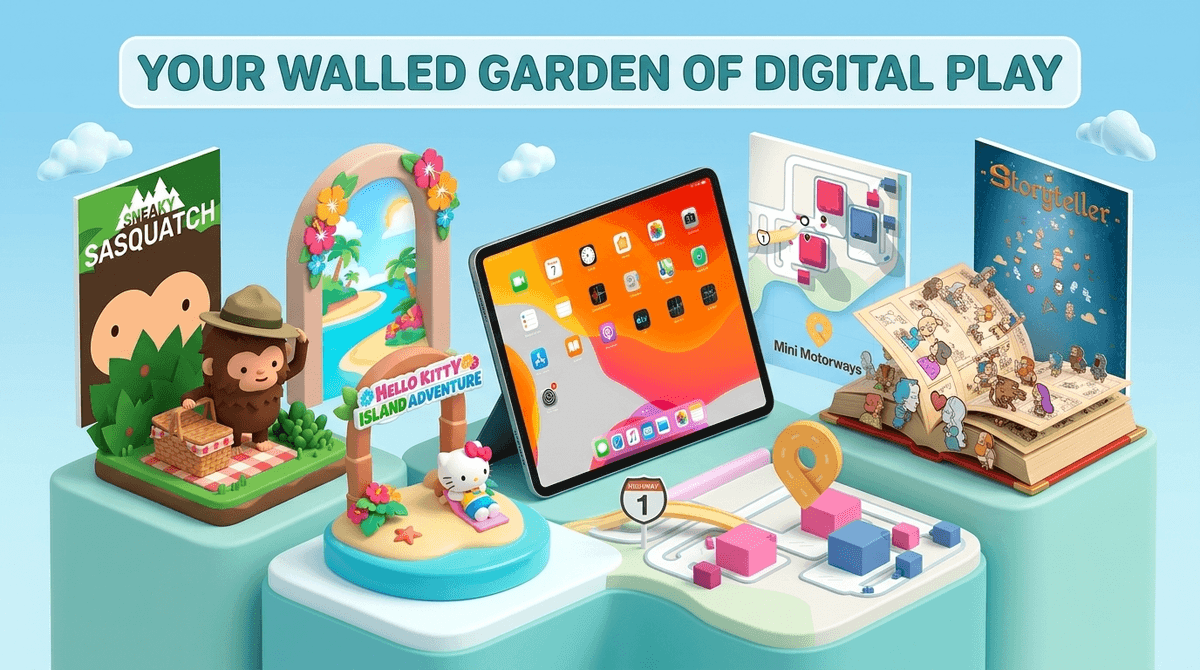
TL;DR: The Quick Take
If you’re tired of your kid asking for "just 99 cents" for a pack of gems or watching them get sucked into a 30-second ad for a plastic surgery simulator in the middle of a puzzle game, premium subscriptions are your new best friend. For the price of one fancy latte a month, services like Apple Arcade and Netflix Games remove the "dark patterns"—the psychological tricks designed to keep kids hooked and spending—and replace them with actual, high-quality games.
Top Recommendations to Start With:
- For the explorer: Sneaky Sasquatch
- For the cozy vibe: Hello Kitty Island Adventure
- For the puzzle lover: Mini Motorways
- For the creative: Storyteller
- For the retro fan: TMNT: Shredder's Revenge
Get games based on your kid's interests
We’ve been conditioned to think mobile games are "free." But as we all know, "free" is the most expensive word in the App Store. Most free games (think Roblox or Candy Crush Saga) make money through microtransactions (buying virtual currency) or ad-ware (forcing you to watch videos to keep playing).
Premium services like Apple Arcade, Netflix Games, and Google Play Pass flip the script. You pay a flat monthly fee, and in exchange, every game in the catalog is "clean."
- No ads: No interruptions, no weird 30-second clips of other apps.
- No in-app purchases: No "gems," "coins," or "energy" to buy.
- Family Sharing: Usually, one subscription covers everyone in your "Family Sharing" group.
When kids play "freemium" games, they aren't just playing; they are being marketed to. These games use "intermittent reinforcement"—the same psychological mechanism used in slot machines—to keep players coming back. If your kid gets "cranky" or "brain-fried" after playing certain games, it’s often because those games are designed to keep their dopamine levels at an unsustainable peak.
Premium games tend to have an actual "end." You finish a level, you complete a story, and you put the phone down. It’s a much healthier relationship with tech.
This is the gold standard for families. For $6.99/month, you get over 200 games. The best part? Many of these are "Arcade Originals," meaning they were built specifically for this service without any of the "pay-to-win" junk. It’s the closest thing we have to the "Nintendo quality" of the 90s on a smartphone.
If you already pay for Netflix, you already have this. Open the Netflix app on your phone or tablet, and there’s a "Games" tab. Most parents completely overlook this, which is a mistake because they have some of the most sophisticated indie games on the market. Just be careful: their catalog includes "Adult" games like Grand Theft Auto, so you’ll want to make sure your Netflix parental controls are locked down.
Ages 5-8: Simple Fun, No Frustration
At this age, ads and "buy now" pop-ups are devastating because kids don't have the impulse control to say no. These games are safe spaces.
- On the regular App Store, this is a subscription nightmare. On Apple Arcade, it’s a fully unlocked creative playground.
- Perfect for the younger set. It’s open-ended digital dollhouse play that encourages curiosity rather than "winning."
- Don't let the branding fool you—this is basically "Animal Crossing Lite." It’s a massive, high-quality world about friendship and crafting. Honestly? It’s better than most $60 console games.
Ages 9-12: Depth Without the Addiction
This is the "Roblox age," where kids start wanting social connection and "status." Premium games can be a great palate cleanser from the high-stress environment of competitive online play.
- If your kid plays one game on this list, make it this one. You play as a Sasquatch living in a campground. You start by stealing food from coolers, but eventually, you can get a job, drive a car, and even run for mayor. It is genuinely funny and weirdly wholesome.
- A minimalist strategy game about drawing roads to connect a growing city. It’s incredibly soothing and teaches logic and spatial awareness without the "brain rot" feel of a match-3 game.
- If your kid loves building in Minecraft, they will love this. It allows them to create their own "diorama" adventures and share them. It’s creative, beautiful, and safe.
Ages 13+: Narrative and Strategy
Teens often migrate toward "prestige" games. Netflix Games shines here.
- A unique puzzle game where you are given a title (like "The Heartbroken King") and you have to arrange characters in comic-book panels to make that story happen. It’s clever, artistic, and short.
- Available on Apple Arcade. It’s a "life-sim" game where you help ghosts on a haunted island. It’s designed to be played in short bursts (about 30-60 minutes a day), which is a built-in screen time boundary.
While these services solve the "predatory spending" problem, they don't solve the "I can't put this down" problem.
- Screen Time Still Counts: Even though Sneaky Sasquatch is "better" for them than a random "Ohio" meme-fest on YouTube, it’s still a screen. Set your Apple Screen Time limits accordingly.
- The "Adult" Filter: Netflix Games are tied to the Netflix profile. If your kid uses an "Adult" profile to play games, they can access Grand Theft Auto. Make sure they are using a "Kids" profile or that you've set maturity ratings.
- Data Usage: Many of these games are large downloads (1GB+). If your kid is playing on an iPad in the car, make sure they download the games at home on Wi-Fi first, or you'll see your data plan disappear faster than a plate of pizza rolls.
The biggest hurdle is often that kids want the "brain rot" games because that’s what their friends are playing. They want the Skibidi Toilet mods in Roblox.
Try framing it like this: "I noticed that when you play [Game Name], you get a lot of ads and it keeps asking for money. That feels more like a commercial than a game. Let's try Apple Arcade for a month—these games are 'full' versions where you get everything from the start, no tricks."
Most kids, once they realize they don't have to wait 24 hours for a "timer" to refill or watch a video to get a new skin, will actually prefer the premium experience. It feels more like "owning" the game.
If you are an intentional parent trying to navigate the 2025 digital landscape, Apple Arcade is arguably the best $7 you can spend. It’s a "walled garden" that actually protects your kid’s attention span and your bank account.
Is it "perfect"? No. Screen time is still a battle, and some games are definitely better than others. But compared to the "Wild West" of the standard App Store, it’s a breath of fresh air. It turns the iPad from a "vending machine that sometimes gives you a game" into a legitimate gaming console.
- Audit your subscriptions: Check if you already have Netflix. If so, download Storyteller or TMNT: Shredder's Revenge tonight and show your kid.
- Start a trial: Apple Arcade usually offers a 1-month free trial (or 3 months with a new device).
- Set a "Game Night": Pick a game like SongPop Party and play it together on the Apple TV. It’s a great way to model "healthy" gaming.
Check out our guide on the best family-friendly Apple Arcade games