

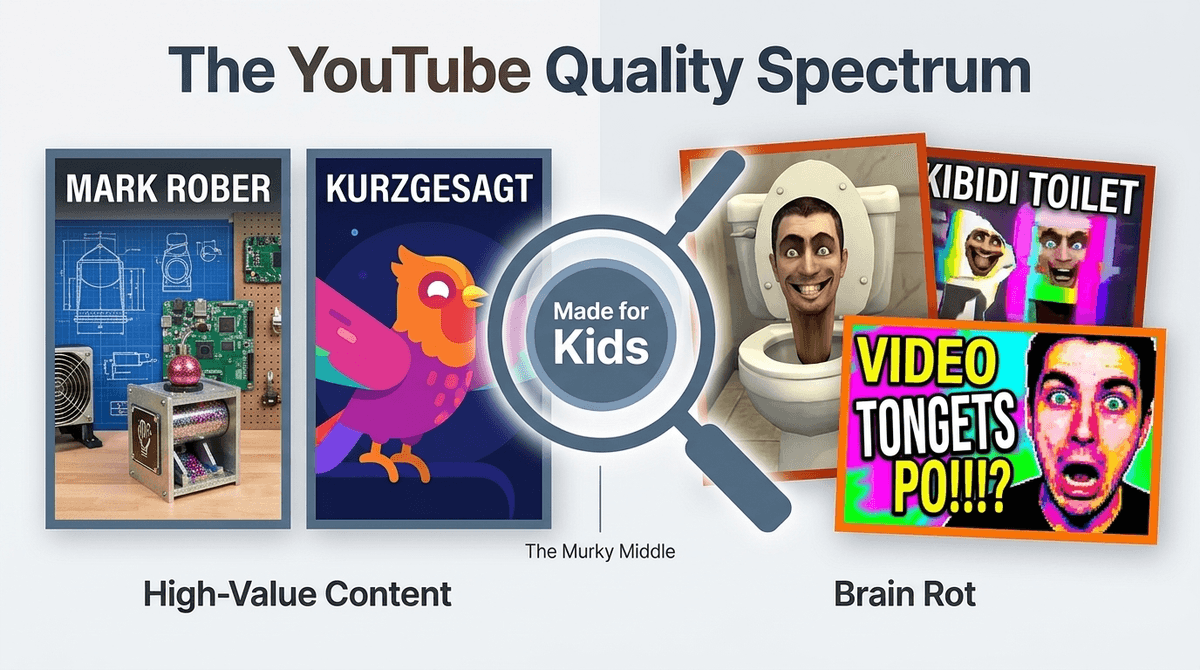
TL;DR: YouTube's "Made for Kids" label is a legal compliance marker (COPPA), not a seal of quality. The algorithm is designed to keep kids watching through "Brain Rot"—high-stimulus, repetitive, and often nonsensical content—and "AI Slop," which are low-effort, AI-generated videos that can sometimes take dark turns.
Quick Links for Quality Alternatives:
- Mark Rober - Engineering and science that’s actually exciting.
- Kurzgesagt – In a Nutshell - Complex topics explained with beautiful animation.
- Art for Kids Hub - Interactive and creative screen time.
- Storyline Online - Celebrities reading high-quality picture books.
- PBS Kids - The gold standard for educational browser-based content.
If you've heard your seven-year-old shout about "Skibidi," "Ohio," or "Fanum Tax," you’ve encountered "Brain Rot." It’s a slang term kids (and self-aware Gen Z-ers) use to describe the hyper-stimulating, often nonsensical content that dominates the YouTube algorithm.
The most famous example is Skibidi Toilet, a series of shorts featuring heads popping out of toilets. While it started as a weird creative project, it morphed into a massive franchise that epitomizes the "more is more" approach to kids' entertainment: loud noises, fast cuts, and zero narrative substance.
"AI Slop" is the more industrial side of the problem. These are videos generated by AI or low-cost animation farms designed to hit specific keywords (like "Spider-man," "Frozen," or "Finger Family") to trick the algorithm into placing them in "Made for Kids" feeds. Because they aren't made by humans with a creative vision, they often feel "off"—the characters move weirdly, the stories don't make sense, and sometimes, disturbing themes (violence or bathroom "humor") slip through the automated filters.
See explanations of the latest YouTube trends your kids mention
Kids’ brains are essentially dopamine-seeking missiles. The YouTube algorithm knows this. It prioritizes Engagement above all else.
If a child watches a 30-second clip of a neon-colored car crashing into a giant pit of slime, the algorithm will serve up ten more just like it. This creates a "zombie state" where kids aren't actually enjoying the content—they are just locked into the next hit of visual candy.
Channels like Ryan's World or the endless "unboxing" genre aren't inherently "evil," but they are built on a foundation of consumerism and constant novelty. They teach kids that the joy is in the getting, not the playing.
When you see the "Made for Kids" tag on YouTube, it mostly means the creator has told YouTube they aren't collecting data on minors. It does not mean the content has been vetted by an educator or a child development expert.
In fact, the "Made for Kids" designation can sometimes be a red flag. Because these videos can’t have targeted ads or comments, creators have to produce massive volumes of content to make money. This leads to the "slop" mentioned earlier—quantity over quality.
Compare the frantic energy of a Cocomelon episode to the gentle, thoughtful pacing of Bluey. One is designed to keep a toddler's eyes glued to the screen through sheer sensory overload; the other is designed to tell a story about family dynamics.
Learn more about the difference between YouTube and YouTube Kids
If you want to move away from the "Brain Rot" and toward content that actually enriches your child's life, you have to be the algorithm for them. Subscribe to specific channels and turn off the "Autoplay" feature.
Mark Rober (Ages 7+)
This is the antidote to low-effort content. Mark is a former NASA engineer who builds complex machines (like the famous Glitter Bomb) to solve silly problems or explain physics. It’s high-energy but intellectually stimulating.
Science Max (Ages 6-12)
Think of this as "Mythbusters" for the younger set. It takes school-level science experiments and scales them up to massive proportions. It’s funny, educational, and respects the viewer's intelligence.
Cosmic Kids Yoga (Ages 3-8)
If your child needs to be on a screen, they might as well be moving. This channel uses storytelling to guide kids through yoga poses. It’s a great way to use digital media to bridge the gap to physical activity.
Storyline Online (Ages 4-10)
Technically a website that hosts its videos on YouTube, this is a fantastic resource where actors read children's books with slight animations of the illustrations. It’s calm, literary, and high-quality.
National Geographic Kids (Ages 6-12)
Their website and YouTube channel are packed with "weird but true" facts and animal documentaries that are actually produced by experts, not AI bots.
The biggest risk on YouTube isn't the first video your child clicks—it's the fifth one.
Even on YouTube Kids, the algorithm can occasionally surface "Elsagate"-style content—videos that use familiar characters in inappropriate or violent scenarios. While YouTube has gotten better at scrubbing these, the sheer volume of uploads (over 500 hours of video every minute) makes it impossible for them to catch everything.
Practical Steps:
- Disable Search: On the YouTube Kids app, you can disable the search function so your child can only watch channels you have pre-approved.
- Use a Shared Account: If your older kids are on the main YouTube app, have them use it on a TV in a common area rather than a private device.
- Check the History: Periodically scroll through the watch history. If you see a lot of videos with nonsensical titles like "GIANT SURPRISE EGG LEARN COLORS WITH SPIDERMAN," it’s time to prune the subscriptions.
You don’t have to be the "fun police," but you can be a "content sommelier."
Instead of saying, "That show is garbage," try asking:
- "How do you feel after watching that? Do you feel energized or kind of grumpy?"
- "Do you think a person made this, or did a computer just put a bunch of random things together?"
- "What was the actual story in that video? I couldn't really follow it."
Helping kids recognize when their "brains feel mushy" is the first step toward them making better choices for themselves.
YouTube is a tool, not a babysitter. While there is incredible, world-class educational content on the platform, it is buried under a mountain of "Brain Rot" and "AI Slop" designed to exploit a child's developing brain for ad revenue.
By being intentional about which channels you subscribe to and moving away from the "Autoplay" trap, you can turn YouTube from a source of "Brain Rot" into a genuine window to the world.
Check out our list of the best educational YouTube channels for every age
Next Steps:
- Audit your subscriptions: Sit down with your child and unsubscribe from any "unboxing" or AI-generated nursery rhyme channels.
- Introduce a "Quality" channel: Show them one video from Mark Rober or Kurzgesagt today.
- Set a "Timer, not a Limit": Instead of "you have 30 minutes," try "you can watch three videos from this specific channel." It breaks the infinite scroll cycle.