

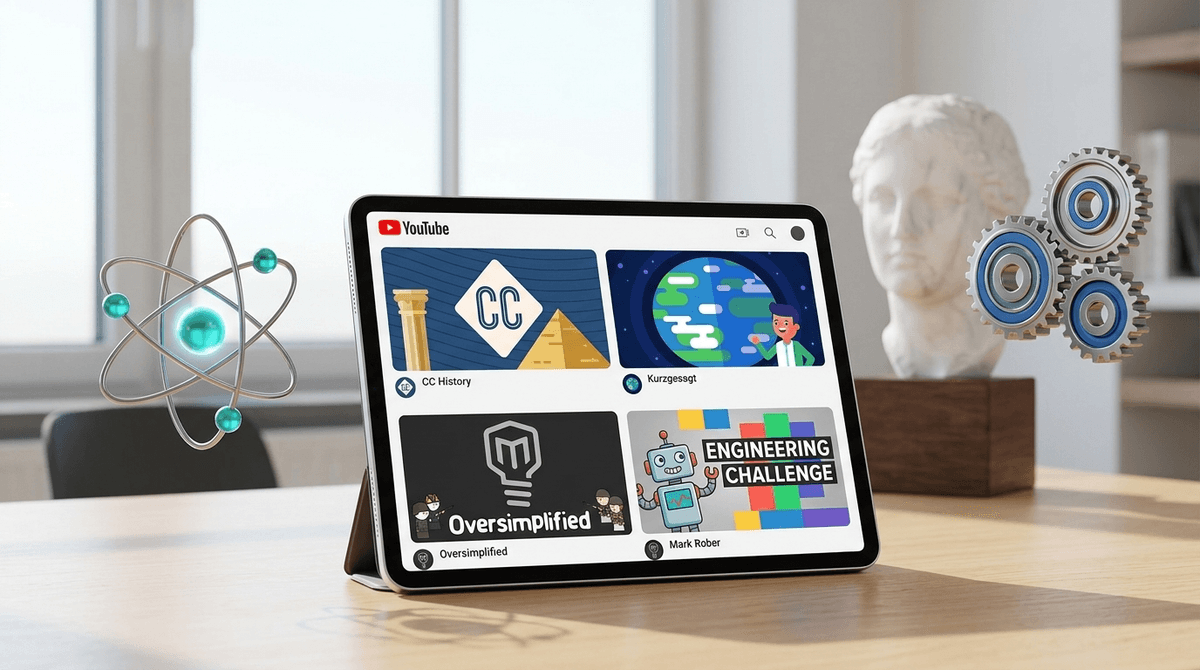
TL;DR: The Quick List
If you only have 30 seconds before your teen asks for DoorDash again, here are the heavy hitters that actually make kids smarter without them realizing it:
- For the Engineering Obsessed: Mark Rober — Former NASA engineer, world-class pranks, and genuine physics.
- For the History Buffs: Oversimplified — Hilarious, animated deep dives into wars and revolutions.
- For Visual Learners: Kurzgesagt – In a Nutshell — Beautiful animation covering everything from black holes to biology.
- For the "How Does That Work?" Crowd: Veritasium — Science and engineering stories that feel like high-budget documentaries.
- For Academic Support: Crash Course — The gold standard for actually passing AP History or Biology.
Walking past the living room and hearing the Skibidi Toilet song for the 400th time is enough to make any parent want to throw the router into the neighbor's pool. We’ve reached a peak "Brain Rot" era where the YouTube algorithm seems determined to turn our tweens' brains into lukewarm oatmeal with "Ohio" memes and infinite MrBeast clones.
But here’s the reality: 95% of teens are on YouTube. It’s their search engine, their TV, and their social hub. Instead of fighting the platform, the goal is to "seed" their algorithm with content that’s actually worth their time. There is a whole world of creators making content that is higher quality than most of what we watched on the Discovery Channel growing up.
Tweens and teens are allergic to being "taught." The second a video feels like a school assembly, they’re clicking away to a Minecraft parkour video. The channels that work are the ones that lean into:
- High Production Value: If it looks like it was filmed on a potato, they aren't watching.
- Authentic Passion: Kids can smell a "corporate educational video" a mile away. They want creators who are genuinely obsessed with the topic.
- Humor and Edginess: A little bit of snark or a well-placed (and age-appropriate) joke goes a long way in keeping them engaged.
If you aren’t subscribed to Mark Rober yet, start there. He’s a former NASA and Apple engineer who became famous for his "Glitter Bomb" videos (targeting porch pirates). While the premise is often a prank or a challenge, the core of every video is a deep dive into mechanical engineering, fluid dynamics, or chemistry. It’s the ultimate "stealth learning" channel. Best for: Ages 8-18.
Derek Muller takes complex scientific paradoxes and breaks them down through high-stakes experiments and travel. He’ll go to the world’s radioactive hotspots or build a wind-powered car that goes faster than the wind just to prove a point. It’s cinematic, smart, and deeply engaging for teens who are starting to ask the "big" questions about how the universe functions. Best for: Ages 12-18.
Destin Sandlin is the "cool dad" of the science world. His videos explore the world through the lens of a flight test engineer. Whether he's filming a supersonic baseball cannon or explaining how a butterfly’s wings work at 10,000 frames per second, his enthusiasm is infectious. It’s wholesome, fascinating, and incredibly well-researched. Best for: Ages 10-18.

History in school can be a dry slog of dates and names. Oversimplified fixes this by using stick-figure animations and a very dry, sarcastic wit to explain things like the French Revolution or the Cold War. It’s incredibly popular with middle schoolers because it feels like they’re getting the "real story" that teachers leave out. Best for: Ages 11-18.
Founded by brothers Hank and John Green (yes, the The Fault in Our Stars author), Crash Course is essentially the backbone of modern American education. If your teen is struggling in a subject, there is likely a Crash Course playlist for it. They’ve expanded from history and biology into everything from Artificial Intelligence to Philosophy. Best for: Ages 13-18.
These are short, beautifully animated lessons on almost any topic imaginable. Want to know why the Roman Empire collapsed? Or how a virus works? Or the "riddle of the three prisoners"? These are bite-sized (usually under 6 minutes) and perfect for kids with shorter attention spans who still want to learn something cool. Best for: Ages 9-18.
While technically a tech review channel, Marques Brownlee is a masterclass in industrial design, cinematography, and the business of technology. For any kid interested in gadgets, AI, or how the products they use every day are actually made, he is the gold standard. He explains the "why" behind tech decisions in a way that is incredibly sophisticated. Best for: Ages 12-18.
For the artistic kid, Jazza is a fantastic resource. He explores different mediums—from digital painting to 3D sculpting to traditional clay—with a focus on the creative process. He often does "challenges" that push the boundaries of what art can be, making it feel less like a lesson and more like a creative adventure. Best for: Ages 10-18.
Math is often the hardest subject to make "cool," but Grant Sanderson manages it. He uses a custom animation engine to visualize complex math concepts like calculus or neural networks. It’s definitely for the more advanced student, but it can turn a kid who "hates math" into someone who is fascinated by the patterns of the world. Best for: Ages 14-18.
As kids move from YouTube Kids to the main YouTube platform (usually around age 12 or 13), the guardrails disappear.
- Tweens (10-12): This is the bridge age. They want to watch what the "big kids" watch, but they aren't always ready for the comments section or the more mature themes in some documentaries. Using "Supervised Experiences" on YouTube is a great middle ground.
- Teens (13+): At this point, it’s less about blocking and more about curation. Encourage them to subscribe to channels that add value. If their feed is 100% "brain rot," their mood and attention span will likely follow suit.
The best way to help your teen find this content isn't by lecturing them on the benefits of educational media. It’s by seeding the algorithm.
YouTube's "Up Next" and Home feed are based entirely on watch history. If you have a shared family account or if you’re helping them set up their own, take five minutes to search for and "Like" a few videos from Mark Rober or Kurzgesagt.
Suddenly, the algorithm realizes, "Oh, they like high-quality science content," and it will start serving up similar creators. It’s the digital version of putting a bowl of fruit on the counter instead of hiding it in the pantry.
YouTube doesn't have to be a digital wasteland. While there is plenty of "junk food" content designed to keep kids scrolling in a zombie-like state, there is also an incredible library of world-class education available for free.
The goal isn't to ban the "brain rot" entirely—let's be real, we all watch mindless stuff sometimes—but to ensure it's balanced with content that actually sparks curiosity. When a kid comes to the dinner table and says, "Did you know that black holes actually leak information over time?" you know the algorithm is finally working in your favor.
- Check the Subs: Take a peek at who your teen is actually following. If it's all "Sigma" memes, it might be time for some suggestions.
- Watch Together: Mark Rober videos are genuinely fun for adults, too. Making it a "family watch" takes the "educational" sting out of it.
- Set Boundaries: Even educational content can become a rabbit hole. Use the "Remind me to take a break" feature in the YouTube app settings.
Learn more about setting up YouTube parental controls Check out our guide on the best podcasts for teens