

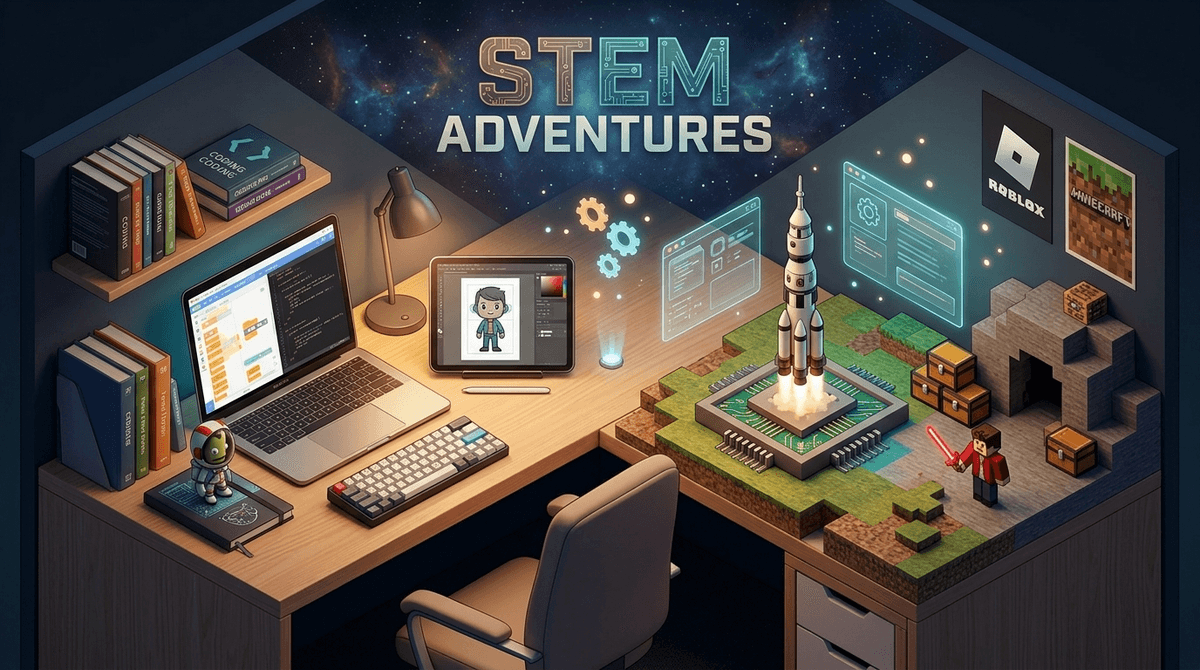
TL;DR: If you’re tired of hearing about "Ohio" and "Skibidi" and feel like your kid’s brain is melting into a puddle of Roblox pixels, take a breath. New 2025 data suggests that for a huge chunk of Gen Alpha, gaming has shifted from passive consumption to a literal masterclass in entrepreneurship, UI design, and systems thinking. We’re moving past the "screens are bad" era into the "my kid is accidentally learning C++" era.
Quick Links to Career-Building Games:
- For Coding: Scratch (Ages 8+) & Roblox Studio (Ages 10+)
- For Logic & Engineering: Minecraft (Redstone is basically electrical engineering)
- For Economics: Stardew Valley and Animal Crossing: New Horizons
- For Collaboration: Among Us (The ultimate lesson in social engineering and rhetoric)
We’ve all been there: you walk past the living room and see your 10-year-old staring at a screen where a blocky character is jumping over "lava" for the 400th time. It looks mindless. It looks like "brain rot." But if you sit down and actually ask what’s happening, you might find out they aren't just playing—they’re analyzing.
In 2026, the "gamer" stereotype has flipped. Research into Gen Alpha’s digital habits shows that kids aren't just consuming media; they are modding, skinning, and building it. When your kid spends three hours in Roblox, they might be navigating complex social hierarchies, managing a digital economy (Robux is basically a gateway drug to FOREX trading), or even learning the basics of Luau coding.
Recent longitudinal studies are starting to back up what we’ve suspected: kids who engage in "high-agency" gaming—games where they build, lead, or solve—show marked increases in fluid intelligence and spatial reasoning.
While TikTok might be shortening attention spans, games like Minecraft or Terraria are doing the opposite. They require sustained focus, iterative testing (trial and error), and long-term project management. If your kid spent two weeks building a functional "Redstone" computer in Minecraft, they didn't just play a game; they completed a freshman-level logic gate project.

Let’s talk about the elephant in the room. Roblox is often a parent's biggest headache because it’s loud, it’s chaotic, and it’s constantly asking for money. But Roblox Studio is a legitimate game development engine.
Kids are learning:
- UI/UX Design: Making menus that people actually want to click.
- Monetization Strategy: Understanding "value exchange" (even if it’s just for a digital hat).
- Community Management: Dealing with toxic players and "moderating" their own servers.
Is it a secret internship? For the kids who move from "playing" to "creating," absolutely. Some teenagers are making six figures via the Developer Exchange (DevEx) program. Even if your kid never makes a dime, the "soft skills" of managing a digital space are 100% transferable to a 2035 resume.
If Roblox is the mall, Minecraft is the workshop. It remains the gold standard for "stealth learning."
- Survival Mode teaches resource management and risk assessment.
- Creative Mode is digital LEGOs on steroids.
- Modding teaches file structures and Java.
If you want to lean into the learning aspect, check out Minecraft: Education Edition, which has specific modules for chemistry and coding.
For the younger crowd (Ages 8-12), Scratch is the ultimate "on-ramp." Developed by MIT, it’s a block-based coding language that lets kids build their own games. It’s not "playing" a game; it’s building the logic behind the game. It’s the difference between eating a cake and learning the chemistry of baking.
If you have a kid who loves organization, these city-builders are basically civil engineering simulators. They have to manage budgets, power grids, sewage (yes, really), and citizen happiness. It’s a crash course in "why taxes exist" and "why urban planning is hard."
We have to be real here: the "internship" has a dark side. Many modern games use predatory monetization tactics. Roblox and Fortnite are designed by world-class psychologists to keep kids clicking and spending.
When does the learning stop and the exploitation begin?
- Learning: Your kid is researching how to trade items to get a better "deal."
- Exploitation: Your kid is clicking "loot boxes" or "gacha" mechanics that are essentially unregulated gambling.
- Ages 6-9: Focus on "Sandbox" games like Minecraft (Creative Mode) or Toca Life World. The goal here is digital literacy and basic problem solving.
- Ages 10-13: Introduce "Systems" games. Kerbal Space Program is incredible for physics. Roblox Studio is great if they want to start building.
- Ages 14+: This is where the "internship" gets real. If they’re into Discord communities or modding, they’re learning high-level collaboration. Just keep an eye on the "grind"—if they’re spending 8 hours a day "working" for a digital guild, it might be time to talk about labor value.
Instead of saying "Stop playing that garbage," try asking questions that treat their gaming like a project:
- "What’s the hardest problem you solved in Minecraft today?"
- "How does the economy work in that game? Is there inflation?" (You’d be surprised how much they know about this).
- "I saw you were building a level in Super Mario Maker 2. How do you make sure it's fair for the player?"
By framing it as a skill rather than a distraction, you change the power dynamic. You’re no longer the "screen police"; you’re the mentor.
Not every hour spent on a screen is equal. Watching Skibidi Toilet on a loop? Probably not building a ton of neural pathways. But navigating a 50-person "raid" in an MMO or debugging a script in Scratch? That’s real work.
The goal for intentional parents in 2026 isn't to eliminate gaming, but to curate it. Move them from the "consumer" bucket to the "creator" bucket. If they’re going to be obsessed with Roblox, let’s make sure they’re the ones building the world, not just paying for it.