

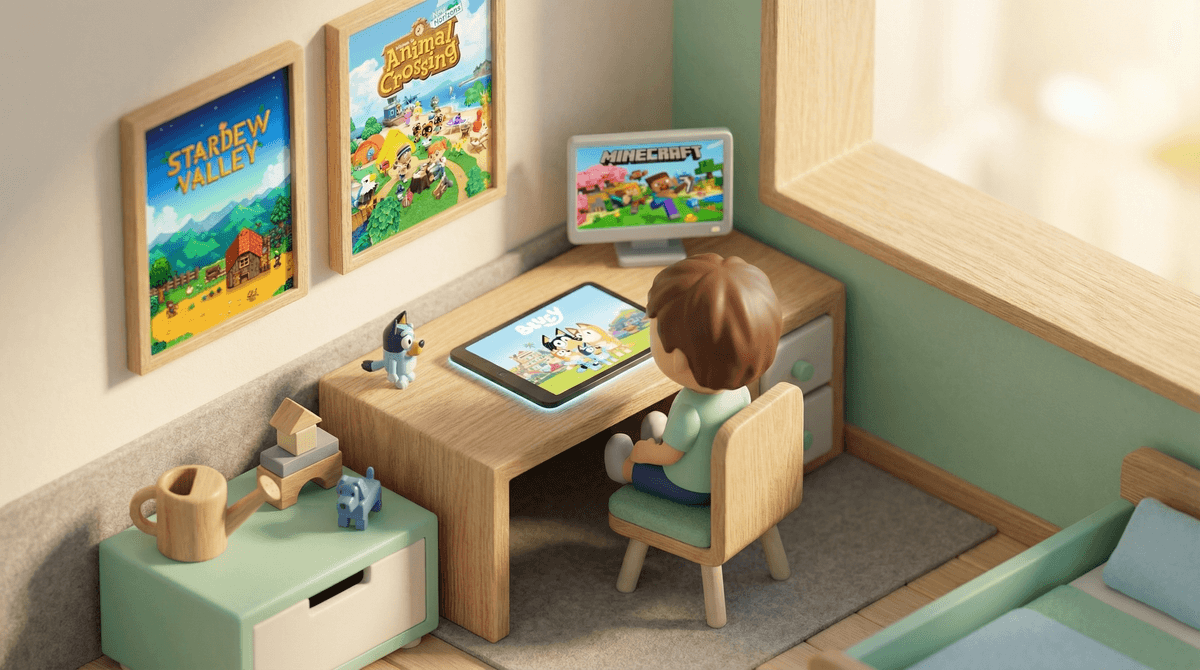
Here's a wild idea: what if screen time wasn't just something to limit, but something you could actually use to build life skills?
I know, I know. We're all drowning in advice about reducing screen time, and honestly, that's important. But here's the thing—your kids are going to be around screens their whole lives. And the digital world is actually packed with opportunities to practice impulse control, delayed gratification, and self-regulation. You know, the exact skills that will help them not blow their first paycheck on crypto or doomscroll through their college finals.
Using media to teach self-control means intentionally leveraging games, shows, and apps as practice grounds for the kind of restraint and decision-making they'll need everywhere else. It's about making the screen time they're already having do double duty—entertainment AND skill-building.
Self-control is one of those foundational skills that affects literally everything: academic success, friendships, financial decisions, emotional regulation, you name it. The famous marshmallow test showed that kids who could delay gratification had better outcomes decades later. But here's what's interesting: self-control is a skill you can practice and improve, not just something you're born with.
And guess what? Digital media is constantly asking kids to make choices about impulse control:
- Do I spend my Robux now or save for that limited edition item?
- Do I binge the whole season or stop after one episode like Mom asked?
- Do I rage-quit this hard level or take a break and try again?
- Do I buy that V-Buck bundle or wait for a better deal?
These aren't just random digital moments—they're real decisions with real consequences (even if those consequences are "just" in a game). And the practice they get making these calls? It transfers to real life.
The alternative is pretending screens don't exist until they're 16, then handing them a smartphone and hoping for the best. That's not a plan.
Start With Games That Require Patience
Some games are basically impulse-control boot camps. Stardew Valley, for example, is all about delayed gratification—you plant crops, wait for them to grow, save money for better equipment, plan for future seasons. There's no instant reward, and kids who stick with it learn that waiting and planning pays off.
Same with Minecraft in survival mode. You can't just build whatever you want immediately—you have to gather resources, manage hunger, plan shelter before nightfall. It's resource management and impulse control wrapped in a game they actually want to play.
Animal Crossing is another great one. The whole game runs on real-world time, so if you want that house upgrade or special event, you literally have to wait. No amount of button-mashing will speed it up.
Ages 6-10: Start with simpler games like Pokémon where they need to save Poké Balls and potions for harder battles, or LEGO games where collecting studs requires patience and exploration.
Ages 11-14: Graduate to strategy games like Civilization VI or Slay the Spire where every decision has long-term consequences and impulsive moves will wreck your whole run.
Use In-Game Currency as Practice for Real Money
This is huge. Games with virtual economies—Roblox, Fortnite, even Pokémon GO—are perfect opportunities to practice financial self-control.
Here's what works:
- Give them a monthly budget for Robux or V-Bucks (even if it's just $5-10)
- Make them wait 24 hours before any purchase to practice the "sleep on it" rule
- Talk through opportunity cost: "If you buy this skin, you won't have enough for the battle pass next month"
- Let them make mistakes with small amounts so they learn before the stakes are real
The goal isn't to never spend—it's to spend thoughtfully. And honestly, learning that Robux is real money is way better at age 10 than at 18 when they're managing a credit card.
Make "One More Episode" a Negotiation, Not a Battle
TV time is actually a great place to practice stopping when you said you would. But you have to set it up right.
Before they start watching:
- Agree on a specific number of episodes (not "until I say stop")
- Set a visible timer they can see
- Talk about why stopping is important: sleep, family time, other activities they enjoy
When it's time to stop:
- Give a 5-minute warning
- Acknowledge that cliffhangers suck: "I know it's hard to stop when it's exciting"
- Follow through consistently—no "just one more" unless there's a real reason
Ages 8-12: Start with shows that have natural stopping points. Bluey is perfect because episodes are only 7 minutes. Avatar: The Last Airbender is harder because it's so good and so serialized, but that makes it better practice.
Ages 13+: This is when you can start having meta-conversations about how Netflix designs shows to be bingeable and why that matters. They're old enough to understand that streaming platforms are literally trying to hack their self-control.
Talk About Game Design and Manipulation
One of the most powerful things you can do is help kids understand how games and apps are designed to keep them hooked. This isn't about making them paranoid—it's about media literacy.
When they're playing Roblox or Fortnite, point out:
- "See how they show you what you're missing if you don't buy the battle pass? That's FOMO—fear of missing out"
- "Notice how the daily rewards get better each day? They're trying to build a habit"
- "That countdown timer on the special offer? That's creating artificial urgency"
This isn't buzzkill behavior—it's empowering them to recognize when they're being manipulated so they can make real choices instead of just reacting to clever design.
Use Pause Buttons as Practice
Literally the pause button. It's a self-control training tool.
The 5-Minute Pause Rule: When your kid is deep in a game and you need them for dinner/homework/life, give them a 5-minute warning, then ask them to pause and come right then. Not after this level. Not after this match. Now.
Yes, they'll protest that they can't pause multiplayer games. That's real—but it's also why you give warnings. And honestly? Learning to manage time so you're not in the middle of a 45-minute raid when dinner's ready is exactly the kind of planning skill they need.
Ages 6-9: Practice pausing during single-player games or shows. Build the habit when stakes are low.
Ages 10-14: Start expecting them to manage their time around multiplayer games. If they can't pause a Fortnite match, they need to not start one 10 minutes before dinner.
Scenario 1: Your 9-year-old is playing Minecraft and found diamonds. They want to use them immediately to make a diamond sword.
Self-control teaching moment: "What else could you make with diamonds? What would be most useful? Should we look up what experienced players recommend?" Help them practice the pause between wanting something and getting it.
Scenario 2: Your 12-year-old wants to spend their entire month's Robux budget in the first week.
Self-control teaching moment: "That's your call, but let's talk about what you're giving up. There's a new update coming in three weeks—will you be okay having zero Robux then?" Let them decide, but make the tradeoff visible.
Scenario 3: Your 7-year-old is watching Pokémon and the agreed-upon two episodes are up, but they're begging for one more.
Self-control teaching moment: "I know it's hard to stop. That's exactly why we're practicing. Tomorrow you'll be glad you stopped because you'll have more to look forward to." Then follow through. The practice only works if the boundary holds.
Ages 5-7: Focus on stopping when asked and waiting short periods (5-10 minutes). Use timers they can see. Celebrate small wins.
Ages 8-10: Start practicing delayed gratification in games and managing small amounts of virtual currency. Begin conversations about why stopping is hard.
Ages 11-13: Expect them to plan screen time around responsibilities and make thoughtful spending decisions with in-game currency. Introduce concepts like FOMO and game design psychology.
Ages 14+: Work toward self-monitoring and self-correction. They should be able to recognize when they're losing control and implement their own strategies. Your role shifts to consultation rather than enforcement.
Screen time doesn't have to be this thing you just tolerate and try to minimize. It can actually be a low-stakes training ground for skills your kids will need everywhere: impulse control, delayed gratification, financial planning, and recognizing manipulation.
The key is being intentional. Don't just hand over the iPad—use it as a teaching tool. Point out the decisions, make the tradeoffs visible, let them practice while the consequences are small.
Will they still beg for one more episode? Absolutely. Will they blow their Robux on something dumb? Probably. But that's the point. Better to learn these lessons at 10 with Robux than at 22 with rent money.
- Pick one area to focus on: In-game spending, stopping when asked, or game time management
- Set up a structure: Clear expectations, visible timers, agreed-upon budgets
- Name what you're practicing: "We're working on impulse control" or "This is delayed gratification practice"
- Be consistent: The skill only builds with repetition
- Celebrate progress: Notice when they make a thoughtful choice or stop without drama
And if you want to go deeper on specific games or apps, check out our guide to Roblox parental controls or learn more about how games teach financial literacy.
Your kids are going to spend time with screens. You might as well make it count.