

The Truth Behind Movie, TV, and Video Game Ratings
TL;DR: Rating systems (MPAA for movies, TV Parental Guidelines, ESRB for games) are useful starting points but wildly inconsistent. A PG-13 movie can show mass murder but not say "fuck" twice. TV-MA means different things on different platforms. And the ESRB often rates games based on what might happen, not what actually does. Here's what you actually need to know to make informed decisions for your family.
Let's break down the three main rating systems you're dealing with:
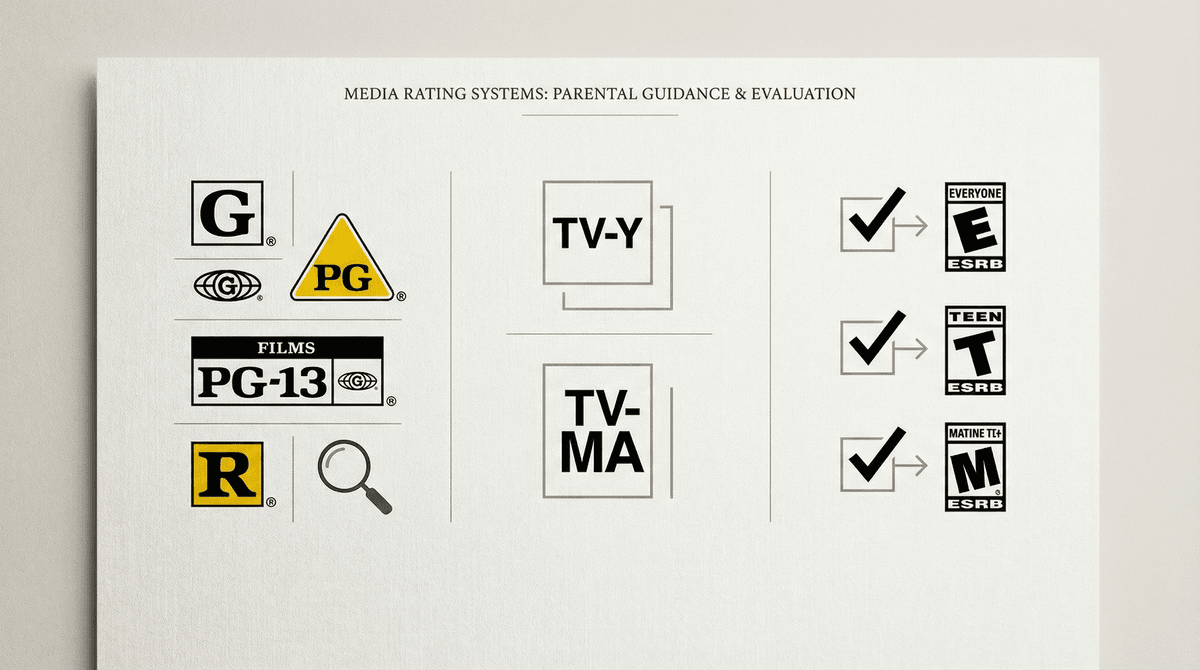
MPAA (Movies): G, PG, PG-13, R, NC-17 TV Parental Guidelines: TV-Y, TV-Y7, TV-G, TV-PG, TV-14, TV-MA ESRB (Video Games): E (Everyone), E10+, T (Teen), M (Mature), AO (Adults Only)
Each system was created by the industry to regulate itself and avoid government intervention. Which means they're designed to protect the industry as much as (or more than) they're designed to protect kids.
The MPAA rating system for movies is famously inconsistent and weirdly puritanical about certain things while being totally fine with others.
Violence gets a pass, everything else doesn't. You can show people getting shot, stabbed, blown up, and brutally murdered in a PG-13 movie (The Dark Knight literally opens with a bank robbery and multiple deaths), but if someone says "fuck" more than once, it's an automatic R rating. Show a woman's nipple? R rating. Show 50 people getting mowed down by gunfire? Maybe PG-13.
The ratings are subjective and secretive. The MPAA doesn't publish specific guidelines for what earns each rating. It's decided by a small group of parents (yes, really—just parents, not child development experts) who watch movies and vote. Their identities used to be secret, and the whole process is still pretty opaque.
Context doesn't matter enough. A movie about the Holocaust showing historical violence might get the same rating as a gratuitous torture-porn film. Schindler's List is rated R. So is Saw. These are not the same.
PG-13 is a marketing sweet spot. Studios will literally edit movies specifically to hit PG-13 because it's the most profitable rating—teens can see it without parents, but it's not so restrictive that families won't go. This means you get movies that push the boundaries of what PG-13 "should" be just to capture that audience.
TV ratings are supposed to work similarly to movie ratings, but they're applied by the networks themselves (not a central board), which means they're all over the place.
TV-MA on Netflix is different from TV-MA on HBO. Netflix tends to rate things TV-MA pretty liberally—sometimes for language that would barely register as edgy. HBO's TV-MA usually means you're getting graphic violence, sex, or both. Stranger Things is TV-14. Game of Thrones is TV-MA. But honestly, some episodes of Stranger Things are more intense than some episodes of other TV-MA shows.
Streaming platforms are inconsistent. Because there's no centralized rating board for streaming content, different platforms rate similar content differently. And some platforms (looking at you, YouTube) barely rate anything at all beyond "this is YouTube Kids" vs "this is regular YouTube."
The content descriptors actually matter more than the rating. TV ratings come with descriptors like V (violence), S (sexual content), L (language), D (suggestive dialogue). A TV-14 with a V is very different from a TV-14 with an S. Actually read those letters.
The video game rating system (ESRB) is honestly the most consistent of the three, but it has its own quirks.
They rate based on potential, not typical gameplay. Minecraft is rated E10+ partly because you can play violently (killing animals, fighting monsters), even though most kids spend their time building houses and farms. Meanwhile, Animal Crossing is rated E for Everyone, and the gameplay is remarkably similar in terms of what kids actually do.
Online interactions aren't rated. Every ESRB rating includes the disclaimer "Online Interactions Not Rated by the ESRB." This is huge. Roblox is rated E10+, but the real concerns with Roblox aren't the game content—they're the chat features, the in-game purchases, and the user-generated content that can range from wholesome to wildly inappropriate. The rating tells you nothing about that.
M for Mature is 17+, but we all know 12-year-olds are playing. Fortnite is rated T for Teen (13+). Call of Duty is rated M for Mature (17+). But talk to any middle schooler and you'll find that a huge percentage of them have played both. The ratings are guidelines, not laws (except for AO-rated games, which most stores won't sell to minors).
The ESRB is pretty good at consistency within their system. If you learn what E10+ means versus T versus M, you can generally trust that games within each category will be similar in content. They also provide detailed content descriptors on their website that are actually useful.
Ratings are a starting point, not a finish line. Here's how to actually use them:
1. Read the content descriptors, not just the rating. PG-13 for "intense sequences of sci-fi violence" is different from PG-13 for "thematic elements and brief drug references." TV-14 DLV (dialogue, language, violence) tells you more than just TV-14.
2. Use Common Sense Media or IMDb Parents Guides. These resources break down exactly what's in a movie, show, or game. They'll tell you how many times someone says "shit," whether there's a sex scene (and how explicit), and what kind of violence you're dealing with. Common Sense Media is particularly good because they include both a "parents say" and "kids say" age recommendation, which often differ from the official rating.
3. Watch trailers and read reviews. For movies and shows, watch the trailer with your kid. For games, watch gameplay videos on YouTube. You'll get a much better sense of the vibe than any rating will give you.
4. Know your kid. A mature 10-year-old might be fine with a PG-13 movie that would give a sensitive 13-year-old nightmares. A kid who's super into history might be ready for Saving Private Ryan (rated R) before they're ready for American Pie (also rated R). You know your kid better than any rating system does.
5. Consider the "why" behind the rating. Is it rated PG-13 because of violence? Language? Sexual content? Scary themes? Some families are more okay with language than violence. Some are fine with fantasy violence but not realistic violence. Some don't care about any of it but draw the line at sexual content. Figure out what matters to your family.
6. For games, focus on the online component. The ESRB rating matters, but for most popular games, the real question is: what's the online experience like? Is there voice chat? Text chat? Can strangers contact my kid? Can my kid spend money? These are often bigger concerns than whether the game is rated E or T. Check out guides on Roblox parental controls or Fortnite safety settings for specifics.
Here's a rough translation of what these ratings typically mean in practice:
Movies (MPAA):
- G: Truly for everyone. Usually animated. Think Toy Story.
- PG: Might have some mild scares or rude humor. Most Pixar movies. Ages 5+.
- PG-13: This is the wild west. Could be a superhero movie with city-destroying violence, or a teen comedy with sex jokes. Ages 10-13+ depending on content. Always check why it's PG-13.
- R: Usually means significant violence, sexual content, drug use, or pervasive language. Ages 15-17+ depending on the kid and the content. Some R-rated movies are totally fine for mature teens (The Martian is rated R basically for saying "fuck" a lot). Others are genuinely adult content.
TV:
- TV-Y: Preschool stuff. Bluey, Daniel Tiger.
- TV-Y7: Early elementary. Mild cartoon violence okay. Avatar: The Last Airbender.
- TV-G: General audience, rare on modern TV.
- TV-PG: Most family sitcoms. Ages 8+.
- TV-14: Most teen shows. Ages 11-14+ depending on content. Stranger Things is here.
- TV-MA: Adult content. Ages 16+ at minimum, often 18+. Graphic violence, sex, or language. The Boys, Game of Thrones.
Games (ESRB):
- E: Everyone, ages 6+. Mario Kart, Animal Crossing.
- E10+: Ages 10+. Mild cartoon violence. Minecraft, Splatoon.
- T: Teen, ages 13+. More intense violence, mild language, suggestive themes. Fortnite, Rocket League.
- M: Mature, ages 17+. Graphic violence, strong language, sexual content. Call of Duty, Grand Theft Auto.
Rating systems are useful as a first filter, but they're not enough on their own. They're inconsistent, they prioritize certain content over others in weird ways, and they can't account for your specific kid or your family's values.
The real work is doing your homework. Spend 5 minutes reading a detailed content breakdown on Common Sense Media. Watch a gameplay video. Ask other parents what they thought. Check out our guides on specific games and shows to get the real story about what your kid will actually experience.
And remember: the goal isn't to shield your kids from everything forever. It's to make sure they're encountering content that's appropriate for their developmental stage and that you can talk through together. A well-chosen PG-13 movie you watch together and discuss can be way better than an E-rated game they're playing unsupervised for hours with strangers online.
Next Steps:
- Check out Common Sense Media for detailed content breakdowns
- Read our guide to Fortnite parental controls if your kid is begging to play
- Learn about YouTube vs. YouTube Kids to understand the difference
- Explore cozy games for kids if you want alternatives to shooter games
Ratings are a tool, not a rulebook. Use them as a starting point, then dig deeper to make the call that's right for your family.