

TL;DR
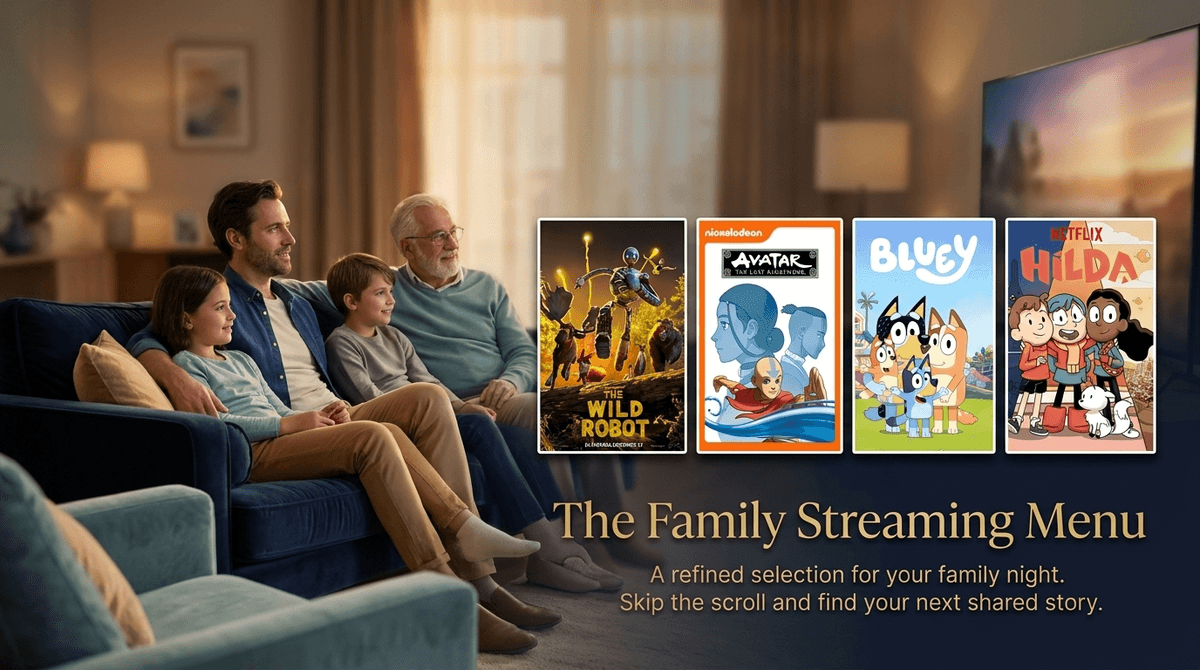
Stop the "Netflix Scroll" before it starts by curating a "Family Menu" of 3-5 pre-approved options. Decision fatigue is real, and it usually leads to picking "brain rot" content just to end the whining. If you’re short on time, here are the gold-standard picks for a low-stress night:
- Preschool: Puffin Rock or Bluey
- Elementary: Hilda or The Wild Robot
- Middle School: Avatar: The Last Airbender or The Mysterious Benedict Society
We’ve all been there. It’s 6:30 PM on a Friday. You’re tired, the kids are vibrating at a frequency that suggests an impending meltdown, and you just want to sit down and watch something together. But instead of "togetherness," you spend forty-five minutes scrolling through rows of brightly colored thumbnails while your seven-year-old yells "No!" at everything you suggest and your ten-year-old lobbies for a MrBeast video you’ve already seen six times.
By the time you actually pick something, everyone is irritable, the popcorn is cold, and you’ve wasted the "quality time" window. This isn't just a first-world problem; it’s streaming decision fatigue, and it’s a genuine drain on your family’s digital wellness.
Decision fatigue is the psychological phenomenon where the quality of our choices deteriorates after a long session of making decisions. As parents, we make about 4,000 decisions before lunchtime (socks or no socks? oatmeal or toast? why is the dog blue?). By the time we hit the couch, our "choice muscle" is exhausted.
Streaming platforms like Netflix, Disney+, and YouTube are designed to keep us scrolling. Their algorithms don't actually want you to find the perfect show immediately; they want you to stay on the platform. This "infinite scroll" mimics the same slot-machine mechanics found in Roblox or TikTok, keeping our brains in a state of high-arousal searching rather than low-arousal relaxing.
When we are fatigued, we default to the "path of least resistance." In the streaming world, that usually means "brain rot."
"Brain rot" is the current Gen Alpha term for low-effort, high-stimulation content that offers zero substance—think Skibidi Toilet or those weird, neon-colored "challenge" videos where people scream for twenty minutes. If you don’t have a plan, you will end up watching something that leaves your kids overstimulated and "Ohio" (that's kid-speak for weird/cringe) instead of actually entertained.
Learn more about what "brain rot" does to a child's attention span
The goal is to move from reactive consumption (scrolling until you're tired) to intentional curation. Here is how to beat the system:
1. The "Analog Menu" Strategy
Don't open the app until you've decided what to watch. Create a physical or digital list of 5 "Family Favorites" and 3 "New Finds." When it’s movie night, the kids choose from that list, not the entire internet.
2. The 10-Minute Timer
If you haven't picked a show in 10 minutes, the TV goes off and we play a board game like Catan or Ticket to Ride. This raises the stakes and forces a decision.
3. Kill the Autoplay
Go into your Netflix or Disney+ settings and turn off "Autoplay Next Episode." This gives you a natural "stop and think" moment between shows.
To help you build your "Analog Menu," here are our current non-negotiable, high-quality picks that are actually worth the bandwidth.
For the Little Ones (Ages 3-6)
At this age, you want "slow media"—shows with gentle pacing and limited cuts that won't fry their developing nervous systems.
- It’s narrated by Chris O'Dowd, it’s beautiful, and it’s incredibly calm. It’s the ultimate "wind-down" show.
- You already know Bluey, but it bears repeating: it is the gold standard for modeling imaginative play and emotional intelligence.
- If they want something faster-paced, this is educational without being obnoxious. It’s basically a modern Sesame Street on steroids.
For the Elementary Crew (Ages 7-11)
This is the danger zone for "brain rot" and "cringe" YouTube content. Steer them toward narrative-driven shows with actual character arcs.
- Based on the Hilda graphic novels, this show is magical, adventurous, and features a female lead who is brave and kind without being a trope.
- If you haven't seen this yet, it’s a masterpiece. It tackles themes of motherhood, technology, and nature. (And yes, read The Wild Robot by Peter Brown first if you can!)
- For kids who are starting to get into Dungeons & Dragons or Minecraft, this offers deep lore and great storytelling.
For the Middle Schoolers (Ages 12+)
At this age, they want "edgy," but you want "substance." Look for shows that deal with complex social dynamics.
- The animated version, not the live-action. It is arguably the best-written show for families ever made. It deals with war, redemption, and friendship in a way that respects the viewer's intelligence.
- Based on the book series, this show celebrates being "weird" and using your brain to solve puzzles. It’s the perfect antidote to the "conformity" of social media.
- If you want a "reality" vibe without the toxicity, Taskmaster is hilarious, creative, and great for watching together. Just check the ratings for the specific season—the "Junior" version is great for younger kids.
Not all "Top 10" lists are created equal. Streaming platforms often push their own "Originals" because they are cheaper to host, not because they are good.
For example, many Netflix kids' movies have high "match" percentages but are essentially 90-minute toy commercials with frantic editing. If a show feels like it was written by an AI that was fed a diet of sugar and CoComelon, it probably was. Don't be afraid to pull the plug on a show that is making your kids act like "monkeys" (overstimulated, aggressive, or glazed over).
When you’re dealing with streaming overload, the biggest safety risk isn't "stranger danger"—it's content creep.
- Profiles matter: Ensure your kids are on restricted profiles. YouTube Kids is better than "Big YouTube," but even then, things slip through.
- The "Vibe Check": If you see your kid watching something and their face looks like they’re witnessing a car crash, it’s too much stimulation.
- The "Ohio" Factor: If your kid starts using slang they don't understand or acting out "memes" that feel aggressive, it’s time to look at their YouTube or TikTok history.
Check out our guide on setting up parental controls for every major streaming service
The "Infinite Scroll" is a thief. It steals your evening, your patience, and your kids' ability to appreciate slow-burn storytelling. By taking five minutes on a Tuesday to pick out what you'll watch on a Friday, you reclaim that time.
You aren't being a "strict" parent by limiting the menu; you're being an intentional one. You're teaching your kids that media is something we choose, not something that just happens to us.
Next Steps:
- Tonight: Look at your "Watch Next" list. Delete anything that feels like "filler."
- This Weekend: Have a 5-minute family meeting. Ask everyone to nominate one "High Quality" show they want to watch this month.
- The Rule: If we spend more than 10 minutes looking, we turn it off and play Uno.
Learn more about how to audit your family's digital habits with the Screenwise Survey