

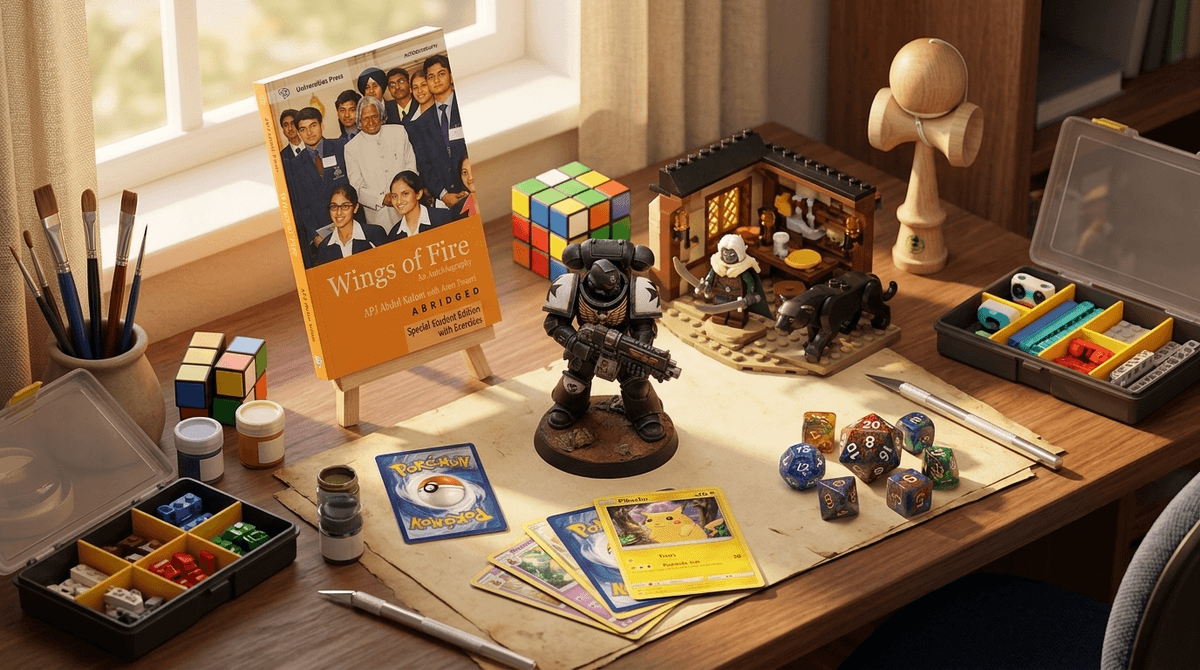
TL;DR: The "Dopamine Swap" Cheat Sheet
If you’re trying to compete with the 1.5-second feedback loop of TikTok or the chaotic agency of Roblox, a standard coloring book isn't going to cut it. You need hobbies that offer "Leveling Up," "Customization," and "Social Currency."
The Heavy Hitters:
- For the RPG Fan: Dungeons & Dragons — It’s basically an unpatched, open-world video game played with paper and dice.
- For the Strategist: Magic: The Gathering — The OG "loot box" experience, but with actual math and face-to-face interaction.
- For the Tactile Creator: Warhammer 40,000 — High-end "skins" for the real world. Painting miniatures is the ultimate flow-state activity.
- For the Speed-Runner: Rubik’s Cubes/Speedcubing — Tactile, fast, and highly competitive.
- For the Lore-Seeker: Wings of Fire or Percy Jackson — Books with "fandom" energy that feel like immersive worlds.
Get screen-free activities for a kid who loves Minecraft and Roblox
We’ve all been there. You announce "Screen-Free Sunday" or whatever boundary you’ve set, and within ten minutes, your kid is wandering the house like a ghost in a Victorian novel, sighing about how there is nothing to do.
The problem isn't that our kids lack imagination. The problem is that digital media has recalibrated their dopamine thresholds. When a kid plays Fortnite, they are getting a hit of "win" or "new discovery" every few seconds. Most traditional hobbies—like, say, stamp collecting—feel like watching paint dry in comparison.
To actually hold their attention, we have to find activities that mirror the flow state and reward systems of their favorite digital worlds. We’re looking for hobbies that are "sticky."
Kids love Minecraft because they have total agency over their environment. They can build, destroy, and customize. To replicate this screen-free, you need something that offers that same sense of "I made this, and it looks cool."
I’m going to be real: this is an investment. It’s a tabletop wargame where you assemble and paint tiny, incredibly detailed plastic soldiers. But here’s why it works for Gen Alpha: it’s the physical version of "buying skins."
Instead of spending Robux on a digital avatar, they are spending time painting a physical one. The community is huge, the lore is deeper than any Netflix show, and the "flow state" achieved while painting is the literal opposite of "scroll fog."
Ages: 10+ (due to tiny parts and complex rules).
If your kid is into Scratch or Roblox game design, they want to see things work. Lego Spike Prime bridges the gap. It’s robotics that doesn’t feel like a dry school project. They build something physical, then use a simple interface to make it move. It provides that "I’m a genius" dopamine hit that keeps them engaged for hours. Ages: 7-12.
Check out our guide on the best coding toys that don't feel like homework
Why are kids obsessed with MrBeast? Often, it’s the spectacle of "the win" and the value of items. You can mirror this through Trading Card Games (TCGs).
The Pokemon obsession is generational at this point. The card game is brilliant because it hits three notes: collecting (the dopamine of the "pull"), math/strategy (the actual game), and social currency (trading with friends). It’s the original loot box, but they can actually hold the "loot" in their hands. Ages: 6+.
Think of this as the "pro" version of Pokemon. If you have a middle schooler who thinks they’re too cool for Pikachu, Magic is the answer. It’s complex, strategic, and has a massive secondary market. It teaches resource management and critical thinking in a way that feels like high-stakes gaming. Ages: 11+.
Gen Alpha spends a lot of time in "Roleplay" servers on Roblox (like Brookhaven). They want to be someone else and tell a story.
If you can get a group of 3-4 kids together for D&D, you have won parenting for the afternoon. It is the ultimate screen-free activity because it is infinite. There are no graphics to get outdated, no lag, and the "dopamine" comes from a well-timed natural 20 roll. It builds empathy, teamwork, and—honestly—improves their math skills without them realizing it. Ages: 8+ (with a simplified "Starter Set").
One reason TikTok is so addictive is the "satisfying" nature of the videos. Hobbies that require high dexterity and offer immediate "win/fail" feedback loops can tap into that same brain space.
It’s not just the standard 3x3 cube anymore. There are pyramids, 5x5s, and "megaminx" puzzles. This is the "speed-running" of the physical world. Kids can track their times, learn "algorithms" (which sounds like coding, because it basically is), and it gives them something to do with their hands that isn't scrolling. Ages: 8+.
If you haven't seen a Kendama, it’s a traditional Japanese toy that has become a massive subculture. It’s a wooden handle with cups and a ball on a string. It looks simple, but the trick progression is endless. It requires the same "just one more try" mentality that makes Geometry Dash so hard to put down. Ages: 7+.
- Elementary (Ages 5-9): Focus on immediate rewards. Pokemon TCG and Lego Spike Prime are great here. They need to see the result of their work quickly.
- Middle School (Ages 10-13): This is the "Social Currency" phase. They want hobbies that make them look "cool" or allow them to be part of a niche community. Warhammer 40,000 or Dungeons & Dragons are perfect for this "identity building" stage.
- High School (Ages 14+): Focus on high-skill mastery and "Flow." Magic: The Gathering or complex building projects (like restoring a vintage bike or advanced woodworking) offer the "deep work" that screens often strip away.
Here is the no-BS truth: The first 20 minutes will suck.
When a kid moves from a high-dopamine environment (like a YouTube rabbit hole) to a low-dopamine one (like painting a miniature), their brain goes into a sort of withdrawal. They will be cranky. They will say it’s "mid" or "Ohio" (which, in this context, just means weird/bad).
Your job isn't to entertain them during those 20 minutes. It's to hold the line until their brain resets and the "flow" of the new activity kicks in.
We can't expect kids to trade a $500 game console for a $2 deck of cards and be thrilled about it. We have to offer them hobbies that respect their intelligence and their desire for agency, customization, and social connection.
Whether it's the tactical depth of Magic: The Gathering or the creative explosion of a Dungeons & Dragons session, the goal is the same: trading the "scroll fog" for a sense of real-world mastery.
- Identify the "Digital Hook": Does your kid like building? (Minecraft/Roblox). Does your kid like competing? (Fortnite/Valorant). Does your kid like the lore? (Five Nights at Freddy's).
- Pick the Analog Equivalent: Use the links above to find the physical hobby that matches that hook.
- Join the "Community": These hobbies work best when there's a social element. Find a local game store or a school club where they can show off their new skills.
Get screen-free hobbies for a 12-year-old who loves strategy games