

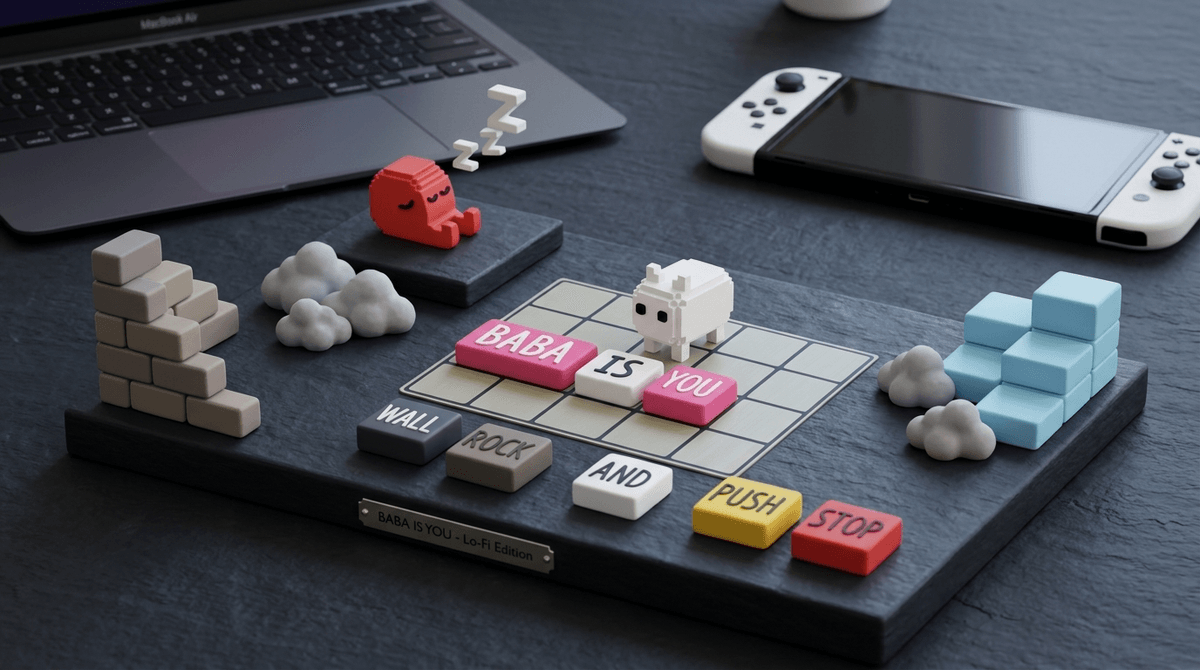
TL;DR: Baba Is You is a mind-bending puzzle game where the rules of the game are physical blocks you can push around. By moving blocks to create sentences like "ROCK IS PUSH" or "WALL IS YOU," kids (and adults) are essentially learning the fundamental logic of programming—syntax, Boolean operators, and debugging—without ever touching a line of Javascript or Python. It’s brilliant, incredibly difficult, and a million times more effective than those "educational" apps that are just math flashcards in a cheap trench coat.
Find logic-heavy games that teach problem solving
If you haven't seen it on a screen in your house yet, Baba Is You looks like a lo-fi relic from the 1980s. You play as a little white four-legged creature (Baba). The goal is usually to touch a flag to win.
But here’s the twist: the rules of the level are written as blocks inside the level.
If there’s a wall blocking your path, you’ll see three blocks sitting nearby that say WALL, IS, and STOP. As long as those blocks are touching in a line, the wall is solid. But if you push the STOP block away, the sentence breaks. Suddenly, the "rule" no longer exists, and you can walk right through the walls.
Even better? You can push a YOU block next to ROCK. Now, ROCK IS YOU. You stop controlling Baba and start controlling every rock on the screen. It’s a total "wait, what?" moment that forces kids to rethink how systems work.
Most "coding games" for kids are basically "move the robot three steps forward, then turn right." That’s fine for five-year-olds, but it doesn't actually teach the logic of how software functions. Baba Is You does, and it does it by making the mechanics of the game feel like a compiler.
1. Syntax (The Order Matters)
In programming, if you misplace a semicolon or put a command in the wrong order, the whole thing breaks. Baba Is You teaches this via "Subject-Verb-Object" logic. BABA IS YOU works. IS BABA YOU does nothing. Kids quickly learn that the structure of their "code" (the blocks) is just as important as the intent behind it.
2. Boolean Logic and Operators
As the game progresses, it introduces blocks like AND, NOT, and LONELY.
LAVA IS MELT AND REDBABA IS YOU AND FLOATKEKE IS NOT PUSH
This is pure Boolean logic. Your kid is learning how to chain conditions together to change the state of the world. They aren't just playing a game; they are manipulating a database of rules in real-time.
3. Object-Oriented Thinking
In Baba Is You, "Baba" isn't a character; it's an object. "You" is a property assigned to that object. When a kid changes BABA IS YOU to WALL IS YOU, they are demonstrating a deep understanding of how properties can be reassigned to different objects—a core concept in languages like C++ or Java.
4. The "Debugging" Loop
The most important skill for a programmer isn't knowing where the keys are; it's having the grit to fix things when they break. Baba Is You is hard. Your kid will break the game constantly. They will accidentally turn themselves into a pile of grass and realize they have no way to move. They have to "undo," look at their logic, find the "bug," and try a different sequence. That is 90% of a software engineer's job.
Learn more about the benefits of puzzle games for cognitive development
We talk a lot about "brain rot" content—those mindless YouTube shorts or repetitive mobile games that seem to turn kids into zombies. Baba Is You is the literal opposite of that.
It’s a "prestige" game. It’s viral in the way that Wordle or Minecraft was—it feels like a secret club for people who are smart enough to "get" it. Kids love the "Aha!" moment when a seemingly impossible level suddenly clicks because they realized they could turn the flag into a key and the key into themselves.
It also has a very active community. You’ll see kids looking up solutions or level designs, which leads them into the world of game design and logic-based problem solving.
While Baba Is You is rated E for Everyone and has zero "mature" content (no violence, no chat, no microtransactions), the "mental age" required is higher than you might think.
- Ages 7-9: They will likely need your help. They’ll get the basic "push the block" mechanic, but the later levels will be frustrating. This is a great "co-op" game to play on the couch together.
- Ages 10-14: This is the sweet spot. They have the logic capacity to handle the complexity, and the satisfaction they get from solving a level is a huge confidence booster.
- Ages 15+: Even for teens who think they’re "too cool" for cute games, the difficulty of Baba Is You offers a genuine challenge that respects their intelligence.
If your kid is playing Baba Is You, don't just ask "Did you win?" Ask them how they broke the rules.
- "What's the weirdest rule you've made so far?"
- "I saw you turned the walls into Baba. How did that help you get to the flag?"
- "When you got stuck, what was the 'bug' in your logic?"
By using this language, you’re reinforcing the idea that they aren't just playing—they’re engineering.
If your kid finishes Baba Is You (or gets too frustrated and needs a break), there are a few other "stealth coding" games worth checking out:
- This one is even more literal. You play as an office worker who has to move boxes based on "commands" that mimic assembly language. It’s funny, dark, and very educational.
- The sequel to Human Resource Machine, focusing on parallel processing (doing multiple things at once).
- If they want to take the logic they learned in Baba and actually make something, Scratch is the gold standard for block-based coding.
- For the older teens who are really into the "how computers work" aspect. You literally build a computer from basic logic gates.
Baba Is You is one of those rare gems in the digital world: it’s genuinely fun, incredibly smart, and completely safe. It doesn't want your money, it doesn't want your data, and it doesn't want to rot your brain. It just wants you to think.
In a world of "Ohio" memes and Skibidi Toilet, having a game that rewards deep, logical thinking is a massive win for any intentional parent. If you’re looking for a way to introduce "coding" without the dry tutorials or expensive bootcamps, this is it.
Next Step: Download the game on Nintendo Switch or PC and try to solve the first ten levels with your kid. Warning: they will probably be faster at it than you are.