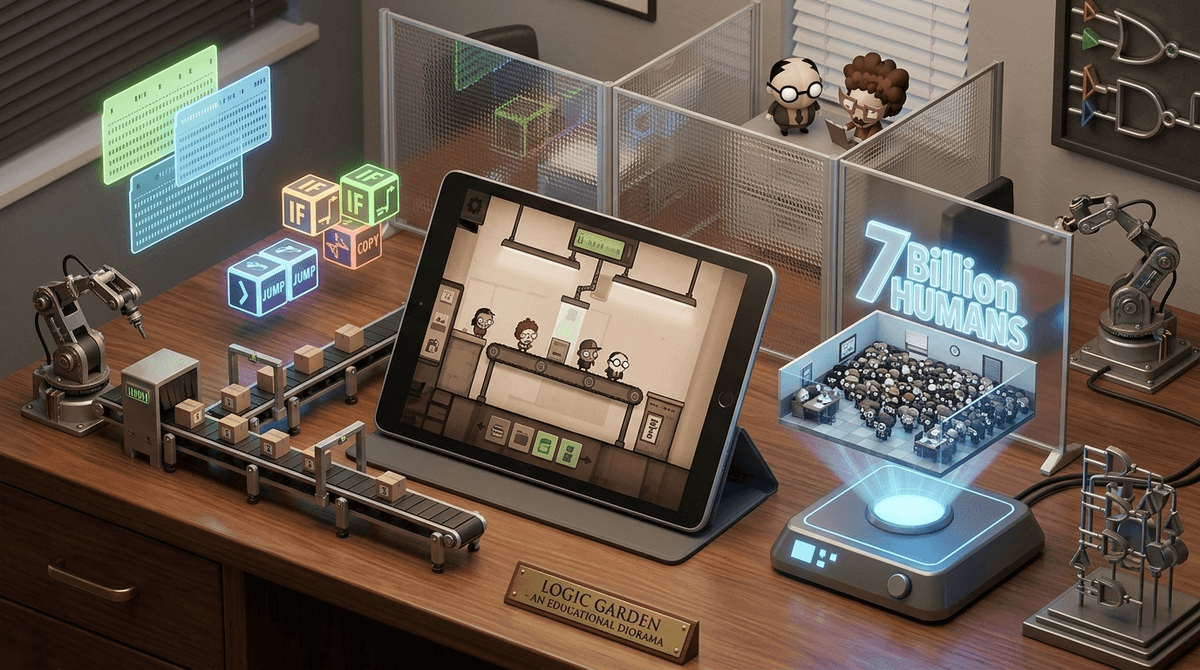
This is one of those rare games that's genuinely educational without feeling like edutainment garbage. Tomorrow Corporation figured out how to make programming fun by wrapping it in quirky visuals and satisfying puzzle design.
The learning curve is real—some kids will hit a wall around level 20 and need encouragement—but the hint system and ability to skip levels keeps it from becoming a frustration fest. It's perfect for the kid who likes to tinker and optimize, or the one who's curious about how computers work but finds traditional coding tutorials boring.
No predatory monetization, no social toxicity, just clean puzzle design that happens to teach computational thinking. At $5-15 depending on platform, it's a steal compared to most 'STEM toys' that cost 10x as much and teach half as much. If your kid shows any interest in logic or coding, this should be in your library.
Age Fit
Best for ages 9-14 who enjoy logic puzzles or have curiosity about coding. Younger kids can play with help; older teens and adults who like programming challenges will also dig it. If your kid loved Human Resource Machine or enjoys games like The Incredible Machine, this is a no-brainer.
WISE Breakdown
Wholesome
88
Cartoon office workers solving puzzles in a satirical but gentle world. No violence, profanity, or mature themes—just quirky humor about bureaucracy and automation. The tone is lighthearted and cooperative, with workers following your commands to achieve goals. Rated E/PEGI 3/9+ across all platforms confirms family-friendly content. The only edge is mild workplace satire that younger kids won't catch.
Imaginative
92
This is visual programming disguised as puzzle-solving—you're essentially writing code to control swarms of workers. The drag-and-drop language teaches loops, conditionals, and parallel execution in creative ways. Each puzzle has multiple solutions, rewarding experimentation and lateral thinking. The concept of a 'parallel computer made of people' is delightfully weird and original. It builds on Human Resource Machine's foundation but expands the creative problem space significantly.
Safe
95
No in-game purchases, no loot boxes, no online chat, no ads. Users can interact locally but there's no social toxicity risk. The hint and skip system prevents frustration loops. No privacy concerns across mobile or PC versions. Content is universally rated for young audiences (E/PEGI 3/9+). The only consideration is cognitive difficulty—puzzles get hard—but that's a feature, not a safety issue. This is as clean as puzzle games get.
Enriching
94
Teaches genuine programming fundamentals—sequencing, loops, conditionals, parallel processing—without feeling like homework. Common Sense Education calls it 'teacher-approved' for computational thinking. The game builds perseverance and systematic problem-solving skills through 60+ levels that scaffold beautifully. It's cognitively demanding in the best way, rewarding optimization and efficiency. Kids who engage with this are learning real logic skills that transfer to coding and beyond.
Parent Info
✓
Why It Might Be Great
Teaches real programming concepts (loops, conditionals, parallel processing) through genuinely fun puzzle gameplay—Common Sense Education labels it 'teacher-approved'
Zero monetization nonsense: no ads, no IAP, no loot boxes, no chat. Just 60+ levels of pure puzzle-solving
Multiple solutions to each puzzle reward creativity and optimization—kids can revisit levels to improve their 'code'
Hint and skip systems prevent rage-quitting, making it accessible even when puzzles get tough
Available everywhere (mobile, PC, Switch) for $5-15, making it easy to play on road trips or at home
⚠
What to Watch For
Difficulty ramps up fast—younger kids (9-10) may need a parent to co-play or talk through the logic
It's a thinking game, not an action game—kids who want fast-paced gameplay will bounce off this
The office/automation satire is gentle but might sail over very young kids' heads (though they won't care)
Conversation Starters
"What's the most efficient solution you found? Could you make it work with fewer commands?"
"If you could program people in real life like this, what would you have them do?"
"Which puzzle made you want to throw your device? What helped you figure it out?"
"Do you think robots will actually take over all our jobs like in the game?"