

TL;DR
- Gaming is the new "Third Place": For 72% of teens, gaming isn't about the high score; it’s the digital equivalent of hanging out at the mall or the local pizza shop.
- Shoulder-to-Shoulder Connection: Teens (especially boys, though girls are catching up fast) often bond better while doing something rather than just talking face-to-face.
- Key Platforms: Roblox, Fortnite, and Minecraft are the heavy hitters, while Discord acts as the "phone line" that stays open for hours.
- Action Step: Shift the conversation from "How much are you playing?" to "Who are you playing with today?"
- Check out our guide on setting healthy gaming boundaries
Back in the day, if you wanted to see your friends on a Tuesday at 7:00 PM, you had to beg for a ride to the mall or spend three hours on a corded landline. Today, our teens just put on a headset.
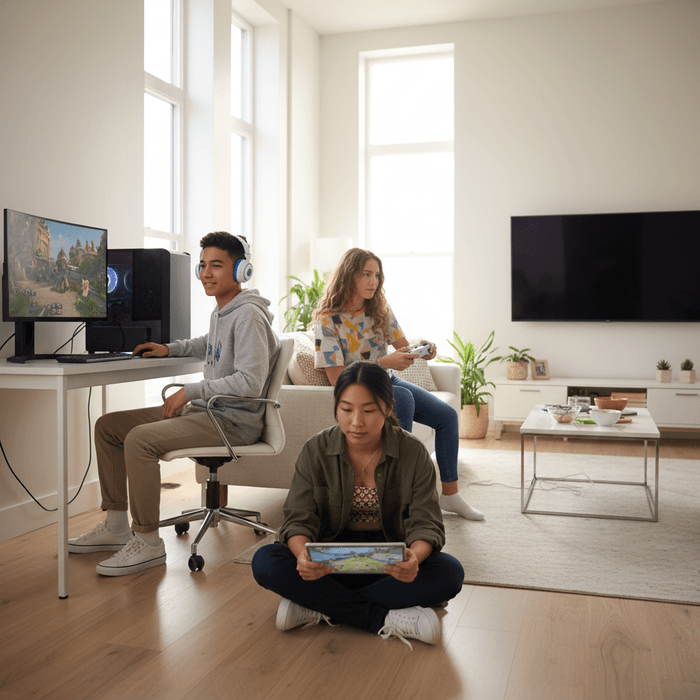
If you see your teen hunched over a controller and think they’re wasting time, you’re missing the forest for the trees. They aren't just "playing a game"—they are participating in their primary social circle. According to recent data, over 70% of teens say they play video games specifically to stay connected with friends they already know in real life.
When your teen says "just five more minutes," they aren't just trying to level up; they’re often in the middle of a conversation. Pulling the plug on the console is the 2026 version of hanging up on your best friend in the middle of a breakup vent. It’s brutal.
There is a concept in psychology called "shoulder-to-shoulder" interaction. While many adults (and often girls) prefer "face-to-face" interaction—sitting across from someone and talking about feelings—many teens find that incredibly high-pressure.
Gaming provides a shared task. Whether they are building a base in Minecraft or trying to survive a round in Lethal Company, the game provides a "buffer." It’s much easier to talk about your stressful math test or that weird thing that happened in the locker room when you’re focused on not getting eliminated by a "sweaty" player in Fortnite.
This isn't "brain rot." It’s collaborative problem solving, digital citizenship, and emotional regulation happening in real-time.
See the benefits of collaborative gaming
Not all games are created equal when it comes to social connection. Here’s a breakdown of the current "neighborhoods" your teen is likely inhabiting:
Fortnite (Ages 10+)
Forget the "Battle Royale" for a second. Fortnite has evolved into a massive social platform. Between "Creative Mode" where they build worlds together and the "Festival" mode (basically Guitar Hero), it’s a place to just be.
- The Social Vibe: It’s high-energy, loud, and full of the latest memes. If your kid is talking about "skibidi" or "rizzing up" their teammates, it probably started here.
Roblox (Ages 8-16)
Roblox is less of a game and more of an infinite arcade. For younger teens, games like Dress to Impress or Adopt Me! are the main draws.
- The Social Vibe: It’s the digital playground. It’s also where they learn the hard lessons about "entrepreneurship" (read: getting scammed for virtual pets or spending your real money on Robux).
- Learn more about how Robux is in fact real money
Minecraft (All Ages)
The "old reliable." Minecraft is the digital LEGO set. It’s where the "architect" friends hang out. Setting up a private server for a group of school friends is one of the safest and most productive ways for teens to bond.
- The Social Vibe: Chill, creative, and project-oriented. It’s like a long-term group project that they actually enjoy.
Discord (Ages 13+)
If the games are the mall, Discord is the basement where everyone hangs out after. It’s a chat app that allows for voice, video, and text. Most teens will have a "server" with just their 5-10 closest friends.
- The Social Vibe: Essential but risky. This is where the real talk happens, but it’s also where unmonitored group chats can get toxic fast.
- Read our full guide on Discord safety
Let’s be real: gaming isn't all sunshine and teamwork. There are real things to watch out for that have nothing to do with "screen time" and everything to do with social health.
1. The "Toxic Lobby" Problem
If your teen is playing "Ranked" matches in games like League of Legends or Call of Duty, they are going to encounter some of the most vile humans on the planet. Random matchmaking is where the "social lifeline" turns into a "social toxic waste dump." Advice: Encourage "party chat" (talking only to friends) rather than "game chat" (talking to everyone in the match).
2. The Cost of Connection
Gaming companies are brilliant at making kids feel like they need the latest "skin" or "emote" to fit in. In 2026, digital fashion is just as important to a 14-year-old as a pair of Nikes was to us. Advice: Set a "digital clothing" budget. It’s not "wasting money" if it’s their allowance, but they need to understand that a $20 skin in Fortnite doesn't actually make them better at the game.
3. The "Always On" Pressure
Because the game is the social hub, there is a massive Fear Of Missing Out (FOMO). If the "squad" is online and your teen isn't, they are missing the jokes, the drama, and the bonding. Advice: Acknowledge this. Don't just say "it's just a game." Say, "I know you don't want to miss out on the hang, but your brain needs sleep to function for that test tomorrow."
Middle School (Ages 11-13)
This is the "Wild West" phase. They are desperate for connection but lack the impulse control to handle toxic players.
- Focus: Private servers and "friends-only" lists.
- Recommended: Among Us for funny, low-stakes mystery solving with friends.
High School (Ages 14-18)
At this point, you’re mostly a consultant. They are likely using Discord and playing more complex games.
- Focus: Balance and mental health. Are they gaming because they enjoy it, or because they’re addicted to the dopamine hit of a win?
- Recommended: Stardew Valley (multiplayer) for a "cozy" social experience that isn't stressful.
- Check out our list of cozy games for teens
If you want to actually get through to your teen, stop asking "When are you getting off?" Try these instead:
- "Who's in the party tonight? Anyone from school?"
- "What’s the goal for the group today? Are you guys building something or competing?"
- "I noticed you sounded pretty frustrated with your teammates earlier. Is everything okay with that group?"
By acknowledging the people behind the screen, you validate their social life rather than dismissing their hobby.
In 2026, gaming is the "New School Mall." It’s where friendships are forged, where school drama is dissected, and where teens feel a sense of belonging. Is it perfect? No. Can it be a time-suck? Absolutely. But if we want to stay connected to our kids, we have to respect the spaces where they connect with each other.
Take our survey to see how your teen's gaming habits compare to your community
- Audit the Audio: Sit in the room while they play with their friends. You’ll learn more about their social standing in 15 minutes of listening to their headset chatter than you will in a week of "How was school?"
- Check the Privacy: Make sure their Discord and console settings are set to "Friends Only" for messages.
- Play a Round: Ask them to teach you how to play. Warning: You will be terrible, they will laugh at you, and it will be the best ten minutes of connection you’ve had all week.