

Games to Play: Finding the Right Fit for Your Family
When you search "games to play," you're probably in one of two situations: either your kid is begging for something new and you need to figure out if it's actually okay, or you're proactively trying to find something that won't make you feel like a terrible parent every time they pick up a controller.
Here's what the data tells us: 55% of families in the Screenwise community are gaming in some form. That's more than half. So if you're navigating this, you're definitely not alone.
The thing is, "games to play" is kind of like asking "what should we eat?" It depends entirely on who's playing, what you're trying to accomplish, and what your family's digital life looks like right now.
Let's start with what kids are actually playing, because chances are you're hearing about these constantly:
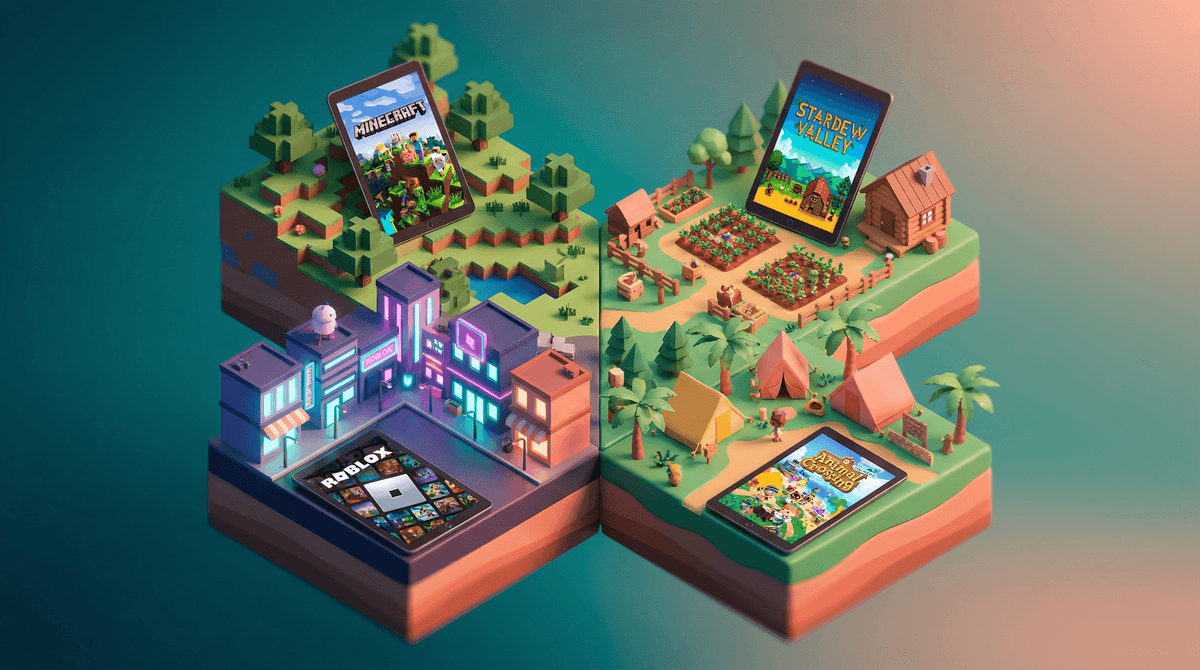
Minecraft is the gateway drug of gaming. Our data shows 40% of families say their kids don't play it at all, 35% play offline, and 25% play on servers. The offline version is genuinely creative—think digital Legos. The server version? That's where things get complicated with chat features and other players. Read our full guide to Minecraft if you're trying to figure out which version makes sense for your family.
Roblox is basically a platform of thousands of mini-games, and 60% of families have kids playing on servers (meaning with other people online). Only 25% aren't playing it at all. It's wildly popular, genuinely has some educational elements around game design and even basic entrepreneurship, but also has legitimate safety concerns around chat and in-game purchases. You absolutely need to set up Roblox parental controls if your kid is playing.
Fortnite is the one that makes parents most nervous. 70% of families aren't playing it at all, which tells you something about how parents feel about it. It's a battle royale shooter (yes, with guns), but it's also cartoonish and has a massive social component. About 20% of families have kids playing it in some form, split between playing with friends only and playing with everyone online.
Ages 5-7: Start with true single-player experiences
At this age, you want games that don't have any online component, period. Think Animal Crossing, Mario Kart (in single-player mode), or Pokémon. These teach basic problem-solving and hand-eye coordination without the chaos of online play.
Ages 8-10: Offline multiplayer and supervised online
This is when Minecraft offline mode becomes huge. Stardew Valley is also fantastic—it's basically a farming simulator that teaches time management and planning. If they're ready for online play, start with heavily moderated environments and always with voice chat off. Splatoon 3 is a great option here—it's a shooter but with paint instead of bullets, and has good built-in safety features.
Ages 11-13: Navigating social gaming
This is when the pressure for Roblox and Fortnite hits hard. If you're going to allow these, you need to be actively involved. That means understanding how Robux actually works , sitting with them while they play initially, and having real conversations about online behavior and safety.
Ages 14+: Teaching digital citizenship
At this point, they're probably going to play what their friends play, and that's developmentally appropriate. Your job shifts from gatekeeper to guide. Games like Valorant, League of Legends, and yes, Fortnite, are where their social lives happen. The question isn't whether they play, but whether you've taught them how to handle toxic behavior, protect their personal information, and maintain balance.
Let's be honest: most "educational games" are either thinly-veiled worksheets or so boring that kids would rather do actual homework. But there are exceptions:
- Kerbal Space Program teaches actual physics and engineering concepts
- Civilization VI is basically a history and strategy masterclass (though it's long and complex)
- Portal 2 is puzzle-solving at its finest
- Duolingo gamifies language learning effectively (even if the owl is aggressive)
But here's the thing: even games that aren't explicitly "educational" teach valuable skills. Problem-solving, collaboration, resource management, spatial reasoning—these all count.
Instead of "is this game good or bad," try these:
- Is this game age-appropriate for the content? (violence, themes, complexity)
- Does it have online interaction with strangers? (and if so, can I control that?)
- What are the in-game purchase mechanics? (is my credit card at risk?)
- Will this fit into our family's screen time boundaries? (some games are designed to be addictive)
- Is this something we could play together? (co-op gaming can be genuinely great family time)
Gaming isn't inherently good or bad—it's a tool, and like any tool, it depends on how it's used. The 55% of families who are gaming aren't all making the same choices, and that's okay.
Your job isn't to find the "perfect" game. It's to find games that fit your family's values, your kid's age and maturity level, and your capacity to stay involved and informed.
If you're feeling overwhelmed, start small: pick one game, learn it with your kid, set clear boundaries around time and money, and adjust as you go.
- Check what your kid's friends are playing and research those specific games
- Explore alternatives to popular games if you're not comfortable with the big names
- Set up parental controls on whatever console or device you're using (yes, before they start playing)
- Consider co-playing at least initially to understand what they're actually experiencing
And remember: the fact that you're reading this means you're already doing the work. That counts for a lot.