

TL;DR
If your toddler acts like they’re going through literal withdrawal when you turn off the TV, you’re likely dealing with the "Cocomelon Crack" effect. Shows like Cocomelon use hyper-fast camera cuts and high-pitched audio to keep tiny brains in a state of constant "orienting reflex," which leads to massive overstimulation and the inevitable post-screen meltdown.
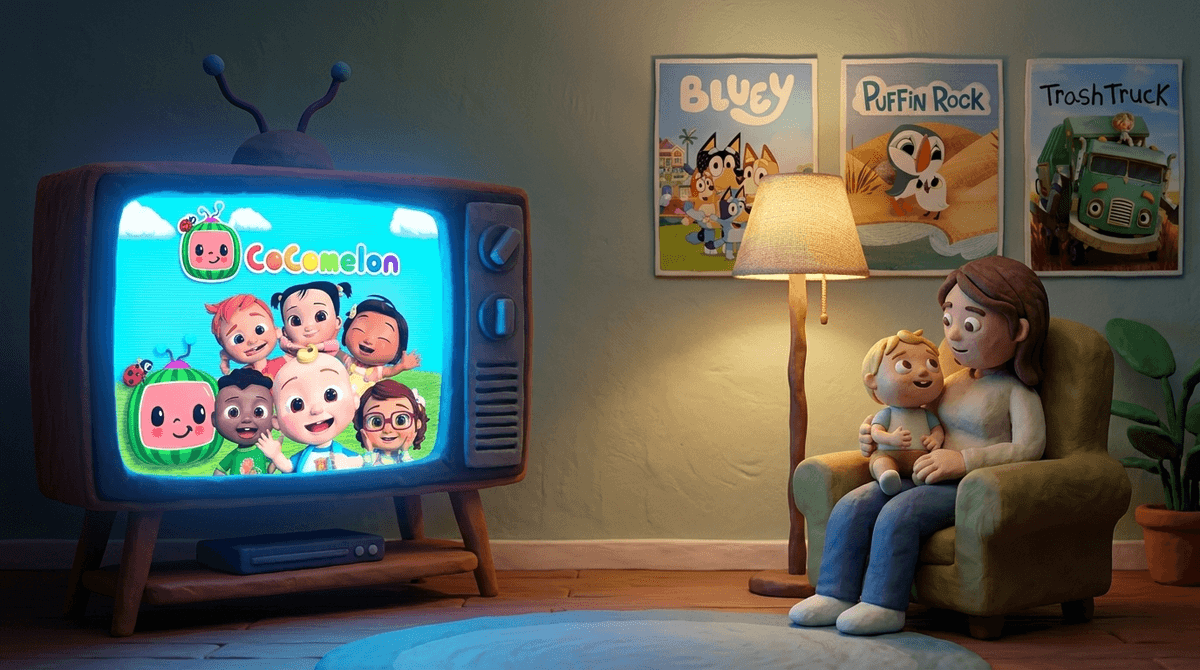
The Quick Fix: Swap the high-speed "digital candy" for "slow-burn" shows like Puffin Rock, Trash Truck, or Bluey.
Get a "low-stim" watchlist based on your kid's favorite characters
We’ve all seen it. That glazed-over, mouth-agape stare. It’s the "Cocomelon Trance."
While Cocomelon might seem like innocent nursery rhymes, it is actually the Ferrari of toddler media—engineered for maximum speed and engagement. When we talk about "overstimulation" in digital content, we aren't just talking about bright colors. We’re talking about the pace of editing.
In a typical episode of Cocomelon, the camera angle changes every 1 to 3 seconds. For a developing brain, every camera cut triggers an "orienting reflex"—a primitive survival instinct that forces the brain to pay attention to a new stimulus. When you do that 60 times a minute, the brain is flooded with dopamine.
It’s not "learning"; it’s a neurological hostage situation.
When the iPad goes dark or the TV turns off, your child isn't just "sad" the show is over. They are experiencing a dopamine crash.
Think of it this way: their brain has been running at 100mph in a neon-colored, high-speed world. When you turn it off, they are suddenly dropped back into a living room where the walls don't move, the cat is just sitting there, and nothing is changing every two seconds. Real life feels agonizingly boring and slow by comparison.
The meltdown is the sound of a nervous system trying to recalibrate from a "hyper-aroused" state back to "baseline."
Learn more about the science of dopamine and toddler screen time
Look, I get it. No judgment here. Cocomelon is the only thing that allows some parents to trim a toddler’s fingernails or finish a cup of coffee while it’s actually hot.
Kids love it because:
- Predictability: The songs are repetitive and familiar.
- Visual Pop: The colors are saturated beyond anything found in nature.
- Constant Novelty: The fast cuts ensure they never have a chance to look away.
Parents use it because:
- The "Zombification" Factor: It is 100% effective at stopping a tantrum in its tracks (even if it causes a bigger one later).
- Accessibility: It’s everywhere—Netflix, YouTube, Hulu. It’s the easiest tool in the shed.
But if you're noticing that your kid is becoming "addicted" or that their behavior is spiraling, it's time to look at low-stimulation media for toddlers.
If you want to end the "Cocomelon Crack" era, you don't have to go "no-screens" (unless you want to!). You just need to lower the "refresh rate" of the content they consume. Look for shows with longer scenes, natural colors, and calmer soundtracks.
Ages 2-5 This is the gold standard of "calm." The animation is beautiful and hand-drawn, the narrator (Chris O'Dowd) has a soothing voice, and the scenes actually breathe. It’s educational without being frantic.
Ages 2-6 A boy and his giant honking trash truck friend. The color palette is muted (lots of greens and browns), the dialogue is gentle, and the pacing mimics real-life play.
Ages 3-99 You already know Bluey. It’s the GOAT. While it’s faster than Puffin Rock, it focuses on imaginative play and emotional intelligence. It doesn't rely on "flashing lights" to keep kids interested; it uses actual storytelling.
Ages 2-5 A direct descendant of Mr. Rogers. It is specifically designed to help kids manage their emotions. If your kid is struggling with the "Cocomelon Meltdown," Daniel Tiger literally has a song for how to handle being mad.
Ages 2-5 Old school but effective. There is often no background music, the characters speak slowly, and the stories are about simple things like making "soup" out of water and sticks. It is the ultimate "low-stim" palate cleanser.
Ages 3-6 Stop-motion animation is naturally slower because of the way it’s filmed. Tumble Leaf is whimsical, visually stunning, and focuses on "figuring things out" rather than just constant noise.
- Under 18 Months: The American Academy of Pediatrics (AAP) still recommends zero screen time (except video chatting). At this age, their brains literally cannot translate what happens on a 2D screen to the 3D world.
- 18-24 Months: If you introduce media, it should be high-quality and "co-viewed." This means you sit there and say, "Look, the Trash Truck is green!" to help them process it.
- Ages 2-5: Limit high-stim content to 30 minutes or less. Focus on educational websites like PBS Kids or Khan Academy Kids which require active interaction rather than passive "zombification."
The biggest danger of Cocomelon isn't the show itself; it’s the YouTube Auto-play.
If you let your kid watch Cocomelon on YouTube, the algorithm will eventually serve them "off-brand" versions or weirder, high-stim content like Skibidi Toilet or those bizarre "Elsagate" style finger family videos.
Pro-tip: If you’re going to let them watch, do it on a platform like Netflix or Disney+ where you have more control over what plays next, or use the YouTube Kids app with strict "Approved Content Only" settings.
You can't just go from Cocomelon to silence without a fight. You need a "bridge."
- The "One More" Rule: Give them a 5-minute and 1-minute warning. Use a physical timer they can see.
- The Visual Bridge: Instead of a show, try Storyline Online, where celebrities read picture books. It's still a screen, but the pacing is much slower.
- The Audio Swap: If they need the "noise," switch to a podcast like Wow in the World. It keeps them entertained without the visual overstimulation.
- The "Active" Screen: Move them toward apps that require "doing" rather than "watching." Khan Academy Kids or Sago Mini World are great for this.
Cocomelon isn't "evil," and you aren't a bad parent for using it. It’s just "digital candy"—fine for a treat, but if it’s the main course, you’re going to deal with a sugar crash.
By shifting toward low-stimulation media, you’re giving your child’s brain the space to develop focus, patience, and the ability to find the "real world" just as interesting as the digital one.
Next Steps:
- Try a "Low-Stim Week." Swap Cocomelon for Puffin Rock and see if the meltdowns decrease. (Spoiler: They usually do).
- Check your family's "Digital Pulse" by taking the Screenwise survey to see how your toddler's screen habits compare to other families in your community.