

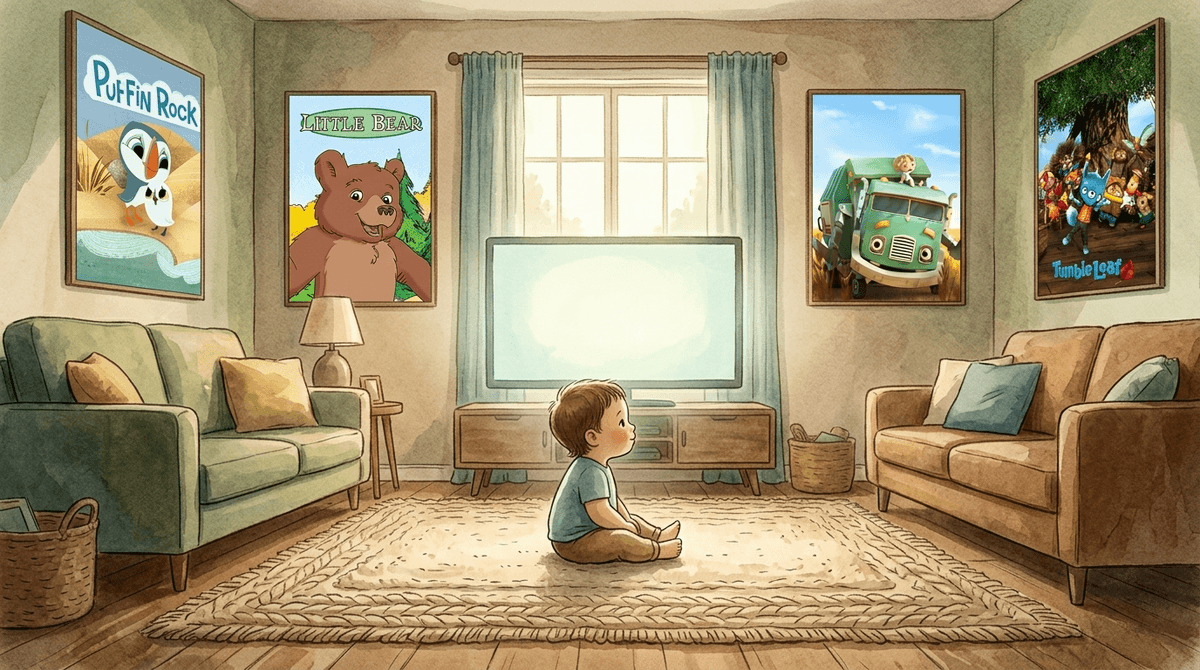
TL;DR: If you’re tired of the post-show tantrums and that eerie, unresponsive "zombie stare" your toddler gets, it’s time to swap the high-octane "digital candy" for low-stimulation content. Our top picks for a calmer living room are Puffin Rock, Trash Truck, and the timeless Little Bear.
We’ve all seen it. You turn on a show to get 15 minutes of peace so you can unload the dishwasher or finally drink a coffee that hasn't been reheated three times. But when the TV goes off, your sweet toddler transforms into a tiny, raging gremlin.
That’s often the result of high-stimulation media.
Low-stimulation shows are the "slow food" of the digital world. They are characterized by:
- Slower pacing: Scenes last longer than three seconds. The camera doesn't jump around like it’s in an action movie trailer.
- Natural color palettes: Think earthy greens, soft blues, and muted tones rather than neon, glowing primary colors.
- Realistic audio: No constant, high-pitched sound effects, jarring transitions, or "Mickey Mouse" voices that grate on your nerves.
- Gentle storylines: The "conflict" is usually something like "we lost a mitten" rather than "the world is ending and we must dance-battle a robot."
When a child is watching something like Cocomelon, their brain is being bombarded with rapid-fire scene changes and hits of dopamine. It’s effectively "digital candy." Their eyes lock on, their mouth hangs open, and they become unresponsive to their environment. This is the Zombie Stare.
The problem isn't just the 20 minutes they spent watching; it's the dopamine crash that happens the second you turn it off. Their brain was running at 100mph, and suddenly the real world—which is much slower and less colorful—feels boring and frustrating. Hence, the meltdown.
Low-stimulation shows allow the brain to process information in real-time. They encourage observation rather than just passive absorption.
Find low-stim shows based on your kid's interests
If you’re looking to overhaul your toddler’s queue, these are the gold standards. These shows are developmentally appropriate, visually soothing, and—blessedly—not annoying for parents to have on in the background.
Ages 2-5 This is arguably the peak of low-stim programming. Narrated by Chris O'Dowd, it follows a young puffin named Oona and her little brother Baba. The colors are gorgeous watercolors, the music is soft Irish folk, and the pacing is incredibly gentle. It teaches biology and nature without being "educational" in that loud, repetitive way. It’s the visual equivalent of a warm blanket.
Ages 2-5 If you have a kid obsessed with vehicles, skip the high-energy truck shows and go straight to Trash Truck. It’s about a boy, his giant trash truck best friend, and their animal pals. The color palette is muted, the dialogue is thoughtful, and the episodes often revolve around simple concepts like learning to whistle or going to the movies. It’s incredibly sweet and grounded.
Ages 3-6 This stop-motion masterpiece is visually stunning. Because it’s stop-motion, it has a tactile, "real-world" feel that CGI often lacks. Fig the Fox discovers an object in a "finding place" and explores how it works (physics, shadows, reflections). It’s slow, curious, and encourages kids to go play with actual sticks and rocks afterward.
Ages 2-6 Based on the classic book The Snowy Day by Ezra Jack Keats, this animated special is a vibe. It captures the quiet, muffled feeling of a snow day perfectly. It’s a one-off movie/special rather than a series, but it’s a perfect introduction to longer-form, low-stim content.
Ages 2-5 A classic for a reason. Based on the books illustrated by Maurice Sendak, Little Bear features no villains, no loud noises, and no frantic movements. The relationship between Little Bear and Mother Bear is a beautiful model of secure attachment. It’s old-school in the best way possible.
Ages 3-7 Apple TV+ did a fantastic job bringing the Frog and Toad series to life. It maintains the "cozy" feeling of the books. The stakes are low—like, "we ate too many cookies" low—and the friendship is sincere. It’s a great pick for older toddlers who need a bit more narrative but still struggle with high-stim shows.
Not every show has to be a watercolor painting of a puffin. There are "mid-stimulation" shows that are generally great but might be a bit much for some kids depending on their sensory threshold.
Ages 3+ Look, we love Bluey. It’s the best written show on television, full stop. However, it is mid-stim. The colors are bright, the music is upbeat, and the energy can be very high. Some parents find that their kids get "wound up" after Bluey because they want to play the high-energy games they just saw. If your kid is sensitive, save Bluey for earlier in the day rather than right before bed.
Ages 2-4 The spiritual successor to Mister Rogers' Neighborhood. It’s excellent for social-emotional learning. It’s a bit more repetitive and "bright" than Puffin Rock, but it still maintains a respectful pace.
Check out our guide on the best PBS Kids shows for emotional intelligence
If you are trying to reduce the "zombie stare," you might want to limit or cut out these shows entirely. No judgment—sometimes you’re on a 6-hour flight and Blippi is the only thing keeping the peace—but for daily life, these are the heavy hitters of overstimulation.
- Cocomelon: The poster child for overstimulation. The camera cuts every 1-3 seconds, the colors are hyper-saturated, and the music is designed to be addictive.
- Blippi: High-pitched, loud, and frenetic. It’s like a human version of a fidget spinner.
- Paw Patrol: While popular, it’s essentially an action show for toddlers. Lots of sirens, flashing lights, and "emergency" vibes.
- Spidey and His Amazing Friends: Very fast-paced with lots of flashing effects. Great for older kids, but often too much for the under-3 crowd.
A quick "cheat sheet" when you’re browsing for new shows: Look for 2D animation.
While not a hard-and-fast rule, 2D animation (like Puffin Rock or Little Bear) is often naturally lower-stimulation than 3D CGI. 3D animation allows for more "camera" movement—zooming, panning, and spinning—which is exactly what triggers that dizzying, overstimulated feeling in a developing brain.
If a show looks like it was painted or drawn in a book, it’s usually a safer bet than something that looks like a plastic toy come to life.
If your kid is used to the high-stim stuff, switching to Trash Truck might result in some initial "this is boring" complaints. Here’s how to handle the transition:
- Don't do it cold turkey: Start by mixing in one "slow" show for every "fast" show.
- Watch together: Low-stim shows are often more "boring" to kids because they require more focus. Sitting with them and pointing things out ("Look at the little crab!") helps them engage.
- The "Bridge" Show: Use Bluey or Daniel Tiger's Neighborhood as a bridge between the hyper-fast stuff and the truly calm stuff.
- Audio-only: If they just need the background noise, try a podcast like Wow in the World or Circle Round. It gives their eyes a break entirely.
Learn more about the benefits of audio-only stories for toddlers
Screen time isn't the enemy, but quality matters. We wouldn't feed our kids Pixy Stix for lunch and expect them not to have a sugar crash; we shouldn't expect them to watch Cocomelon and then calmly transition to nap time.
By choosing low-stimulation shows, you’re giving your child’s brain a chance to rest, observe, and learn at a human pace. You’ll get your 15 minutes of peace, and they’ll get to keep their sanity when the "off" button eventually gets pushed.
Next Steps:
- Audit your "Continue Watching" list on Netflix.
- Try one episode of Puffin Rock today.
- Check out our guide on setting up a "Calm Tech" profile on your TV