

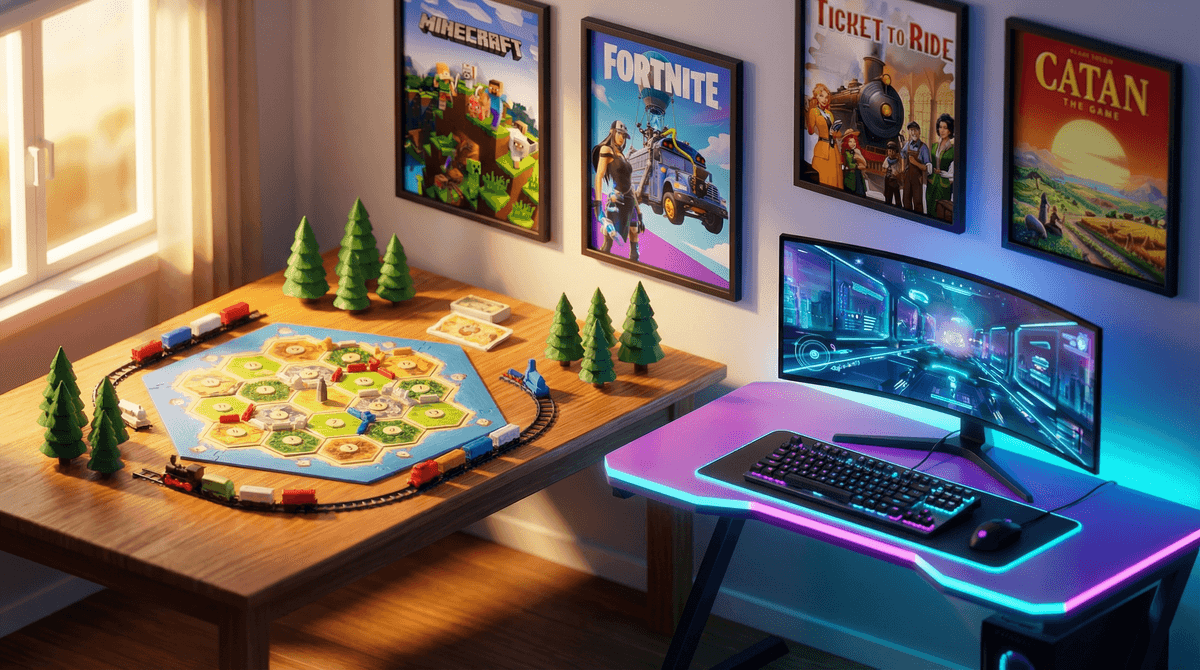
Here's something I wish I'd realized earlier: that copy of Catan gathering dust on your shelf? It's basically teaching the same resource management skills as Minecraft. And Ticket to Ride? That's strategic planning just like Fortnite, minus the battle royale chaos.
Board games that map to video games are tabletop experiences that share core mechanics, strategic thinking, or gameplay loops with popular digital games. They're not replacements for screen time (let's be real, your kid isn't going to think Monopoly is the same as Roblox). But they ARE incredible tools for understanding what your kids are actually doing when they're gaming, and for having real conversations about game mechanics, strategy, and decision-making.
When my 9-year-old asked for Among Us, I had no frame of reference. Was this appropriate? Educational? Total brain rot? Then we played The Resistance at a friend's game night, and suddenly I got it. The social deduction, the lying, the group dynamics—it all clicked.
Board games give you a shared language with your kids about gaming. When you understand that Splendor and Clash of Clans both revolve around resource optimization, you can have actual conversations about strategy instead of just asking "are you winning?"
Plus, research shows that understanding game mechanics helps parents make better decisions about screen time. You're not just saying yes or no to a game—you're evaluating whether the strategic thinking involved aligns with your family's values.
For the Minecraft Obsessed
Try: Catan (Ages 10+) or Kingdomino (Ages 8+)
Both games are about resource gathering, building, and strategic planning. Kingdomino especially feels like placing blocks in creative mode—you're literally building a kingdom tile by tile. The difference? You can see the whole board, which makes it easier to discuss strategy and planning.
If your kid loves Stardew Valley, try Agricola (Ages 12+). Same farming optimization, same "just one more turn" energy.
For the Battle Royale Players
Try: King of Tokyo (Ages 8+) or Survive: Escape from Atlantis (Ages 8+)
These capture the "last one standing" energy of Fortnite without the shooting. King of Tokyo has the same risk/reward decision-making—do you go for points or damage? Do you stay in Tokyo or bail? Kids who love battle royales already understand these trade-offs.
For the Roblox Entrepreneurs
Try: Monopoly Deal (Ages 8+) or Machi Koro (Ages 8+)
If your kid is running a virtual business in Roblox or trading items in Adopt Me, they're already thinking about economics. Machi Koro makes that visible—you're literally building a city and managing income. And yes, you can talk about whether those Robux purchases are actually investments or just spending .
.
For the Social Gamers
Try: Codenames (Ages 10+) or Wavelength (Ages 10+)
Kids who love Among Us, Discord gaming, or any multiplayer game are craving social interaction through games. These party games capture that same energy—you're reading people, communicating under constraints, and laughing together.
For the Puzzle Solvers
Try: Azul (Ages 8+) or Blokus (Ages 7+)
Kids who get absorbed in Portal 2 or The Legend of Zelda are spatial thinkers. Azul and Blokus scratch that same itch—pattern recognition, planning ahead, and that satisfying click when everything fits.
This isn't about replacing screen time. I'm not going to tell you that board games are "better" than video games (though they do force eye contact and turn-taking, which, let's be honest, is sometimes nice). This is about building bridges.
Start with their interests. If your kid loves Pokemon, try the Pokemon Trading Card Game. If they're into Mario Kart, there's literally a Mario Kart board game. Meet them where they are.
Use board games as research. Before saying yes to a new video game, find a board game with similar mechanics. If your 7-year-old wants Splatoon, play a few rounds of Splat! to see how they handle competitive territory control.
The magic is in the conversation. When you're both looking at the same board, you can ask questions: "Why did you make that choice?" "What's your strategy?" "How are you feeling about your chances?" These same questions work for video games, but it's easier to learn the language at a table.
Ages 5-7: Outfoxed, Rhino Hero, Kingdomino These build logic and planning skills that transfer to early gaming.
Ages 8-10: Sushi Go Party, Ticket to Ride, King of Tokyo Gateway games that introduce resource management and strategic thinking.
Ages 11+: Catan, Azul, 7 Wonders Complex strategy that mirrors the decision-making in teen-favorite games.
Board games won't replace video games in your house (and that's okay!). But they give you a shared vocabulary for talking about games, strategy, and decision-making. They let you see how your kid thinks through challenges. And honestly? They're a sneaky way to learn what the heck is actually happening in Roblox without having to figure out how to move your avatar.
This week: Pick one board game that maps to a video game your kid already loves. See board games similar to specific video games your kid plays.
This month: Have a "board game before screen game" experiment—play the analog version, then the digital one, and compare notes. What's different? What's the same? What does your kid prefer and why?
Long-term: Build a collection of bridge games that help you evaluate new digital requests. When your kid asks for a new game, you'll have the framework to understand what they're actually asking for.
And remember: you don't need to become a board game expert or a gaming guru. You just need to be curious about what your kid loves and willing to learn alongside them. That's the whole point.