

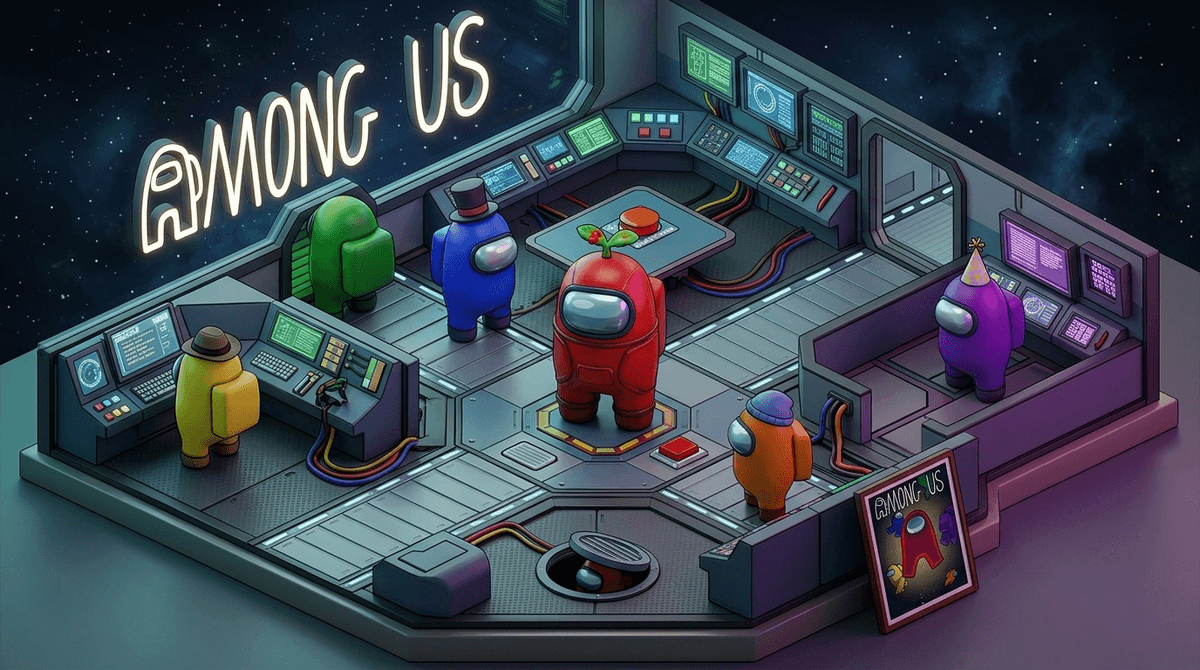
TL;DR: Among Us is a "social deduction" game that is basically a digital version of the classic party game Mafia or Clue. It’s generally safe for ages 10+ if you stick to private lobbies with friends. The main risks are the unmoderated public chat and the "sus" behavior of strangers. On the plus side, it actually teaches kids how to build an argument and spot a lie.
Quick Links for the Multi-Tasking Parent:
If you’ve heard your kid screaming "Red is sus!" or "I saw him vent!" from the other room, you’re officially living in the Among Us era.
At its core, the game is simple. Between 4 and 15 players are on a spaceship (or a base). Most are Crewmates trying to complete simple mini-games (tasks) like fixing wiring or emptying trash. However, one or more players are Impostors.
The Impostors' goal is to sabotage the ship and "kill" the Crewmates without getting caught. When a body is found or someone calls an "Emergency Meeting," the game pauses, and everyone enters a chat room to debate who the killer is. They then vote to kick someone off the ship. If they kick the Impostor, they win. If they kick an innocent Crewmate, the game continues.
It’s high-stakes hide-and-seek mixed with a courtroom drama.
It’s not just about the gameplay; it’s about the social engineering.
Kids love the thrill of being the "bad guy" in a controlled, low-stakes environment. Being the Impostor requires a level of stealth and poker-faced lying that is incredibly satisfying for a 12-year-old.
But more than that, it’s a social hub. In a world where kids are often talking through Discord or Roblox, Among Us provides a structured way to hang out. It’s the "water cooler" of the middle school digital world. They aren't just playing a game; they are performing for their friends.
Also, the character designs (the "beans") are cute, customizable, and have become a massive part of internet culture—right up there with Minecraft creepers.
The game itself is ESRB rated E10+ (Everyone 10 and up) for "Fantasy Violence" and "Mild Blood." When a character is killed, there’s a quick cartoon animation—think a laser beam or a little knife—and the body is just a bean cut in half with a bone sticking out. It’s very "Looney Tunes," not "Slasher Film."
The real concern isn't the cartoon violence; it’s the Public Lobbies.
Public vs. Private Lobbies
When your kid plays in a Private Lobby, they are playing with people they know (friends from school, cousins, etc.). This is the gold standard for safety.
When they join a Public Lobby, they are playing with strangers. This is where things can get "Ohio" (weird/cringe) or worse. Because the game relies on chat, public rooms can quickly become toxic. People use slurs, talk about inappropriate topics, or try to "online date."
Quick Chat vs. Free Chat
InnerSloth (the developer) introduced a "Quick Chat" feature. This allows players to only use pre-written phrases (e.g., "Where?", "I was in Medbay," "It was Blue"). If you set your kid’s account to under 13, they are locked into Quick Chat. This is a fantastic safety feature because it completely eliminates the ability for strangers to type inappropriate messages to them.
I’m going to say something controversial: Among Us is actually great for the brain.
While some parents see it as "teaching kids to lie," I see it as teaching critical thinking and rhetoric. To survive a round of Among Us, a kid has to:
- Observe Data: "I saw Green go into Navigation, but the lights went out two seconds later."
- Formulate an Argument: "It couldn't have been me because I was doing the Simon Says task in Reactor."
- Detect Deception: "Why is Yellow being so quiet? Usually, they talk a lot."
- Collaborate: Working with other Crewmates to verify "alibis."
In an age of "fake news" and deepfakes, learning how to question a narrative and look for holes in a story is a genuine life skill. They are essentially practicing the Socratic method, just with more space-beans.
Ages 7-9: The "No Free Chat" Zone
At this age, the logic of the game might be a bit much, but they love the hats and the "hide and seek" aspect. Verdict: Only play in private lobbies with family or very close friends. Ensure "Quick Chat" is the only option. Monitor the screen because the "Emergency Meetings" can get loud and stressful.
Ages 10-12: The Sweet Spot
This is the core demographic. They understand the strategy and the social nuances. Verdict: This is a great age for Among Us. Encourage them to play with their school friends. This is also a good time to talk about "Digital Citizenship"—remind them that being an Impostor is a game, but being a jerk in the chat is real-life behavior.
Ages 13+: The Wild West
Teens will likely want to use Discord to talk while they play. This makes the game 10x more fun but also 10x more distracting. Verdict: Fine for this age, but keep an eye on the Discord servers they are joining.
Check out our guide on the best Discord safety settings for teens
- The "One More Game" Trap: Rounds are short (5-15 minutes), which makes it very easy for "just one more" to turn into two hours. It’s the "TikTok-ification" of gaming.
- The Chat is the Problem: The game isn't toxic. People are toxic. If your kid is playing with strangers, they will eventually see a swear word or a "sus" username. It’s unavoidable in public lobbies.
- Microtransactions: There are "Stars" (in-game currency) used to buy skins, pets, and hats. It’s not as predatory as Roblox or Fortnite, but those "mini crewmate" pets are hard for kids to resist.
If your kid loves Among Us and you want to branch out (or get them off the screen), try these:
This is a brilliant board game about secret agents and word association. It requires the same "read the room" energy as Among Us but involves much more vocabulary building.
The OG social deduction game. No screens required. It’s perfect for sleepovers or family game nights. One person is the narrator, and everyone else is a villager or a werewolf.
If they are bored of Among Us, this is the main competitor. It’s very similar but with more complex roles (like a "Dodo" who wins if they get voted off). Note: It’s a bit more "chaotic" and the community can be even more unfiltered than Among Us.
If you have older teens (14+), this reality show is literally "Among Us: The Human Edition." It’s a great way to watch the mechanics of social deduction play out in real life and talk about how people manipulate others.
Among Us is a rare bird in the gaming world: it’s popular, it’s actually fun, and it isn't "brain rot." It’s a game of wits.
If you can keep your kid out of the public chat rooms and in private lobbies with their real-life friends, it’s one of the better ways they can spend their screen time. It’s certainly better than watching 40 consecutive hours of Skibidi Toilet on YouTube.
Just don't be surprised if they start questioning your "alibi" when you say you didn't eat the last cookie. They're just practicing their skills.
- Check the stats: See what percentage of kids in your grade are playing Among Us

- Set the boundaries: Sit down with your kid and create a "Private Lobby Only" rule for the first month.
- Play a round: Seriously. Ask them to show you how to do a task. You’ll see very quickly why they’re hooked.
Get a script on how to talk to your kid about sus behavior online