

TL;DR: Blokus is the rare "perfect" board game that bridges the gap between the addictive spatial satisfaction of Tetris and the high-stakes strategy of Chess. It takes less than a minute to learn, about 20 minutes to play, and builds genuine STEM skills without your kids feeling like they’re "learning." It is the ultimate antidote to "brain rot" content and a great way to reclaim the dining room table from the digital void.
Quick Links:
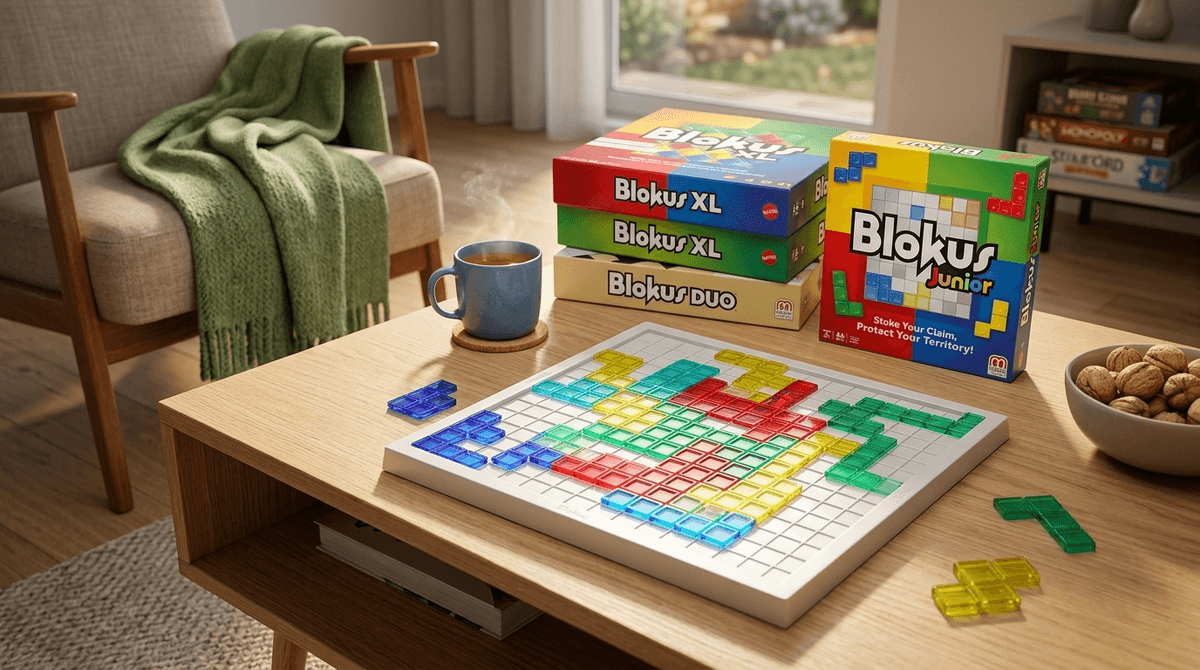
If you haven’t seen it, Blokus looks like a neon-colored geometric puzzle exploded on a white plastic grid. The game consists of 84 pieces (21 for each of the four colors: blue, yellow, red, and green). These pieces are "polyominoes"—shapes made of small squares joined together, exactly like the pieces in Tetris.
The rules are refreshingly simple. In fact, there is really only one rule: Your pieces must touch at least one other piece of your color, but only at the corners. They can never touch flat side to flat side with your own color. (They can, however, touch your opponents' pieces in any way.)
The goal? Get as many of your pieces onto the board as possible. The player with the fewest squares remaining at the end wins. It sounds peaceful, but by the middle of the game, it becomes a cutthroat battle for territory where you’re desperately trying to sneak a tiny 1-square piece through a gap to block your spouse from dumping their giant 5-square "L" piece.
In a world where kids are constantly overstimulated by the "skibidi" chaos of YouTube or the dopamine loops of Roblox, Blokus offers a different kind of engagement.
Kids love it because it’s tactile. The pieces are made of a translucent, jewel-toned plastic that is strangely satisfying to handle. It feels like playing a video game in physical space. There’s no waiting for a 10GB update, no "Ohio" memes popping up in the chat, and no one is asking for your credit card to buy "skins."
Parents love it because it’s a "level playing field" game. Unlike some strategy games where an adult’s advanced logic will crush a child every time, Blokus is visual. An 8-year-old with good spatial awareness can—and will—absolutely wreck you. It’s also one of the few games that actually supports exactly four players perfectly, making it the "Goldilocks" choice for family game night.

We talk a lot about "educational" apps, but Blokus is a masterclass in spatial reasoning. Research consistently shows that spatial skills—the ability to mentally manipulate 2D and 3D objects—are a massive predictor of success in STEM fields (Science, Technology, Engineering, and Math).
When a kid plays Blokus, they are doing high-level mental rotations. They are looking at a piece in their hand, flipping it mentally, and trying to see if it fits into a jagged opening on the other side of the board. This is the same part of the brain used in:
- Architecture and Engineering: Understanding how parts fit into a whole.
- Coding: Visualizing the structure of a program (similar to what they do on Scratch).
- Geometry: Recognizing symmetry and area.
It’s basically a workout for the parietal lobe, disguised as a colorful game.
If your kid is obsessed with Minecraft, they will likely gravitate toward Blokus. Both games rely on the "blocky" aesthetic and the satisfaction of building/filling space.
However, Blokus offers something Minecraft often lacks: forced social interaction and immediate consequence. In a digital game, if you mess up, you can often just respawn or undo. In Blokus, if you play your 5-square piece too early and get blocked, you have to live with that decision for the next 15 minutes. It teaches "forward-thinking" in a way that is tangible.
Ages 7+ This is the standard 4-player version. It is the best value and the most versatile. Even if you only have two players, you can play by each person controlling two colors. It’s the "OG" for a reason.
Ages 7+ Specifically designed for two players. The board is smaller, and the game is much tighter and more aggressive. If you find yourself playing 1-on-1 with a child or spouse frequently, this version is actually better than the original because the board balance is tuned for two.
Ages 5-7 If you have a younger child who wants to join in but gets frustrated by the complex blocking strategies of the adults, this is a great "on-ramp." It uses a smaller grid and simpler shapes to help them understand the corner-to-corner rule without the "mean" strategy of the full game.
Ages 8+ If your kids love the geometric vibe of Blokus, they might also like the tabletop version of Tetris. It’s more about speed and matching than territory control, but it hits the same spatial reasoning notes.
While the box says "7 and up," Blokus is actually one of the most age-flexible games out there.
- Ages 4-6: They likely won't understand the strategy of blocking others, but they will love treating the board like a puzzle. You can play "Collaborative Blokus" where you just try to fit all the pieces onto the board together. Safety Note: The smallest pieces (the 1x1 squares) are definitely a choking hazard for toddlers, so keep this one away from the "mouth everything" phase.
- Ages 7-10: This is the sweet spot. They will understand the rules and start to develop "defensive" play. This is a great age to teach them to save their smallest pieces for the end of the game (the "pro" move).
- Ages 11-14: Expect things to get "sweaty." Middle schoolers love the "I’m not winning, but I’m making sure you don't win" aspect of the game. It’s a great way to bond with a tween who might otherwise be retreating into their phone.
1. It Can Get Competitive (In a "Mean" Way)
Blokus is a game of exclusion. To win, you often have to actively block someone else from placing their pieces. For some sensitive kids, this can feel like a personal attack. It’s a good opportunity to talk about "gamesmanship" and how blocking is a mechanic, not a "mean" move.
2. The "Clean-Up" Factor
There are 84 pieces. If you lose the tiny 1-square yellow piece, the game is still playable, but it will haunt your perfectionist soul. We recommend a Ziploc bag for each color inside the box. Don't rely on the plastic insert; the pieces will inevitably slide out and end up under the couch.
3. It’s a Great "Transition" Game
If you’re trying to move your family away from a heavy screen-time habit, Blokus is a great "gateway drug" to the world of hobby board gaming. It’s faster than Monopoly and less complex than Catan.
Check out our guide on transitioning from screens to board games
Instead of saying, "Let's play this because it's good for your brain," try these angles:
- "I bet I can block you before you get your big pieces down." (Challenges their competitive side).
- "This is basically 4-player competitive Tetris." (Relates it to something they already know).
- "Let's see if we can actually get every single piece on the board tonight." (Frame it as a family goal).
Blokus is a must-own for any intentional parent's game closet. It’s inexpensive, it never goes out of style, and it provides a genuine "analog" high that mirrors the best parts of digital gaming without any of the "brain rot" downsides. It’s a 10/10 for spatial development and a 10/10 for family fun.
- Pick up a copy of Blokus (or Blokus Duo if it's just you and one kid).
- Schedule a 20-minute window after dinner—since the game is fast, it’s easy to squeeze in before homework or bedtime.
- Watch a 2-minute "How to Play" video on YouTube if you’re visual, but honestly, you can just read the one-page manual in thirty seconds.
- Explore other "logic" games like Codenames or Ticket to Ride if your family catches the board game bug.