

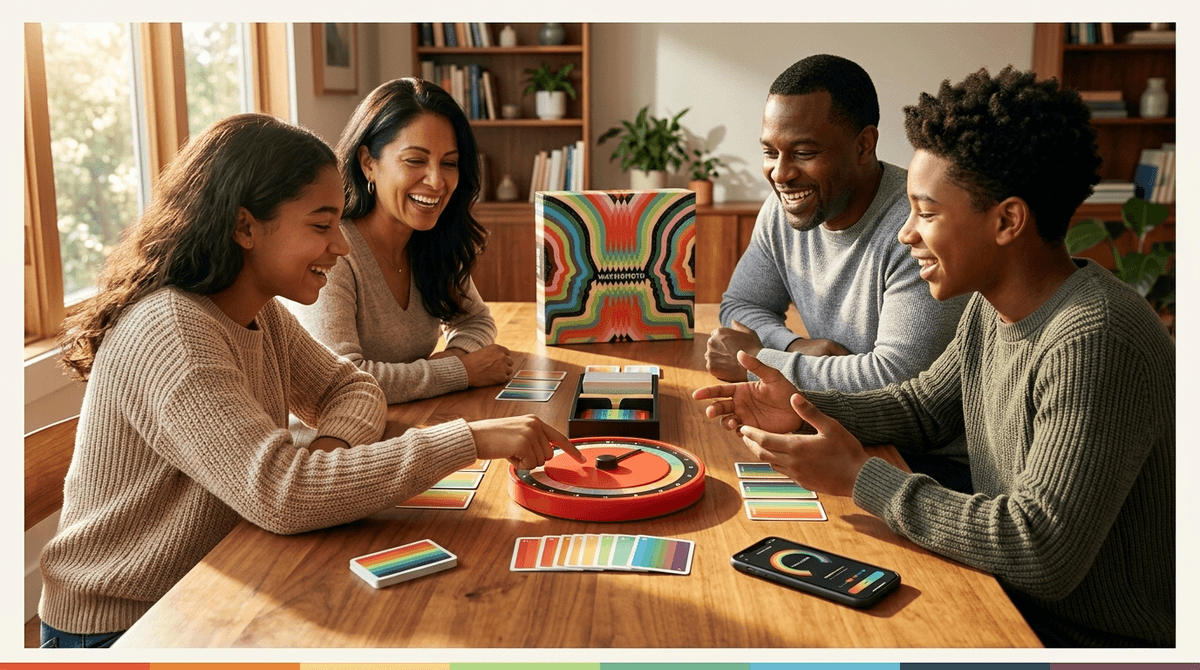
TL;DR: Wavelength is a social guessing game that uses a spectrum to help people get on the same "wavelength." It’s one of the rare apps that actually encourages eye contact and deep conversation rather than mindless scrolling. If you want something for the dinner table or a long car ride that isn't Roblox or TikTok, this is it.
Quick Links:
- Wavelength (App) - Best for car rides and portability.
- Wavelength (Board Game) - The physical version with a very satisfying plastic dial.
- Codenames - A similar "vibe-based" deduction game.
- Heads Up! - The classic Ellen-approved party app.
We’ve all been there: you’re sitting at a restaurant or in the living room, and your kid is giving you one-word answers while their brain is halfway inside a Skibidi Toilet YouTube rabbit hole. You want to connect, but asking "How was school?" feels like pulling teeth from a very uncooperative shark.
Enter Wavelength.
Originally a hit boardgame, the app version has become a staple for intentional parents because it does something almost no other "digital" activity does: it forces kids to think about how you think. It’s a "social deduction" game, but instead of lying about being a murderer like in Among Us, you’re trying to figure out where your mom’s "vibe" sits on a scale from "Trashy" to "Classy."
The concept is dead simple. You’re presented with a spectrum—two opposites. For example: Hot vs. Cold, Useless vs. Useful, or Forbidden vs. Encouraged.
One person (the "Psychic") sees where a target is hidden on that spectrum. Let's say the spectrum is Quiet vs. Loud and the target is about 80% of the way toward "Loud." The Psychic has to give a one-word clue to guide the rest of the team to that exact spot.
If the Psychic says "A Rock Concert," the team might move the dial to 100% Loud. If they say "A Vacuum Cleaner," the team might guess 70%. The goal is to get as close to the Psychic's target as possible.
It sounds basic, but when the prompt is "Basic vs. Hipster" and your 13-year-old says "Starbucks," you’re going to have a 10-minute debate about whether Starbucks is actually "Ohio" (weird/cringe) or just "mid" (average).
Kids, especially the 10-15 age bracket, are currently obsessed with "vibes" and social signaling. They spend a massive amount of time on Discord and Instagram trying to decode what’s cool and what’s not.
Wavelength gamifies that exact social instinct. It’s not a trivia game where they feel dumb for not knowing who the Vice President is. It’s a game where their opinion on whether a Nintendo Switch is a "toy" or a "tool" is the entire point of the game.
It’s low-stakes, high-engagement, and it lacks the "brain rot" quality of infinite-scroll apps. There’s no winning items, no Robux to buy, and no "leveling up." The reward is simply the "Aha!" moment when you realize you and your kid are totally in sync.
We talk a lot about "screen time" as a monolith, but there’s a massive difference between a kid isolated in their room playing Fortnite for six hours and a family passing a phone around to play a round of Wavelength.
This is what researchers call "Co-viewing" or "Co-playing." When you use technology as a bridge rather than a barrier, the negative effects of screens (isolation, dopamine loops, sedentary behavior) are significantly mitigated.
Wavelength uses the screen as a prompt for face-to-face interaction. You aren't looking at the phone; you're looking at your daughter, trying to figure out why on earth she thinks "Ketchup" is a "Smoothie." (Yes, that is a real debate we’ve had).
Which one should you get? Honestly, both have their place.
The App
- Pros: It’s free to download and try. It’s portable (perfect for the "are we there yet?" phase of a road trip). It handles all the scoring for you.
- Cons: It’s on a phone, which means notifications might pop up and distract you. Some of the themed "packs" (like the "Adult" or "Deep Thoughts" packs) cost a few bucks.
- Best for: Restaurants, cars, waiting rooms.
The Board Game
- Pros: The physical "dial" is one of the most satisfying components in modern gaming. It’s a big, plastic wheel with a physical shutter. There’s something tactile and "event-like" about bringing it to the table.
- Cons: It’s bulky. You can’t exactly play it in a booth at Chili’s.
- Best for: Dedicated family game nights.
Check out our full guide on the best board games for tech-heavy families
Recommended Age: 10+
While the app is rated 4+ in the App Store, the nuance required makes it better for older kids. An 8-year-old can play, but they might struggle with abstract concepts like "Stationary vs. Mobile" or "Ethical vs. Unethical."
A note on the "Adult" packs: The Wavelength app has various card packs. The standard pack is totally family-friendly. However, there is an "Adult" pack that includes more suggestive or mature prompts. If you’re letting your kid host a game with their friends on their own device, just make sure they haven't toggled on the "spicy" settings.
Here’s the thing: Wavelength isn't going to teach your kid coding like Scratch or math like Prodigy. It’s not "educational" in the traditional sense.
But it is a masterclass in Empathy.
To win, you have to step out of your own head. You have to think, "If I say 'The Sun' for the spectrum Small vs. Large, will my dad think that's a 10 (the biggest thing ever) or a 7 (because he's thinking about galaxies)?"
In a world where kids are increasingly siloed into their own algorithmic bubbles, any tool that forces them to model someone else's perspective is a massive win.
If you want to use Wavelength as a conversation starter, wait for a "miss."
When the clue was "A Penguin" for Useless vs. Useful and you guessed "Useless" but your kid meant "Useful" (because they're cute!), don't just move to the next round. Ask: "Wait, why are penguins useful to you?"
You’ll learn more about your kid’s internal logic in five minutes of Wavelength than you will in a week of "How was your day?"
Learn more about how to have better conversations with your teens about tech
Wavelength is a rare 10/10 in the digital wellness world. It’s fun, it’s clean, it’s social, and it actually makes you feel better after playing it rather than drained.
If you’re looking for a way to reclaim the dinner table or make a flight go by faster without everyone retreating into their own private screens, download the app or buy the boardgame. It’s the best $0 to $35 you’ll spend on "entertainment" this year.
- Download the app and play a "pass and play" round tonight after dinner.
- Check the settings to ensure "Adult" content packs are turned off if you're playing with younger kids.
- If they love it, consider moving to the physical boardgame for your next family gathering.
- Explore similar games like Heads Up! or Psych! if you want to keep the "phones-as-party-tools" vibe going.