

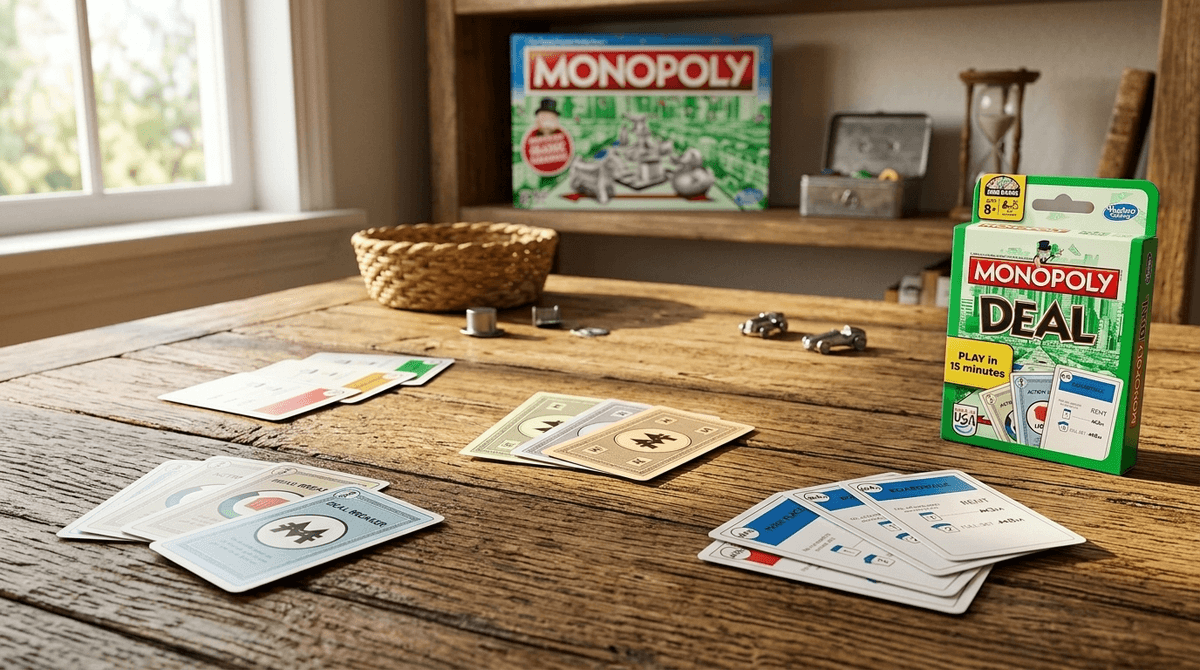
TL;DR: Monopoly Deal is the holy grail of "car games" and "restaurant games." It’s a fast-paced, 15-minute card game version of the classic that removes the four-hour bankruptcy-induced tears and replaces them with high-speed strategy. It’s the perfect bridge for kids who are obsessed with the "quick-hit" dopamine loops of Roblox or Brawl Stars.
- Best for: Ages 8+ (though savvy 7-year-olds can hang)
- Play time: 15 minutes (actually, not "Monopoly minutes")
- Price: Usually under $10 (cheaper than a Robux
 top-up)
 - Value: High. Teaches math, negotiation, and how not to be a "salty" loser.
If your only memory of Monopoly is a dusty box in your parents' closet that ended in a physical fight over who got to be the top hat, forget everything you know. Monopoly Deal is a deck of 110 cards. There is no board. There are no tiny metal pieces to step on.
The goal is simple: be the first player to complete three full property sets of different colors. You do this by drawing cards, playing property cards, and using "Action" cards to charge rent, steal properties, or—the ultimate friendship-ender—play a "Deal Breaker" card to steal an entire completed set from someone else.
It’s fast. It’s ruthless. And unlike the original Monopoly board game, the person who is losing can actually make a comeback in a single turn.
We talk a lot about "brain rot" and the addictive nature of apps like TikTok or YouTube Shorts, but we rarely talk about why they are so sticky. It’s the "short loop." You get a reward, you feel a spike of dopamine, and you want to go again.
Monopoly Deal accidentally hacked this loop for the tabletop world. Because a game only takes 15 minutes, kids feel that same "just one more round" urge.
The "Ohio" Factor
In kid-speak, something "Ohio" is weird or cringey, but Monopoly Deal is surprisingly "sigma" (that's a good thing, stay with me). It’s got a high "cool factor" because it allows them to be a little bit devious. Stealing a property from a parent or an older sibling feels just as satisfying as a "clutch" win in Fortnite.
We’re all trying to find that "middle ground" between being the parent who bans all tech (impossible) and the parent who lets the iPad do the heavy lifting at Chili’s (tempting, but we pay for it later).
1. It’s a "Transition" Game
If you’re trying to move your kid away from a heavy Minecraft session, jumping straight into a 1,000-piece puzzle is a recipe for a meltdown. The energy levels don't match. Monopoly Deal has the intensity to match a gaming session but brings the interaction back to the physical world.
2. Real-World Math and Logic
This isn't "school math." This is "I have $2M in my bank, and you're charging me $4M in rent, so I have to give you my Boardwalk" math. It’s logic, risk assessment, and resource management. It’s basically a simplified version of the entrepreneurship skills they claim to be learning in Roblox Tycoon games, but with actual human eye contact.
3. Portability
This is the ultimate travel hack. It fits in a pocket. I’ve seen families play this on airplane tray tables, in the back of Minivans, and while waiting for a table at a restaurant. It’s the direct competitor to the "hand them the phone so they stay quiet" move.
If your kids have seen the ads for Monopoly GO! on YouTube, you need to know the difference.
- Monopoly GO! is a mobile app that uses "gacha" mechanics (basically gambling-lite) to keep kids clicking. It’s designed to drain your wallet via in-app purchases.
- Monopoly Deal is a one-time $8 purchase that builds actual strategic thinking.
If they like the vibe of the app, they will love the mechanics of the card game. It’s a great way to pivot them away from a predatory app and toward a healthy family activity.
Read our full guide on the dangers of in-app purchases and "loot boxes"
The box says Ages 8+, and that’s a pretty solid benchmark.
- Ages 6-7: They can play with a "partner" or an open hand. The math is simple enough (mostly adding and subtracting millions), but the strategy of when to play a card might be tricky.
- Ages 8-12: This is the sweet spot. They are old enough to be "mean" in the game (stealing cards) without it turning into a real-life sob fest (usually).
- Teens: Surprisingly, teens actually like this because it’s fast. It doesn’t feel like a "family game night" chore.
Let’s be real: Monopoly Deal can be frustrating. You can be one card away from winning, and then someone plays a "Deal Breaker" and takes your entire set.
This is actually a top-tier teaching moment. In a world where video game algorithms often manipulate difficulty to keep kids winning (to keep them playing), a card game is honest. Sometimes you get a bad hand. Sometimes your sister steals your favorite card.
Learning to be "salty" (upset about losing) and then getting over it in a 15-minute window is a vital digital wellness skill. It builds the emotional regulation they need when they inevitably lose a match in Rocket League.
If you want to pitch this to your kids without sounding like you’re "assigning" a game, try this:
"Hey, I heard this game is basically the card version of a heist. You can steal people's entire properties in one move. Want to see if you can bankrupt me in under 10 minutes?"
Focus on the speed and the "stealing" aspect. That’s the hook.
Monopoly Deal is one of the few physical games that can actually compete with the "high-speed" feel of modern digital entertainment. It’s cheap, it’s portable, and it’s genuinely fun for adults too.
If you’re looking for more ways to reclaim the dinner table or the long car ride from the "screen zombies," check out these other fast-paced alternatives:
- Exploding Kittens (Ages 7+, very funny, very fast)
- Uno (The classic, though arguably more "Ohio" than Monopoly Deal)
- Dobble / Spot It! (Great for younger kids' reflexes)
- Sushi Go! (A great "entry-level" strategy game)
- Pick up a deck. You can find them at most big-box stores or pharmacies for the price of a fancy latte.
- Play a "practice" round with hands open so everyone sees how the Action cards work.
- Set a "No Phones at the Table" rule specifically for the duration of the game—it’s only 15 minutes, so even your teen can't complain that much.
- Lean into the chaos. Don't hold back on those Deal Breakers. Show them how to play with strategy!
Learn more about how to set healthy screen time boundaries without the drama