

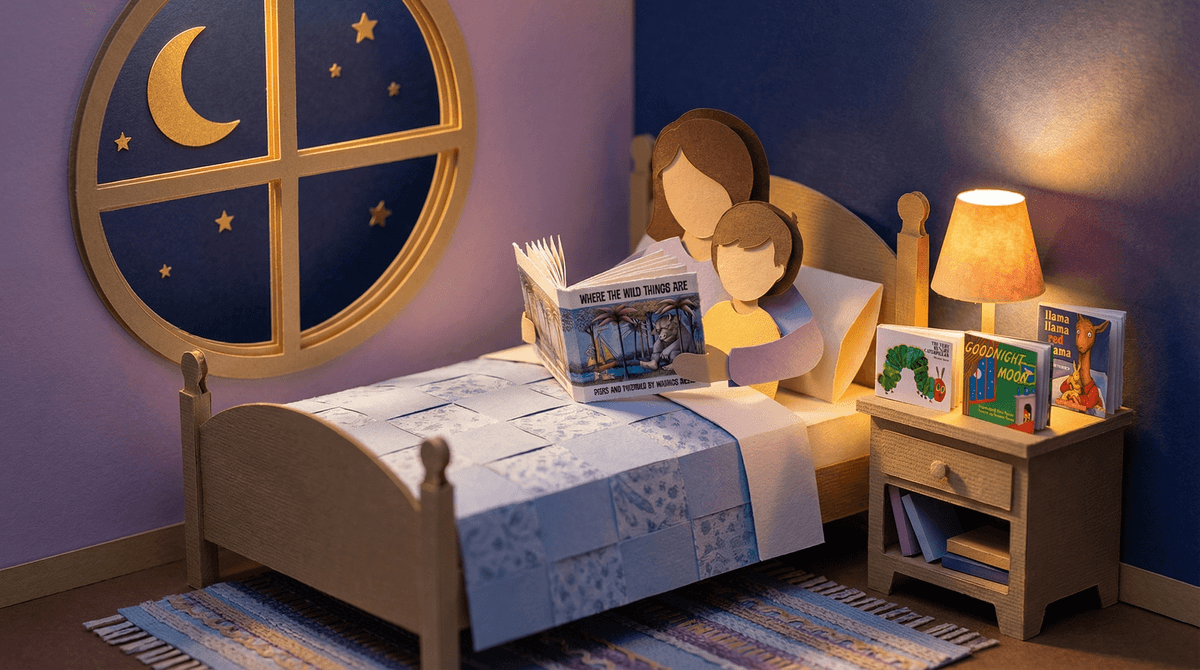
Okay, let me start by acknowledging the obvious: you know what bedtime books are. You probably had them read to you as a kid. But here's what's changed — bedtime books are now competing with YouTube Kids, iPad games, and "just one more episode" of Bluey. And honestly? The screens are winning in a lot of households.
Bedtime books are physical or e-reader books (though we'll get into why physical matters) that you read with or to your kids as part of their wind-down routine. They're the classic parenting move that somehow got lost in the shuffle of modern life, even though the science behind them has only gotten stronger.
The real question isn't "what are bedtime books?" — it's "why should I fight my exhausted 7-year-old to read a book when handing them the iPad means I can finally sit down?"
Fair question. Let's dig in.
Here's the thing: screens before bed aren't just "less good" than books. They're actively working against your kid's ability to fall asleep and stay asleep. The blue light from screens suppresses melatonin production — that's the hormone that tells your brain it's time to sleep. It's not about being a purist. It's biology.
But beyond sleep (which, let's be honest, is reason enough), bedtime reading does something screens can't replicate:
- Language development: Kids who are read to regularly hear thousands more words than kids who aren't. This gap shows up in vocabulary, reading comprehension, and academic performance later.
- Emotional regulation: Stories help kids process feelings, fears, and experiences in a safe, contained way. The monster under the bed becomes less scary when you've read about other kids dealing with monsters.
- Bonding: This is your kid's undivided attention time with you. No notifications, no multitasking, just you two in a story together.
- Building reading identity: Kids who associate books with comfort and connection become readers. Kids who associate screens with comfort become... well, you see where this is going.
And look, I get it. After a long day, reading The Pigeon Wants a Puppy for the 47th time feels like torture. But here's what's wild: your kid doesn't care if you're tired or bored or reading the same book again. They just want you there, fully present, for 15 minutes.
Let's be real about what's happening in most homes: kids are getting 20-30 minutes of screen time before bed because it's easy and it works (in the short term). They're watching Cocomelon, playing Roblox, or scrolling through YouTube Kids.
The problem? That "calm" you're seeing isn't actually calm. It's overstimulation that looks like calm because they're quiet and still. Then bedtime becomes a battle because their brains are still lit up like Times Square.
Compare that to books: the act of reading (or being read to) actually slows heart rate and reduces cortisol. It's genuinely calming, not just distracting.
Does this mean screens are evil and books are perfect? No. But if you're going to pick one wind-down activity that sets your kid up for actual sleep success, books win every single time.
Ages 0-3: Board books with simple pictures and rhythmic text. Goodnight Moon, The Very Hungry Caterpillar, anything by Sandra Boynton. At this age, it's about routine and snuggling more than story comprehension.
Ages 4-7: Picture books with more complex stories. This is the golden age for bedtime reading. Where the Wild Things Are, anything by Mo Willems, Dragons Love Tacos. They can follow plot, ask questions, and connect emotionally to characters.
Ages 8-10: Chapter books that you read together over multiple nights. Charlotte's Web, Diary of a Wimpy Kid, Percy Jackson. This age is tricky because they might be reading independently, but don't give up reading together. It's still bonding time, and you can tackle more sophisticated themes together.
Ages 11+: They're probably reading on their own, but consider a family read-aloud a few times a week, or at least checking in about what they're reading. The Hunger Games, Harry Potter, graphic novels like Smile by Raina Telgemeier.
"My kid fights bedtime reading."
Yeah, because they've learned that screens are an option. If you're transitioning from screens to books, expect pushback for about a week. Then it becomes the new normal. Consistency is everything here.
"We use audiobooks — does that count?"
Audiobooks are great! They're better than screens for sleep. But they don't replace the bonding of reading together, and they don't give you the same control over pacing and discussion. Use them for car rides and quiet time, but try to keep bedtime as a together activity.
"What about reading on an iPad or Kindle?"
E-readers with e-ink (like basic Kindles) are fine — no blue light. But iPads and tablets? You're back in screen territory. If you must use them, enable night mode and keep brightness low. But honestly, physical books are better for bedtime. There's something about the tactile experience that signals "wind down" in a way screens don't.
"My kid only wants to read the same book every night."
Let them. Repetition is how kids learn and find comfort. You'll survive another round of Llama Llama Red Pajama. I promise.
"I'm too tired to read at night."
I hear you. Some nights you're running on fumes. On those nights, audiobooks are your friend, or even just looking at picture books together without reading every word. Something is better than nothing, and screens are not the answer.
Bedtime books aren't just a nice tradition from the pre-iPad era. They're one of the most effective tools you have for better sleep, stronger language development, emotional connection, and raising kids who actually like reading.
The move: Pick 2-3 books, set a timer for 15 minutes, and make it non-negotiable. Screens off 30 minutes before bed, books on. If your kids are already in a screen-before-bed habit, expect a rough transition week. But stick with it.
And if you need book recommendations? Check out our guide to age-appropriate books or Get suggestions based on your kid's interests .
.
You've got this. And honestly? That 15 minutes might end up being your favorite part of the day too.