

TL;DR
- The Goal: Stop fighting the screen and start using it as a "digital springboard" for real-world play.
- The Problem: Passive "brain rot" content like Skibidi Toilet creates a dopamine loop that makes the outdoors seem "Ohio" (weird/boring) by comparison.
- Top Bridges to the Outdoors: Pokemon GO, Geocaching, and Merlin Bird ID.
- Top Creative Catalysts: Scratch for coding, Stop Motion Studio for filmmaking, and Minecraft (Creative Mode only) for architectural thinking.
- Quick Link: Get an outdoor bridge plan for your child's specific interests

If you’ve heard your ten-year-old describe a sunset as "low-key mid" or call a slightly messy room "only in Ohio," you’re witnessing the linguistic fallout of the current digital age. We’re living in the era of "brain rot"—a term kids actually use to describe the hyper-stimulating, nonsensical loops of YouTube Shorts and TikTok.
The struggle isn’t just that they’re on screens; it’s that the screens are winning the battle for their dopamine receptors. When a kid can get a thousand hits of "newness" in ten minutes from Skibidi Toilet, a slow afternoon building a fort in the backyard feels physically painful to them.
But here’s the no-BS reality: we can’t just "unplug" and expect them to suddenly become 1950s children playing with hoops and sticks. We have to build bridges from the digital world back to the physical one.
For a modern kid, the command to "just go outside" feels like being exiled to a desert island. They aren't just losing their entertainment; they’re losing their social hub (Roblox), their creative outlet (Minecraft), and their primary source of humor.
The goal isn't to delete the digital life, but to rebalance the scales. We want to move from passive consumption (staring at a screen) to active creation (using a screen to do something) and finally to physical exploration (leaving the screen behind).
Learn more about the difference between active and passive screen time
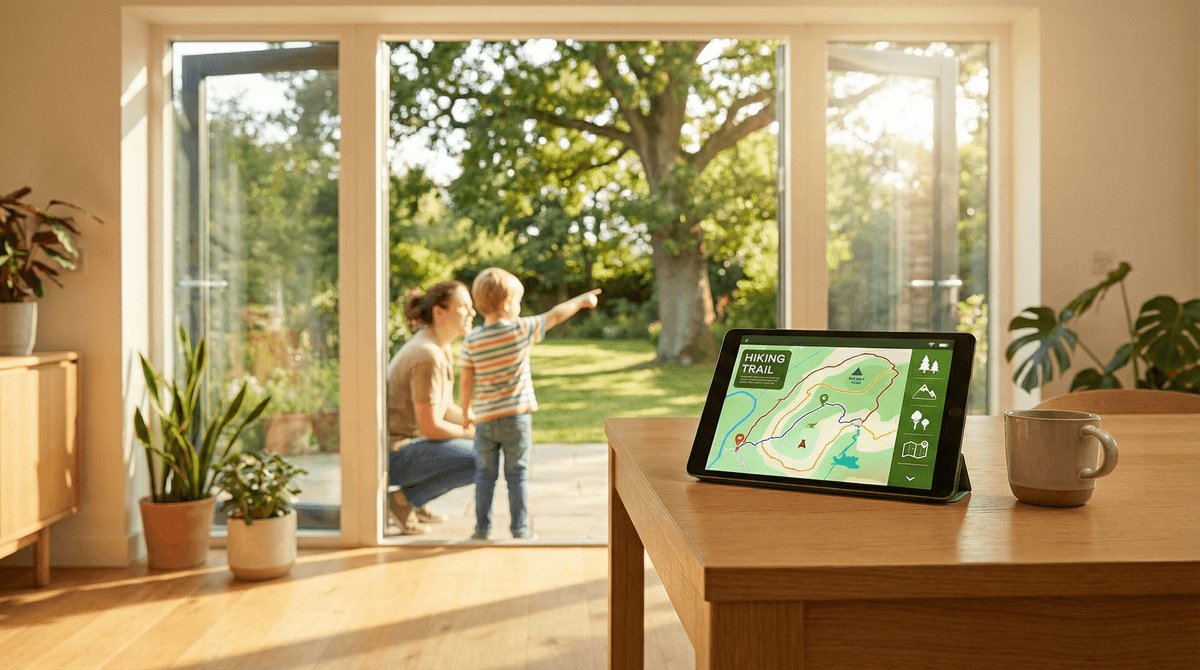
The best way to get a kid outside is to make the outdoors feel like an expansion pack for their digital life.
This is the "gateway drug" to hiking. It uses augmented reality to turn your local park into a map filled with creatures to catch. It’s been out for years, but for the 7-12 age group, it remains the most effective tool for tricking a child into walking three miles without complaining.
Think of this as a global treasure hunt. Using your phone’s GPS, you find physical containers hidden by other people. It turns a boring walk into a "mission." It’s basically a real-life fetch quest, which maps perfectly to the logic of games like The Legend of Zelda: Tears of the Kingdom.
If your kid likes "collecting" things in games or filling out a "Pokedex," this app is a game-changer. You hold the phone up, it listens to bird sounds, and identifies them in real-time. It’s surprisingly addictive and shifts their focus from the screen to the trees.
If they’re going to be on a screen, let’s make sure they’re actually doing something. Most "brain rot" content is passive. We want them in the driver’s seat.
Ages 8-16. Instead of just playing games, they can build them. Scratch is a block-based coding language developed by MIT. It’s free, it’s brilliant, and it teaches logic. If your kid spends all their time on Roblox, point them here to see if they actually want to be a creator or if they’re just addicted to the Robux slot machine.
Ages 6+. This is the ultimate bridge to physical play. They take their LEGO sets or action figures, set up a scene, and use the app to create a movie. It requires patience, physical setup, and storytelling. It’s the literal opposite of "brain rot."
If you want to spark a conversation about nature via tech, this is the book. It’s about a robot stranded on an island of animals. It’s poignant, beautifully written, and manages to make "nature" feel as exciting as a sci-fi movie.
Check out our guide on the best books for kids who hate reading but love gaming
We have to talk about Roblox. About 65% of kids in grades 2-8 are on it. Parents often ask: "Is it teaching them business?"
The short answer: Rarely. Most kids are just consumers in a digital mall designed to extract money through FOMO (Fear Of Missing Out). However, if your kid is using Roblox Studio to actually build worlds, then yes, they are learning 3D modeling and Lua scripting. That’s a win. If they’re just begging for $20 to buy a "limited" hat, that’s just a bank account drain.
Learn how to set up Roblox parental controls to stop the spending
Ages 5-8: The "Bluey" Standard
At this age, screen time should be high-quality and slow-paced. Bluey is the gold standard because almost every episode is a blueprint for a real-world game (like "Keepy Uppy" or "Shadowlands"). Avoid: Cocomelon or hyper-edited YouTube toy reviews. They are designed to overstimulate, making the real world feel "broken" and boring afterward.
Ages 9-12: The Social Transition
This is the peak "Ohio" age. They want to be where their friends are. This usually means Fortnite or Minecraft. The Strategy: Use "The 1-for-1 Rule." For every hour of gaming, they earn an hour of "choice" time, provided they spend 30 minutes doing something creative or outdoors first. It’s not a punishment; it’s a trade.
Ages 13+: The Critical Thinkers
By now, they’ve seen it all. The goal here is media literacy. Talk to them about why TikTok is so addictive. If they’re interested in AI, show them ChatGPT and discuss how it might change their future jobs. At this age, "outdoor play" might just look like a walk with a podcast like Stuff You Should Know.
If your kid is currently deep in a "brain rot" cycle—constantly irritable, unable to focus on a board game, or throwing a tantrum when the iPad dies—they likely need a dopamine reset.
This isn't a "grounding." It's a physiological necessity. When the brain is flooded with high-speed digital input, the "real world" feels painfully slow. It takes about 48 to 72 hours of low-stimulus activity for those receptors to recalibrate.
Pro-tip: Don’t do a "digital detox" on a weekend when you’re busy. Do it when you have the energy to be the "entertainment" for the first few hours until their own boredom kicks in. Boredom is the birthplace of creativity. If they never get bored, they’ll never pick up a paintbrush or a soccer ball.
Instead of saying "Get off that junk," try:
- "I noticed that after you watch MrBeast for an hour, you seem really cranky. Let's go hit the bike trail for 20 minutes to reset."
- "I saw this cool thing on Geocaching that says there’s a hidden treasure near the library. Want to go find it?"
- "If you want to spend money on Roblox, you have to show me one thing you’ve built in the game this week, not just something you bought."
Digital wellness isn't about how many minutes are on the timer; it's about the quality of the content and the context of the usage. A kid spending two hours coding a game on Scratch is in a much healthier headspace than a kid spending 20 minutes scrolling through "Skibidi" memes.
Reclaiming real-world play doesn't mean deleting the apps. It means ensuring the apps aren't the only thing in their world. We want our kids to be "Screenwise"—smart enough to enjoy the tech, but grounded enough to know that the best stuff still happens "low-key" in the real world.
- Audit the "Rot": Check your kid's YouTube history. If it's all 15-second clips of loud noises, it's time to pivot.
- Download a Bridge: Install Geocaching or Pokemon GO and go for a "tech-integrated" walk this weekend.
- Swap Consumption for Creation: Introduce Stop Motion Studio for their next indoor play session.