

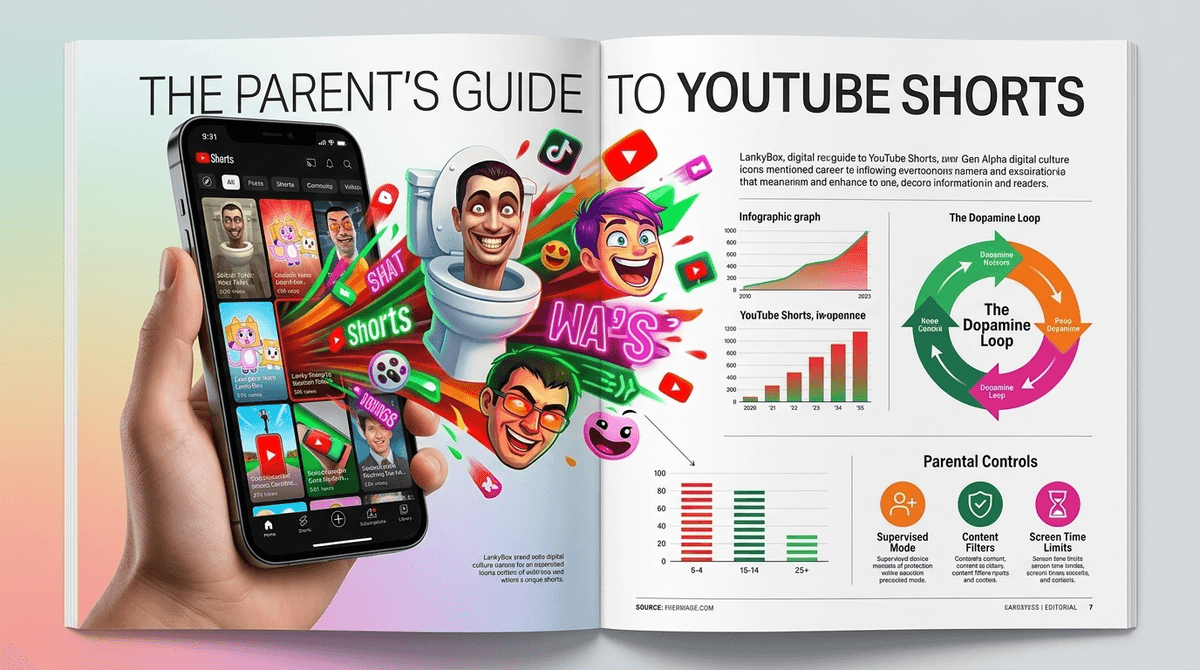
The Parent’s Guide to YouTube Shorts: Dopamine Loops and 'Brain Rot' Explained
TL;DR
- The Issue: YouTube Shorts uses a "variable reward" algorithm designed to keep users scrolling indefinitely, which can be particularly hard on developing brains.
- The Content: "Brain rot" is the slang kids use for hyper-stimulating, nonsensical content like Skibidi Toilet or LankyBox that offers high noise but low value.
- The Fix: You can’t "turn off" Shorts easily, but you can use YouTube Supervised Accounts and Restricted Mode to filter the worst of it.
- The Pivot: Encourage long-form creators like Mark Rober or Kurzgesagt who build narrative and curiosity rather than just a 60-second dopamine hit.
If you’ve seen your kid holding their phone vertically, flicking their thumb upward every 15 to 60 seconds like they’re trying to win a speed-scrolling contest, they are watching YouTube Shorts.
It’s YouTube’s direct answer to TikTok and Instagram Reels. While the main YouTube platform was built on "destination viewing" (you search for a video on how to beat a level in Minecraft and you watch it), Shorts is "discovery viewing."
The algorithm chooses the content for you. You don't pick the video; you just react to what the machine serves up. For a 10-year-old, this is the digital equivalent of a never-ending bag of Flamin' Hot Cheetos. It’s hard to stop because you never know if the next one is going to be the funniest thing you’ve ever seen.
Learn more about the differences between YouTube and TikTok
The "dopamine loop" isn't just a buzzword; it's a physiological reality. When a child swipes and sees a video they like, their brain releases a tiny squirt of dopamine. Because the videos are short, that reward comes fast and frequently.
The danger isn't necessarily the content itself (though we’ll get to "brain rot" in a second), but the context-switching. When a brain is forced to process a new environment, a new person, and a new joke every 30 seconds, it loses the ability to sustain attention on things that move slower—like a book, a teacher, or a conversation at dinner.
By 2025, data shows that nearly 75% of middle schoolers are consuming short-form vertical video daily. It’s become the "water cooler" for Gen Alpha. If they haven't seen the latest viral sound or the "Ohio" meme, they feel left out of the loop.
You’ve probably heard your kids say it. "That’s so brain rot." Or maybe they’re just acting like it.
"Brain rot" refers to content that is intentionally loud, chaotic, and nonsensical. It’s designed to trigger the "Ooh, shiny!" part of the brain without requiring any actual thought.
The poster child for brain rot. It started as a weird animation of a head coming out of a toilet and turned into a massive, multi-episode war saga. Is it inherently "evil"? No. Is it weird? Incredibly. Is it high-quality storytelling? Not exactly. It’s pure, uncut visual stimulation.
Justin and Adam are the kings of high-energy, high-pitched reaction videos. They often play Roblox or react to memes. For parents, it’s like nails on a chalkboard. For kids, the bright colors and constant shouting are magnetic.
Even high-production creators like MrBeast have mastered the Short. These are often "fast-cut" challenges. While better than a head in a toilet, they still contribute to that "I need a new thing every 10 seconds" mindset.
We often say screens are "shrinking" attention spans. It’s more accurate to say they are training attention spans. If a kid spends two hours a day on YouTube Shorts, they are training their brain to expect a high-intensity payoff with zero effort.
When they sit down to play Catan or read Percy Jackson, the "pacing" feels broken to them. It's not that they can't focus; it's that the "slow" activity feels like physical withdrawal from the dopamine hits they’ve been getting.
YouTube does not make it easy to turn off Shorts. They want your kids in that loop because it’s incredibly profitable. However, you have some levers to pull:
If your child is under 13, do not give them a standard Google account. Set up a Supervised Account. This allows you to select content settings:
- Explore: For ages 9+ (filters out most live streams and some more "mature" Shorts).
- Explore More: For ages 13+ (broader, but still filters some content).
This is a device-level setting that hides videos that may contain "mature" content. It’s not 100% foolproof—the algorithm is a machine, not a person—but it helps prune the worst of the Shorts feed.
3. The "Not Interested" Button
This is your best friend. If you’re sitting with your kid, and a "brain rot" video pops up, tap the three dots and hit "Not Interested." It takes about 10-20 of these to start retraining the algorithm to show more educational or hobby-based content.
4. Third-Party Help
Apps like Google Family Link or Screen Time (iOS) allow you to set a hard time limit on the YouTube app. You can’t limit just Shorts, but you can limit the app as a whole.
Check out our guide on the best parental control apps for 2026
The best way to fight the scroll is to introduce content that is actually worth the time. Long-form videos that teach a skill or tell a deep story are the "whole grains" of the digital world.
The gold standard. He’s a former NASA engineer who builds crazy contraptions (like glitter bombs for porch pirates). His videos are long, educational, and genuinely funny. It’s science without the "brain rot."
Destin Sandlin explores the world through a lens of "how does this work?" From deep-sea physics to how a helicopter flies, it’s the kind of content that sparks real-world curiosity.
If your kid needs a visual reset, the slow, beautiful pacing of My Neighbor Totoro or Spirited Away is the perfect "digital detox." It’s the literal opposite of a 15-second Short.
[Hobby-Based Creators]
If your kid likes Minecraft, steer them toward Hermitcraft creators like Mumbo Jumbo. These are long-form, project-based videos that encourage kids to go build something themselves rather than just consuming mindless clips.
If you just tell your kid "Shorts are rotting your brain," they will tune you out. Instead, try a more nuanced approach:
- The "Vibe Check": Ask them, "How do you feel after scrolling for an hour? Do you feel energized or kind of tired and grumpy?" Most kids will admit they feel "meh" after a long scroll.
- The "Slot Machine" Analogy: Explain that the app is designed like a casino. It’s trying to trick their brain into staying longer than they planned. Kids actually hate the idea of being "manipulated" by a big corporation.
- The "One for One" Rule: For every 15 minutes of Shorts, they have to spend 15 minutes on a "deep work" activity—reading a book like Wings of Fire, playing a board game like Ticket to Ride, or practicing an instrument.
YouTube Shorts isn't going anywhere. It is the most addictive feature on the world's most popular video platform.
You don't have to ban it entirely, but you do need to be the "pacing coach." In 2026, the most valuable skill a child can have is the ability to protect their own attention. By setting boundaries around the infinite scroll and pointing them toward high-quality, long-form content, you’re helping them build a brain that can focus on the things that actually matter.
- Check the History: Open your kid's YouTube account and look at the "Shorts" history. Is it all Skibidi Toilet, or is there some substance there?
- Set a Timer: Use Family Link to limit YouTube to 30-60 minutes a day.
- Find a "Long-Form" Hook: Find one creator (like Mark Rober) that you can watch together on the big screen to model what "good" content looks like.