

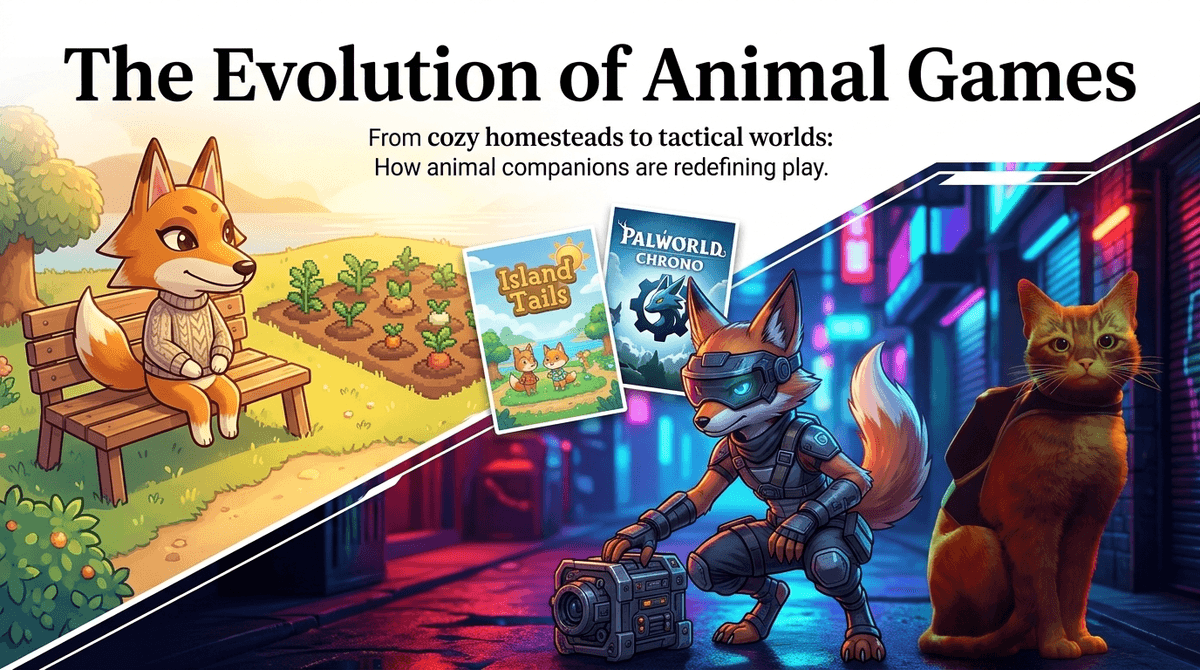
TL;DR: Animal games have evolved from simple "feed the cat" simulators into complex economic markets and survival shooters. If your kid is asking for "the one with the blue penguin and the assault rifle," they’re talking about Palworld. If they're obsessed with trading neon dogs, they're in Adopt Me!.
Quick Links to Top Picks:
- The Gold Standard: Animal Crossing: New Horizons (Ages 6+)
- The "Cozy" Legend: Stardew Valley (Ages 10+)
- The Trading Hub: Adopt Me! (Roblox) (Ages 7+)
- The "Pokémon with Guns": Palworld (Ages 12+)
- The Nature Lover’s Choice: Wingspan (Ages 10+)
Remember Nintendogs? You’d pet a golden retriever on your DS screen, it would bark, and that was the whole game. It was wholesome, low-stakes, and impossible to "lose."
Today, "animal-themed" is a massive umbrella. It covers everything from the ultra-chill vibes of Unpacking (where you might just be setting up a cat’s bed) to the high-stress survival mechanics of Palworld, where animals aren't just pets—they’re workers, weapons, and sometimes food.
The shift we’re seeing is from passive caretaking (feeding a pet) to active utility (using animals to build a base or win a battle). For parents, this means we can't assume a game is "safe" or "simple" just because there’s a cute bunny on the cover.
It’s not just about the "cute" factor, though that’s a big entry point. Kids gravitate toward these games for three main reasons:
- Agency and Ownership: In Adopt Me!, a child isn't just a kid; they’re a homeowner and a pet collector with a "net worth" based on the rarity of their animals.
- Low-Stakes Companionship: Digital pets don't need real walks at 6 AM, but they provide a sense of routine and reward that feels very real to a 9-year-old.
- The "Gotta Catch 'Em All" Itch: Games like Pokémon Scarlet/Violet tap into the human desire to categorize and complete collections.
If you’re looking for "brain rot" alternatives, this is your sweet spot. These games are generally about building, decorating, and befriending NPCs (non-player characters).
This is the ultimate "gentle" game. You live on an island with animal neighbors, catch bugs, and pay off a mortgage to a tanuki named Tom Nook. It’s slow-paced because it follows real-world time. If it’s 8 PM in real life, it’s 8 PM on the island. It teaches patience and basic financial literacy (in a very cute way).
While it's a farming sim, the animal husbandry is a huge part of the draw. You can pet your cows, name your chickens, and eventually get a pet cat or dog. It’s deeper than Animal Crossing because it involves combat in "the mines," but it’s still firmly in the "cozy" camp.
Think of this as "Baby's First RPG." It’s an open-world adventure filled with cat puns. It’s charming, easy to pick up, and a great way to introduce kids to quest-based gaming without the toxicity of online multiplayer.
This is where things get a bit more "real." In these games, the animals are essentially currency.
In Roblox, Adopt Me! is a juggernaut. On the surface, you dress up pets. In reality, it is a complex trading economy. Kids spend hours trying to trade a "Common" dog for an "Ultra-Rare" unicorn. The Red Flag: This is where "trust trading" scams happen. A kid might say, "Give me your pet first, and I promise I'll give you my rare one next." Spoiler: They won't.
This game is basically a clicking simulator. You use pets to break coins to buy more pets. It’s highly addictive because of the "gambling-lite" mechanics of opening eggs to see what’s inside. It’s not "bad," but it’s definitely designed to keep kids glued to the screen (and eyeing your credit card for Robux).
Learn more about how Robux is in fact real money
This is the newest trend, and it’s the one causing the most "wait, what?" moments for parents.
You’ve probably heard this called "Pokémon with guns." That’s... accurate. You capture "Pals," but instead of just fighting in sanctioned tournaments, you use them to help you survive in a harsh world. The No-BS Take: You can give your Pals assault rifles. You can also "butcher" them for resources or put them to work in factories. It’s a satirical, darker take on the genre. It’s not "M-rated" gore, but it’s definitely for the 12+ crowd who can handle the irony and the survival difficulty.
We can't talk about animal games without Minecraft. From taming wolves to breeding axolotls, the animal mechanics here are iconic. It sits in the middle—animals are friends, but they are also resources (leather, wool, food).
If you want to lean into the "intentional" part of Screenwise, these are the titles that actually teach something about biology or ecology.
Technically a boardgame (with a great digital version), this is a masterpiece. You’re an enthusiast seeking to discover and attract the best birds to your wildlife preserves. It uses real-world bird data, habitats, and behaviors. It’s beautiful and genuinely educational.
This is the modern successor to Zoo Tycoon. It’s a deep simulation game where you have to manage animal welfare, genetics, and conservation. It’s complex—maybe too complex for younger kids—but for a teen interested in zoology, it’s incredible.
For the younger set, this website offers browser-based games that are safe, free, and actually teach animal facts.
- Ages 5-7: Stick to PBS Kids or Toca Boca World. Avoid online trading environments like Roblox unless you’re sitting right there.
- Ages 8-11: Animal Crossing and Minecraft are the sweet spots. This is the age where they’ll start begging for Adopt Me!. If you say yes, have the "scam talk" immediately.
- Ages 12+: They’re likely looking at Palworld or Stray (a beautiful game where you play as a cat in a cyberpunk city). These are great, but check the ESRB ratings as themes get more mature.
1. The "Cute" Trap Just because a game features a cartoon cat doesn't mean it's for kids. Stray has some genuinely frightening "monster" sequences. Palworld features sweatshop-style labor. Always watch a 5-minute "Let's Play" video on YouTube before you buy.
2. The Trading Economy is Stressful In games like Adopt Me!, kids can feel immense social pressure to have "legendary" pets. This isn't just "playing with animals"—it’s navigating a social hierarchy. If your kid is crying because they "got scammed," take it seriously. To them, that neon unicorn was worth 20 hours of work.
3. In-App Purchases Animal games are notorious for "Gacha" mechanics (randomized loot boxes). You want that rare Dragon? It’s a 1% drop rate from an egg that costs $2.00. Those dollars add up fast.
Check out our guide on how to talk to your kids about loot boxes
Instead of asking "Is that game fun?" (the answer is always "yes"), try these:
- "What's the rarest animal you've found so far?" (Gets them talking about the economy/rarity).
- "How do you take care of your animals in this game?" (Helps you see if it’s a caretaking game or a 'utility' game).
- "Has anyone ever tried to trade with you? How do you know if a trade is fair?" (Opens the door for safety talks).
Animal-themed games are a fantastic way for kids to explore responsibility, creativity, and even basic economics. However, the genre has moved far beyond the "digital pet" stage. Whether they are building a sanctuary in Planet Zoo or surviving the wilds of Palworld, the key is knowing whether the game is about companionship or consumption.
- Check their Roblox history. If they play Adopt Me! or Pet Simulator 99, ask to see their pet collection.
- Download a "Cozy" alternative. If they're stressed by competitive games, suggest Stardew Valley.
- Set a "No-Trading" rule for younger kids if you aren't ready to manage the drama of digital scams.