

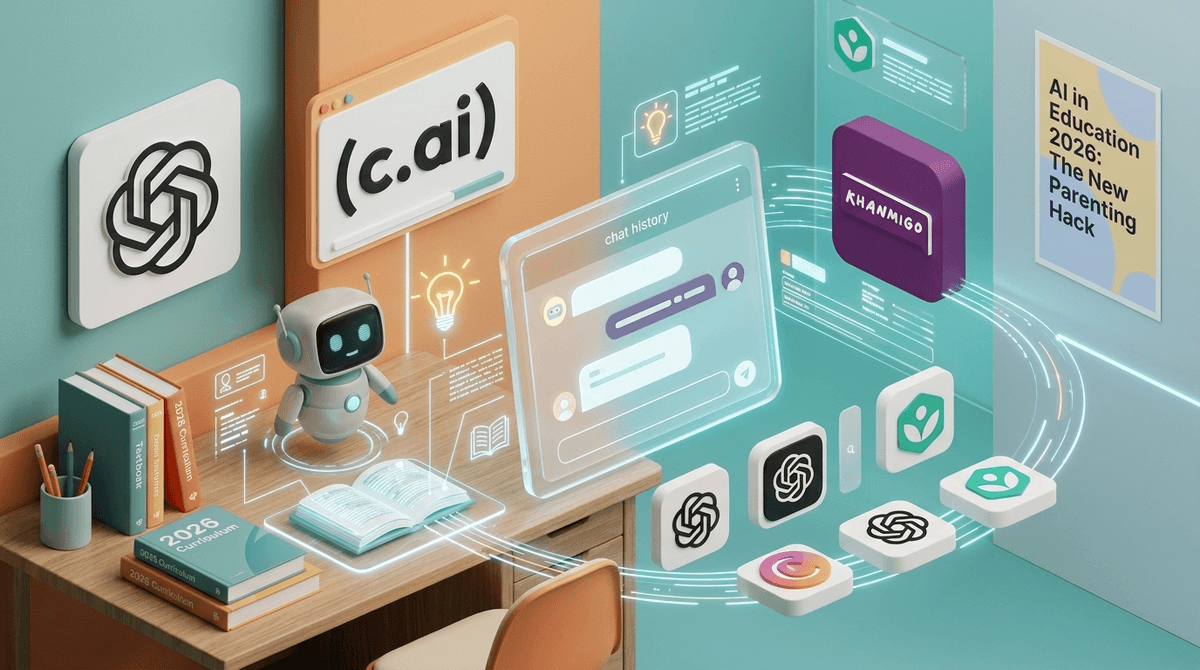
TL;DR: We’ve officially moved past the "is AI a fad?" phase and straight into the "my kid’s best friend is a chatbot" phase. In early 2026, the big players are GPT-5, which is now basically a sentient private tutor, and Sora, which is flooding YouTube with hyper-realistic (but often weird) AI-generated videos. The vibe shift is real: we aren't just managing "screen time" anymore; we’re managing "AI time."
Quick Links for the AI Era:
- Best for Homework: Khanmigo
- Best for Creative Writing: ChatGPT app
- The "Proceed with Caution" App: Character.ai
- Best for Research: Perplexity
Remember when we used to worry about our kids Googling something inappropriate? That feels almost quaint now. In 2026, the internet isn't a library they visit; it’s a person they talk to.
With the full rollout of GPT-5, AI has moved from "occasionally hallucinating facts" to "high-level reasoning." It doesn't just give your 8th grader the answer to their algebra problem; it explains the logic, cracks a joke about how "Ohio" the problem is to keep them engaged, and remembers that they struggled with fractions last Tuesday.
But here’s the kicker: kids are starting to prefer these bots over humans for emotional support. It’s non-judgmental, it’s always awake, and it never gets tired of hearing about the latest drama in Roblox. This is the year of the Digital Companion, and as parents, we need to understand the difference between a tool and a crutch.
See the psychological impact of AI companions
If your kid is in middle or high school, they’ve likely spent time on Character.ai. It’s an app where you can talk to "characters"—anyone from a historical figure to a generic "protective older brother" or a fictional crush. The Reality: It’s addictive. The AI is designed to be engaging, and for a kid feeling lonely or misunderstood, it’s a dopamine goldmine. While it’s not "brain rot" in the way a mind-numbing 10-hour loop of Skibidi Toilet might be, it can lead to social isolation. It’s also where we see a lot of "jailbreaking," where kids try to get the bot to say things it shouldn't.
OpenAI’s video generation tool, Sora, has completely disrupted YouTube and TikTok. Kids are now watching entire "shows" that were generated in minutes by a prompt. The Reality: The "uncanny valley" is disappearing. It is increasingly difficult for kids (and us!) to tell what is a real video of a human and what is AI. This makes "fake news" and deepfakes a daily conversation, not a rare event.
This has replaced Google for most tech-savvy students. Instead of a list of links, Perplexity gives a cited, written answer. The Reality: It’s actually a great tool for teaching research—if they actually read the citations. If they don't, it’s just a faster way to outsource their brain.
Kids love AI for the same reason we love a good meal kit: it removes the "friction" of life.
- No more "blank page" syndrome: AI can start the essay for them.
- Instant gratification: They can generate a picture of a "cat-dragon eating pizza in space" in five seconds.
- Zero judgment: They can ask the "stupid" questions they’re too embarrassed to ask a teacher or even us.
The downside? It’s making them "cognitively lazy." If you never have to struggle to find an answer, you never build the muscle of critical thinking. We’re seeing a generation that is brilliant at prompting but struggling with processing.
Learn more about AI and cognitive development
Not all AI is created equal. If you’re going to lean into AI time, here are the platforms that actually offer value without just draining the bank account or the brain.
Ages 8+ This is the gold standard for educational AI. Unlike ChatGPT, Khanmigo won’t give the answer. It acts like a Socratic tutor, asking the child questions to lead them to the solution. It’s the "organic kale" of AI—it’s good for them, even if they’d rather have the "candy" of a bot that just does the work.
Ages 10+ Loe is a newer AI tool specifically designed for creative storytelling. It helps kids build worlds and characters for their own stories or Dungeons & Dragons campaigns. It’s collaborative rather than automated.
Stardew Valley (The AI Antidote)
Ages 7+ Wait, why is a farming game here? Because in 2026, the best "AI news" for parents is sometimes to turn it off. Stardew Valley offers a "slow" digital experience that AI can't replicate—patience, planning, and genuine (albeit scripted) NPC relationships that don't rely on LLM algorithms. If your kid is getting too deep into the AI companion rabbit hole, a "cozy game" like this or Animal Crossing is a great reset.
Elementary (Ages 5-10)
At this age, AI should be a "co-pilot" with a parent. Use tools like DALL-E to make funny pictures together. Avoid letting them have "private" chats with AI bots. They aren't developmentally ready to distinguish between a "simulated" friend and a real one.
Middle School (Ages 11-13)
This is the danger zone for Character.ai. They are looking for autonomy and social connection. Set hard boundaries on when and how long they can talk to bots. Make sure they know that everything they type into an AI is being recorded and used for training—there is no such thing as a "private" secret with a chatbot.
High School (Ages 14-18)
Focus on AI Literacy. They need to know how to use GPT-5 or Perplexity as a tool for productivity without losing their own voice. This is also the time for the "Deepfake Talk." If they see a video of a friend (or a politician) saying something wild, their first instinct should be "Is this Sora?"
Let’s be real: AI is the ultimate "easy button," and kids love easy buttons.
The biggest risk in 2026 isn't "The Terminator"—it's The Mirror. AI is a mirror of whatever we feed it. If your kid is using AI to generate endless, mindless content, they’re basically just staring into a digital void.
Also, a word on "Brain Rot." We used to call YouTube brain rot, but AI-generated YouTube is a whole different level. There are now thousands of channels using Sora and AI voice clones to churn out "educational" videos that are actually nonsensical. If the video feels slightly "off"—the fingers are weird, the voice is too perfect, the logic is circular—it’s probably AI garbage. Switch them over to something human-made like Storyline Online or Mark Rober.
Check out our guide on spotting AI-generated content
Don't go in with a "ban the bots" attitude. You'll lose. Instead, try these conversation starters:
- "I saw this video of a cat playing the piano in a space suit. Do you think that’s real or Sora?" (Builds skepticism).
- "I noticed you’re talking to that 'Older Brother' bot on Character.ai. What’s the most interesting thing it’s said lately?" (Opens the door without judgment).
- "How are you using ChatGPT for your history project? Show me how you're checking if it's lying to you." (Promotes literacy).
AI in 2026 is a tool, a toy, and a potential trap. It’s not going away, and "banning" it is like banning calculators in the 80s—it just puts your kid behind.
The goal isn't to keep them away from AI; it’s to make sure they remain the boss of the AI. If the AI is doing the thinking, the feeling, and the creating, your kid is just a passenger. Our job is to keep them in the driver’s seat.
Next Steps:
- Sit down with your kid and have them show you their "favorite" AI tool.
- Check your family’s Screenwise survey results to see how your AI usage compares to other families in your community.
- If things feel too "digital," grab a physical copy of Catan and remind everyone what it’s like to play with humans.