

What Is Skibidi Toilet and Why Is Your Kid Obsessed With It?
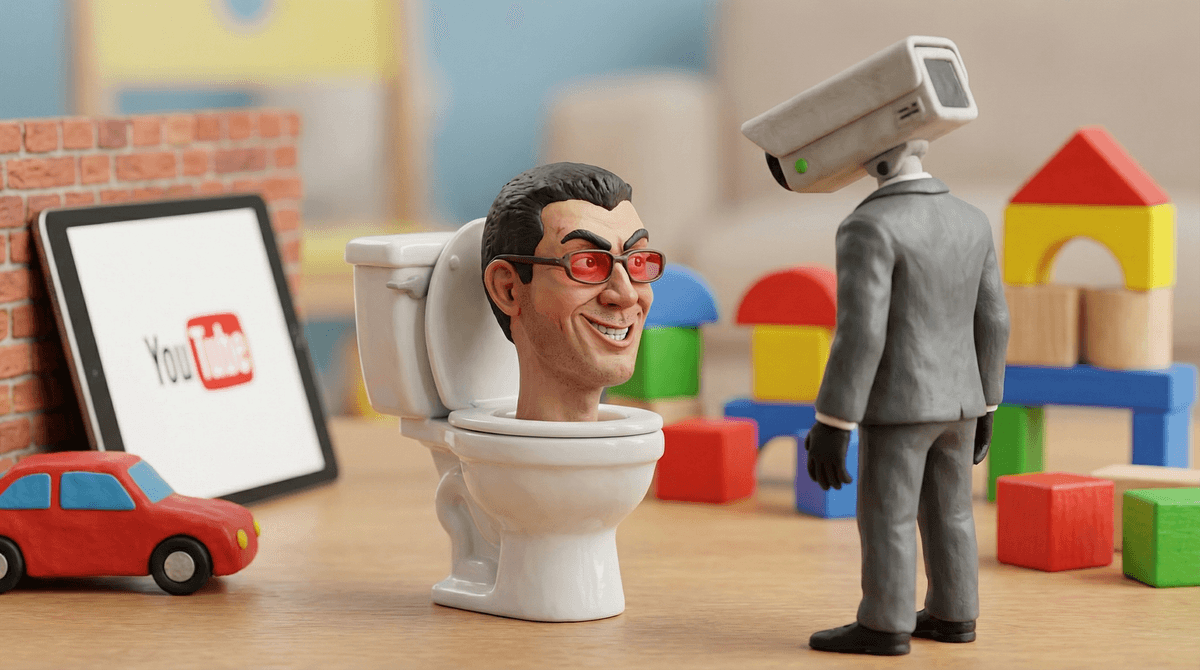
Skibidi Toilet is a bizarre YouTube series featuring singing heads emerging from toilets battling humanoids with cameras for heads. It's absurdist, wordless, and wildly popular with elementary and middle schoolers. The violence is cartoonish but constant, there's no educational value whatsoever, and honestly? It's kind of the definition of brain rot. But it's also not actively harmful, and understanding why kids are obsessed helps you decide how much is too much in your house.
Age recommendation: 8+ (though plenty of 6-year-olds are watching)
Content concerns: Repetitive violence, jump scares, zero narrative depth
Time to watch an episode: 1-3 minutes
Your sanity level: Will be tested
Skibidi Toilet is a YouTube series created by animator Alexey Gerasimov (DaFuq!?Boom!) that launched in February 2023. Each episode is 1-3 minutes of 3D-animated chaos: disembodied heads singing a remix of "Give It to Me" by Timbaland emerge from toilets and battle against humanoid figures with surveillance cameras, speakers, and TV screens for heads.
There's no dialogue. No plot to speak of beyond "toilet heads vs. camera heads." No character development. Just increasingly elaborate battle sequences set to repetitive music, with the occasional jump scare thrown in.
By mid-2024, the series had racked up billions of views and spawned an entire ecosystem of merchandise, fan animations, Roblox games, and playground debates about whether you're Team Toilet or Team Camera Head.
The appeal is actually pretty straightforward once you stop trying to find deeper meaning:
It's absurdist humor at its purest. Kids ages 6-12 are in their peak "random = funny" phase. A singing toilet head? That's objectively hilarious to a third-grader. The complete lack of logic is the point.
It's designed for short attention spans. Each episode is bite-sized, perfect for the YouTube algorithm and for kids who want quick entertainment hits between activities.
It's memetic and shareable. The catchphrases (mostly just "skibidi" and "yes yes yes") spread like wildfire on playgrounds. Kids love being in on the joke, and this is pure playground currency.
The violence is cartoonish but satisfying. There's something primal about watching escalating battles, especially when they're rendered in video game-style graphics. It scratches the same itch as watching Minecraft PvP videos or Fortnite montages.
It's theirs, not yours. Parents don't get it, which makes it even better. This is Gen Alpha's version of the weird flash animations millennials watched, or the gross-out humor Gen X loved. Every generation needs content that makes adults go "what the actual hell?"
Let's be real: Skibidi Toilet is not going to win any awards for enriching young minds. But here's what you actually need to know:
The Content Itself
Violence: Constant but cartoonish. Toilet heads and camera heads blast, flush, and explode each other in every episode. There's no blood or gore—it's all very video game-like—but the violence is the entire premise. If your kid is sensitive to conflict or gets nightmares easily, this might be too much.
Jump scares: Occasional and mild, but they're there. Usually just a toilet head popping up suddenly with loud music.
Language: None. Literally zero words beyond "skibidi" and song lyrics.
Educational value: Absolutely none. This is pure entertainment junk food.
Addictive qualities: High. The short format and algorithm-friendly structure make it very easy to watch "just one more" for an hour straight.
The Ecosystem Around It
The series has spawned a massive secondary market that's worth understanding:
Merchandise: Plushies, t-shirts, action figures—all over Amazon and in stores. Most of it is unlicensed knockoffs, but kids don't care.
Roblox games: Dozens of Skibidi Toilet Roblox experiences exist, many with in-game purchases. If your kid is playing these, check what they're spending Robux on.
Fan content: Other YouTube creators make Skibidi Toilet reaction videos, theories, and spin-offs. The rabbit hole goes deep, and not all fan content is age-appropriate.
Playground culture: Kids are acting out Skibidi Toilet battles at recess, making toilet jokes, and using it as social currency. This isn't necessarily bad, but it's worth knowing what's happening.
Ages 5 and under: Probably skip it. The violence and jump scares are too much for most preschoolers, and there's genuinely nothing beneficial here.
Ages 6-8: This is peak Skibidi Toilet demographic. If your kid is watching, set time limits (maybe 15-20 minutes max) and make sure it's not replacing better content. Use it as a reward or transition activity, not a default.
Ages 9-12: They're old enough to understand the absurdity and probably won't be scared. The bigger concern is the sheer amount of time they could waste watching endless episodes. Consider it alongside other YouTube content guidelines.
Ages 13+: If your teen is watching Skibidi Toilet, they're either doing it ironically or you have bigger concerns about their media diet.
This is where I'm going to be straight with you: Skibidi Toilet is not harmful in the way that predatory apps or toxic social media can be. It's just... aggressively mediocre. It's the video equivalent of eating an entire bag of chips for dinner—not dangerous, but not great either.
Consider allowing it if:
- Your kid is 7+ and not prone to nightmares
- You can set and enforce time limits
- It's balanced with other activities and better-quality content
- Your kid isn't acting out the violence inappropriately
Pump the brakes if:
- It's becoming an obsession that crowds out everything else
- Your kid is having trouble sleeping or getting anxious
- They're spending money on Skibidi Toilet merchandise or Roblox games without your knowledge
- The toilet humor is bleeding into every conversation and driving you insane
Instead of just banning it (which will probably make it more appealing), try these approaches:
Watch an episode together. Yes, it will be painful. But you'll understand what your kid finds funny and can have a real conversation about it.
Ask questions: "What do you like about this?" "Who do you think will win?" "Why are the toilets fighting the cameras?" (Spoiler: there is no good answer to that last one.)
Set boundaries collaboratively: "I can see why this is funny to you. Let's figure out how much time makes sense for watching it."
Introduce alternatives: If they like the absurdist humor, try The Amazing World of Gumball or Adventure Time. If they like the battle sequences, maybe Pokémon or Avatar: The Last Airbender would scratch that itch with actual storytelling.
Use it as leverage: "You can watch two Skibidi Toilet episodes after you finish your reading." Sometimes the weird stuff makes great motivation.
Skibidi Toilet is a symptom of how kids consume media in 2026: fast, algorithm-driven, and optimized for maximum engagement with minimum substance. It's not the first and won't be the last piece of "brain rot" content that captures kids' attention.
The question isn't really "Is Skibidi Toilet okay?" but rather "How does this fit into my kid's overall media diet?"
If your kid is also reading books, playing outside, engaging in creative activities, and watching some quality content alongside their Skibidi Toilet habit, you're probably fine. If Skibidi Toilet is crowding out everything else, that's when you need to intervene.
Think of it like actual food: a bag of chips isn't going to kill anyone, but you wouldn't want it to be the only thing your kid eats.
Skibidi Toilet is weird, low-quality, and kind of annoying. It's also relatively harmless for most kids 7 and up who aren't particularly sensitive to cartoonish violence.
Your job isn't to police every piece of content your kid consumes—that's exhausting and probably impossible. Your job is to make sure their overall media diet is balanced, that they're developing critical thinking skills about what they watch, and that screen time isn't taking over their lives.
If you decide to allow Skibidi Toilet, set clear time limits, keep an eye on the related content they're finding, and make sure they're also getting exposure to better quality shows, engaging books, and creative games.
And hey, at least it's not Elsagate. Small victories.
Set up time limits: Use YouTube parental controls or screen time settings to cap how long your kid can watch.
Check their Roblox activity: If they're playing Skibidi Toilet games, make sure you understand how Robux works and set spending limits.
Find better alternatives: Explore age-appropriate YouTube channels that offer actual educational or creative content.
Have the conversation: Talk to your kid about media quality and help them develop critical thinking skills about what they watch. Ask them what makes something worth their time.
Join Screenwise: Take our family survey to see how your kid's media habits compare to their peers and get personalized recommendations for better content that they'll actually want to watch.