

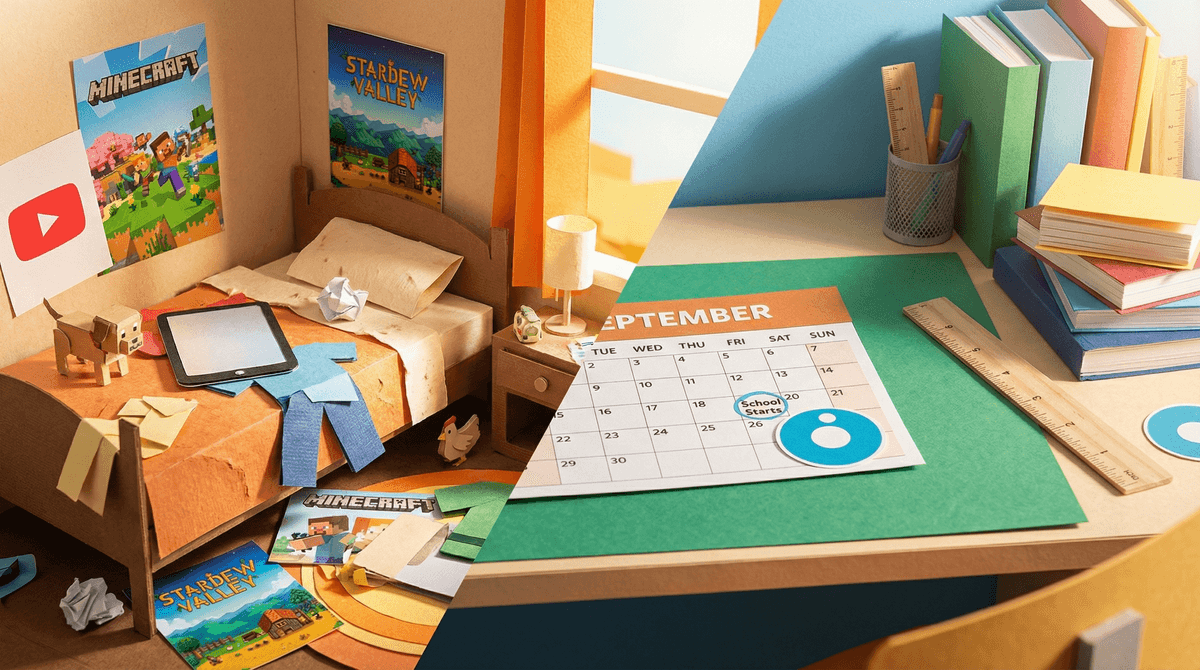
Easing Back Into School Routines After Summer Screen Time
Look, we all know what happened this summer. Those carefully crafted screen time limits? They melted faster than ice cream on hot pavement. The kids had more screen time, you had more work calls, and honestly, everyone survived. But now school is starting, and you're staring down the barrel of a kid who thinks 11pm YouTube binges are totally normal and that "just one more episode" is a reasonable negotiation tactic at 7am.
Here's the thing: you're not alone, and this transition doesn't have to be a nightmare. Let's talk about how to actually reset without turning your house into a war zone.
Summer screen time is different, and that's fine. The structure disappeared. Camp schedules were inconsistent. You were juggling work and childcare. Maybe you took a trip where an iPad was the only thing standing between you and a complete meltdown in the back of a minivan for six hours.
The problem isn't that summer happened. The problem is that summer habits don't work during the school year, and our kids' brains don't automatically flip a switch on the first day of school. They've spent weeks in a different rhythm, and now we're asking them to completely change gears.
It's not just about arbitrary rules or being the screen time police. Here's what's really happening:
Sleep is compromised. If your kid has been gaming or watching videos until midnight all summer, their circadian rhythm is legitimately shifted. They're not being difficult when they can't fall asleep at 9pm on a school night—their brain chemistry is actually different now.
Dopamine baselines are elevated. After months of high-stimulation content (Roblox, Fortnite, TikTok, YouTube), sitting in a classroom doing math problems feels physically uncomfortable. It's not about willpower—their brains are literally craving more stimulation.
Attention spans have shortened. This isn't permanent brain damage, but it is real. If your kid spent the summer watching 30-second TikToks or playing fast-paced games, their ability to focus on a 45-minute lesson has atrophied like a muscle they haven't used.
The good news? All of this is reversible. But it takes intentional effort, not just hoping it'll work itself out.
Forget going from summer free-for-all to strict school-year rules overnight. That's a recipe for meltdowns, sneaking devices, and everyone being miserable. Instead, try a gradual reset starting two weeks before school starts (or right now if you're reading this after school has already begun).
Week One: Establish the New Normal
Start with bedtime, not screen time. Work backward from when your kid needs to wake up. If they need 10 hours of sleep and have to be up at 6:30am, bedtime is 8:30pm. Non-negotiable. But here's the key: screens off 60 minutes before that. So in this example, all screens go away at 7:30pm.
This isn't punishment—it's biology. The blue light and stimulation genuinely prevent their brains from producing melatonin. You can explain this to kids as young as 7 or 8 in simple terms: "Your brain makes a sleepy chemical, but screens block it. We're helping your brain do its job."
Replace, don't just remove. That hour before bed needs something else. This is where you need to have actual alternatives ready:
- Physical books (not Kindle—the backlight defeats the purpose)
- Audio books or podcasts like Brains On! or Story Pirates
- Board games with family (Ticket to Ride, Sushi Go, even Uno)
- Drawing, journaling, or other hands-on activities
Week Two: Rebuild Daytime Structure
Now that sleep is stabilizing, tackle the daytime habits.
Create a visual schedule. Even for older kids, having a physical chart helps. Not because they can't tell time, but because it removes you from being the bad guy. "I'm not saying no—the schedule says screen time starts at 4pm after homework."
Front-load the hard stuff. Screen time should come after responsibilities, not before. This is basic behavioral psychology—the reward comes after the work. If your kid plays Minecraft before homework, getting them to focus afterward is like pushing a boulder uphill.
Set quantity and quality limits. Not all screen time is equal. An hour of Duolingo or playing Stardew Valley is different than an hour of infinite-scroll TikTok. You can acknowledge this without being a hypocrite: "You can have 30 minutes of YouTube and 30 minutes of gaming, or 60 minutes of gaming. Your choice."
Here's what doesn't work: "You had too much screen time this summer and now we're cracking down."
Here's what does: "Summer was different, and that was fine. But school requires different things from your brain, and we need to help it adjust."
Make it collaborative, not dictatorial. For kids 10+, you can have a surprisingly mature conversation:
"This summer you were staying up late gaming. That worked when you could sleep in. But now you need to be sharp at 8am for school. What do you think would help you fall asleep easier?"
You're not asking permission—the bedtime is happening—but you're inviting them into the solution. Maybe they want a later weekend bedtime. Maybe they want to earn extra screen time on Fridays. Give them some agency in the details while you control the framework.
They're going to test you. Of course they are. Here's how to handle it:
Expect extinction bursts. This is a real psychology term. When you remove a reward (unlimited screen time), behavior gets worse before it gets better. Your kid will have a massive meltdown right when you think you're making progress. This is actually a sign the boundary is working. Don't cave.
Use natural consequences. If your kid sneaks their phone after bedtime and is exhausted the next day, let them feel that exhaustion. Don't rescue them with extra screen time to "recover." The consequence teaches the lesson.
Be consistent, not perfect. You'll have nights when you're too tired to enforce the rule. That's human. But inconsistency is worse than strictness. If the rule is "no screens at dinner," and you allow it three times this week, your kid learns the rule is negotiable. Pick your battles and hold the line on the ones that matter.
Different rules at the other parent's house? You can't control that. What you can say is: "At this house, these are our rules. I know it's different at Mom/Dad's house, and that's okay. Different houses, different rules." Kids are actually pretty good at this—they follow different rules at school vs. home all the time.
Your kid says "everyone else gets unlimited screen time"? They're lying. Not maliciously, but they genuinely don't know what happens in other houses. You can say: "Maybe some kids do. We're doing what works for our family." You're not running a democracy.
What about educational screen time? This is where it gets nuanced. Khan Academy? Totally different from YouTube shorts. But also, if your kid is spending 6 hours at school staring at screens, they might need less educational screen time at home, not more. Context matters .
.
You can't parent through apps alone, but some tools genuinely help:
- Screen Time (iOS) or Family Link (Android) for setting automatic limits. The key is setting them with your kid when everyone is calm, not as punishment mid-tantrum.
- Circle or Bark if you need more robust filtering and monitoring for older kids.
- Gabb phones if you have a kid who needs communication but isn't ready for a smartphone.
But remember: tech solutions only work if you have the conversations and boundaries in place first. An app can't replace parenting.
Transitioning from summer screen habits to school-year routines isn't about being strict or lenient—it's about being intentional. Your kid's brain genuinely needs time to adjust, and that adjustment won't happen by accident.
Start two weeks out if you can. Focus on sleep first. Replace screen time with actual alternatives, not just empty space. Have the conversation about why this matters, not just what the rules are. Expect pushback and don't cave during extinction bursts.
And here's the thing nobody tells you: this will be hard for about two weeks, and then it'll be normal. Kids are incredibly adaptable. The routine you establish now will carry through the whole school year. You're not fighting this battle every day—you're fighting it once, intensely, and then you're done.
You've got this. And if you need help figuring out what's age-appropriate or how to set up parental controls for specific apps, that's literally what Screenwise is here for.
- Right now: Pick your back-to-school bedtime and work backward to when screens need to turn off.
- This week: Have the conversation with your kid about why the transition matters (biology, not punishment).
- Before school starts: Create a visual schedule together that includes screen time after responsibilities.
- First week of school: Expect pushback, stay consistent, and remember that hard doesn't mean wrong.
And if you want personalized guidance based on your specific kid's age and habits, take the Screenwise survey—it takes 5 minutes and gives you data on how your family compares to others in your community, plus custom recommendations for your situation.