

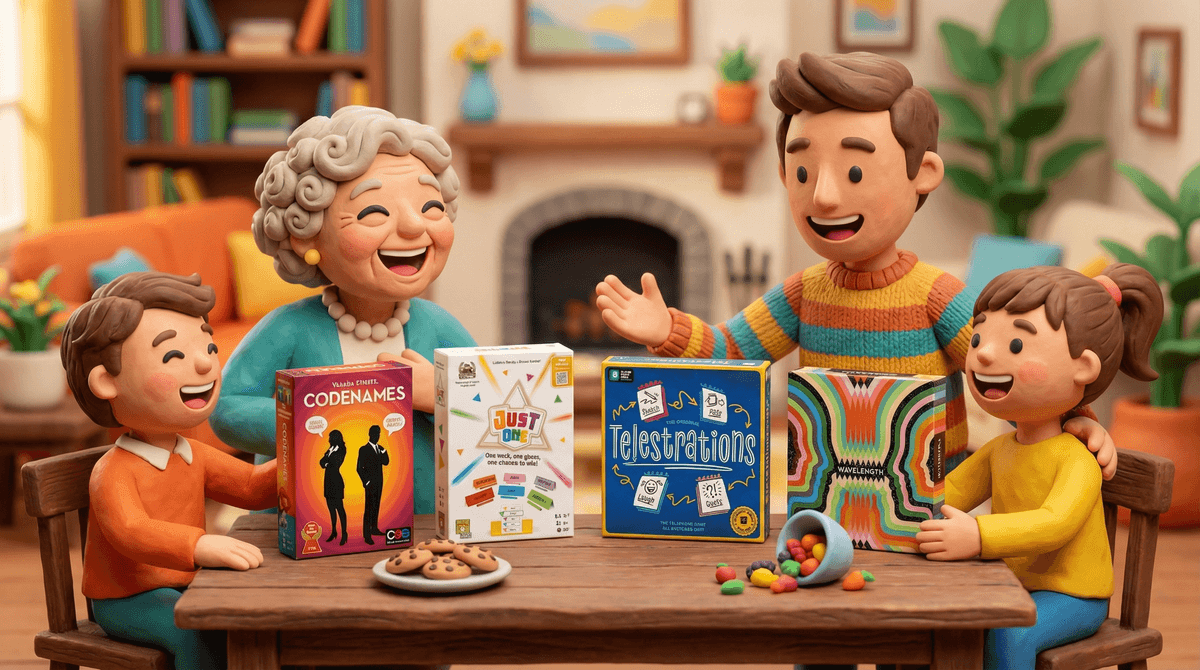
Look, we all know the scene: extended family gathering, ages 4 to 74, everyone's had enough small talk, and someone suggests a game. Then comes the negotiation olympics. The 6-year-old can't read yet. Grandma doesn't want anything too loud. The teenagers are rolling their eyes before you even open the box.
Party games for families are the holy grail of multi-generational entertainment—games that can actually engage everyone without requiring a PhD in rules or leaving half the players checking their phones. We're talking about games with simple mechanics, quick rounds, and that magical quality where losing is almost as fun as winning.
The best part? These are screen-free activities that don't require convincing anyone to put their phone away because they're genuinely more entertaining than scrolling TikTok. (Yes, really. I know that sounds impossible in 2026, but stick with me.)
Before you think this is another lecture about unplugging, let me be clear: this isn't about demonizing screens. If your family has a blast playing Mario Kart together, that's quality time too.
But here's what makes party games different:
Face-to-face interaction hits different. You catch the micro-expressions, the genuine laughter, the trash talk that's actually funny instead of toxic. Kids learn to read social cues, manage disappointment when they lose, and celebrate without a victory dance emote.
They're great equalizers. A well-chosen party game doesn't care if you're 8 or 80, whether you're a "gamer" or someone who still calls every console "a Nintendo." Everyone starts on the same playing field.
No updates, no subscriptions, no in-app purchases. Once you own Codenames or Sushi Go, you're done. No one's asking for V-Bucks mid-game.
For Mixed Ages (Preschool through Elementary)
Outfoxed is a cooperative whodunit that works for ages 5+. Everyone works together to catch the thief, so there's no "I lost and now I'm melting down" drama. The deduction element keeps older kids engaged while younger ones can participate meaningfully.
Sleeping Queens (ages 8+, but honestly works younger) is pure chaos in the best way. Simple math, memory, and strategy—but fast enough that attention spans don't wander.
Spot It is the MVP for ages 4+. Rounds take 2 minutes. Everyone can play. It's basically impossible to explain why matching symbols is so addictive, but trust me, Grandpa will get VERY competitive.
For Elementary and Up
Sushi Go Party (ages 8+) is card-drafting perfection. You're passing cards, building sets, making split-second decisions. Games take 15-20 minutes, so if someone's sulking, the next round starts quickly.
Just One (ages 8+) is cooperative word-guessing where the twist is that duplicate clues get canceled. Watching a 9-year-old and their grandfather both write "yellow" and then have to cross it out is comedy gold.
Telestrations (ages 8+, though 12+ is more reliably hilarious) is telephone meets Pictionary. By round three, "horse" has somehow become "alien spaceship" and everyone's crying laughing. This is the game that creates family lore.
For Tweens, Teens, and Adults (That Kids Can Join)
Wavelength (ages 14+, but mature 10-year-olds can hang) is about getting on the same wavelength as your teammate. Where does "Roblox" fall on a spectrum from "cringe" to "cool"? The arguments alone are worth it.
Codenames (ages 14+, works for younger with patient adults) is word association in team format. It scales beautifully—works with 4 players or 12. And there's Codenames: Pictures for younger or ESL players.
Coup (ages 13+) is bluffing and deduction in 15 minutes. Can you lie convincingly to your own mother? We're about to find out.
Start with games that have zero reading requirements if you've got pre-readers. Spot It, Outfoxed, and Sleeping Queens work great here.
Cooperative games are your friend for sore losers. If someone in your crew struggles with competitive games (no judgment, we all have that kid or uncle), start with games where everyone wins or loses together. Outfoxed and Just One are perfect for this.
Short games = more chances to win. Instead of one 90-minute game where someone's checked out by minute 12, play games with 10-15 minute rounds. Play multiple rounds. Suddenly everyone's won something and no one's rage-quit.
House rules are not cheating. If a rule isn't working for your family, change it. Let the youngest player go first every round. Skip the advanced rules. Do whatever keeps people at the table and laughing.
You don't need a massive collection. Five solid games that your family actually enjoys beats 30 games collecting dust. Start small, see what clicks, build from there.
The best party game for your family is the one that gets everyone to the table without groaning. That might be Uno (yes, it counts). It might be Exploding Kittens. It might be charades with a decades-old set of cards.
The magic isn't in the game itself—it's in the shared experience of trying something together, laughing at failures, and creating memories that don't live in a camera roll.
Start with one game from this list. Try it at your next gathering. See what happens. Worst case? You've got a new game. Best case? You've got a new family tradition that doesn't require WiFi, batteries, or anyone asking "what's the password?"
Pick one game based on your youngest player's age. If you've got a 5-year-old, grab Outfoxed or Spot It. If your youngest is 10+, go straight for Codenames or Sushi Go Party.
Set the vibe before you start. Make it clear: we're trying something new, it might be weird at first, and that's okay. No one's getting eliminated from family if they don't love it.
Have a backup plan. If the game flops, have another activity ready. Sometimes the best game night is the one where you tried a game for 10 minutes, collectively decided it wasn't the vibe, and pivoted to alternatives to traditional board games.
And hey, if you need help figuring out what games might work specifically for your family's ages and interests, Find party games for your family . We've got you.