

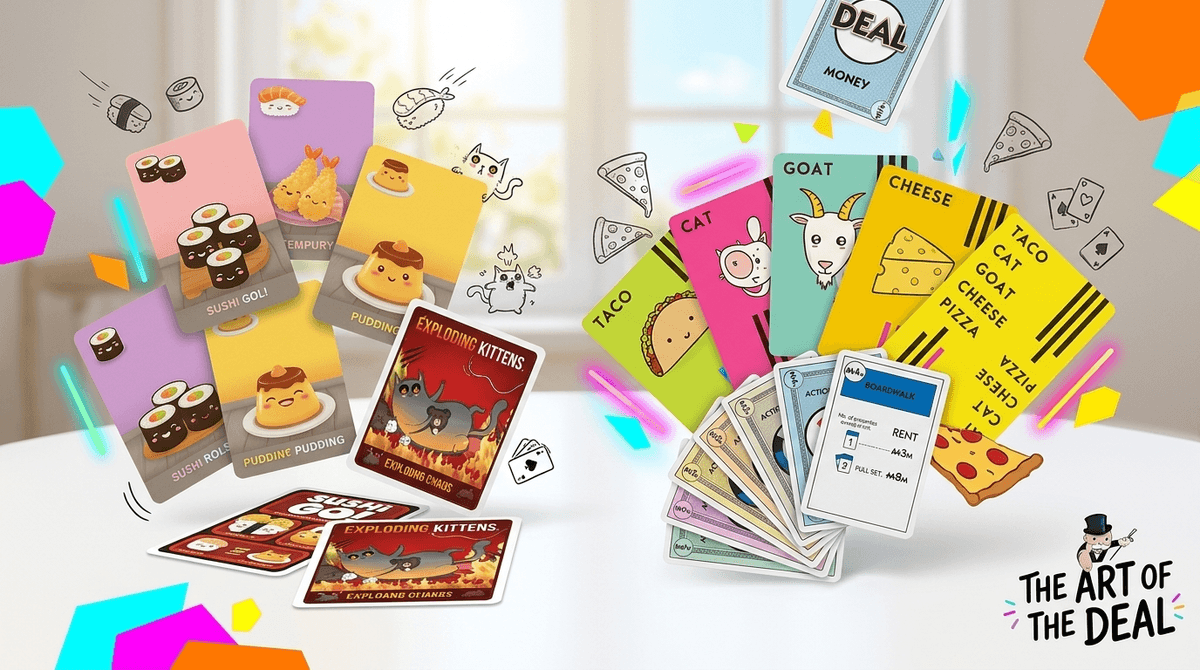
TL;DR: The Cheat Sheet If you’re looking to reclaim the dinner table from the siren call of Roblox, these are the heavy hitters that actually hold a kid's attention in 2026:
- For pure chaos: Exploding Kittens
- For the "one more round" speedsters: Taco Cat Goat Cheese Pizza
- For the strategy lovers: Sushi Go!
- For the competitive math-heads: Skyjo
- For the "I hate Monopoly" parents: Monopoly Deal
We’ve all been there. You announce "Family Game Night" with the enthusiasm of a 90s game show host, and your kids look at you like you just asked them to do long division for fun. To a kid who spends their afternoon in the high-octane, neon-soaked worlds of Fortnite or [Brawl Stars](https://screenwiseapp.com/media/brawl-stars-app, a standard deck of cards feels... well, mid.
The problem isn't that kids don't like games anymore; it’s that their "game loop" expectations have changed. They want fast turns, high stakes, a bit of "trolling" (in a fun way), and visuals that don't look like they were designed in 1952.
If you're trying to compete with TikTok trends and Skibidi Toilet lore, you need card games that have main character energy.
Digital wellness isn't just about setting up parental controls or tracking screen time percentages. It’s about replacement theory. You can’t just take away the iPad and leave a void; you have to fill it with something that provides a similar dopamine hit.
Card games are the ultimate "bridge" media. They offer:
- Low Barrier to Entry: No 4-hour rulebooks (looking at you, Catan).
- Social Engineering: You’re forced to look at each other’s faces, read "tells," and engage in actual banter.
- Portability: You can play these while waiting for appetizers at a restaurant or in a tent while camping.
Learn more about the benefits of analog play for digital-native kids
These games are for the kids who love the frantic pace of Among Us. Expect yelling, slapping the table, and a lot of laughing.
Ages 6+ This game is pure, unadulterated "brain rot" in the best way possible. It’s a rhythmic slapping game. You say the words in order, and when the card matches the word, everyone slaps the pile. It’s simple, it’s loud, and it’s surprisingly difficult for adults because our brains are slower than an 8-year-old’s reflexes. It’s the perfect 10-minute filler.
Ages 7+ Think of this as Russian Roulette but with kittens, laser beams, and goat cheese. The goal is to not draw the exploding kitten. The art style (by The Oatmeal) resonates perfectly with the internet-humor vibe kids love. It’s strategic but mostly chaotic. It teaches kids how to "screw over" their opponents in a way that feels fair because it’s so random.
Ages 8+ If your kid is a "pro gamer" with high APM (actions per minute), this is their game. It’s a fast-paced "vonderful" game where everyone plays at the same time. There are no turns. You’re just trying to empty your deck as fast as possible. It’s basically Solitaire on caffeine.
If your kid spends their time building empires in Minecraft or managing "work" in Adopt Me!, they’ll appreciate games that require a bit of planning and "engine building."
Ages 8+ This is a "pick and pass" game. You’re drafting a meal of sushi, trying to get the best combinations of tempura, sashimi, and maki. It teaches basic probability and risk assessment. It’s incredibly cute, very fast, and is a great gateway to more complex "euro-style" games.
Ages 8+ This has become a massive "sleepy hit" in the parenting community. The goal is to get the lowest score possible by swapping out cards in your 12-card grid. It’s lowkey addictive. It involves a lot of "mental math" that kids don't realize they're doing—which is the ultimate parenting win. It’s great for that 3rd-5th grade range where they’re mastering addition and subtraction with negative numbers.
Ages 8+ Forget everything you hate about Monopoly. The board game is a friendship-ending slog that takes three hours. Monopoly Deal is a 15-minute card game that is actually good. You collect property sets, steal cards from other players, and charge rent. It’s high-stakes and feels like you’re pulling off a heist.
These games are about reading the room, which is a skill many kids lose when they spend too much time behind a screen.
Ages 8+ This is less of a game and more of a "social experiment." You have to play cards in ascending order (1-100) without talking. You just have to "feel" the timing of the other players. It sounds impossible, but when your family gets into the rhythm and plays five cards in a row perfectly, it feels like you’ve developed telepathy. It’s a great way to practice non-verbal communication and focus.
Ages 10+ This is the gold standard for family gatherings. You have a "spymaster" giving one-word clues to help their team find their secret agents on a grid of words. It’s brilliant because it forces kids to think about word associations and how other people think.
Check out our full guide on why Codenames is the best game for building vocabulary
When picking a game, don't just look at the box age. Look at your kid's frustration tolerance.
- Grades K-2: Stick to games like Taco Cat Goat Cheese Pizza or Uno. They need quick wins and simple rules.
- Grades 3-5: This is the sweet spot for Sushi Go! and Exploding Kittens. They can handle a bit of strategy and "take that" mechanics where they can target their siblings.
- Middle School & Up: They want games with depth or irony. Codenames or even What Do You Meme? Family Edition (which taps into their love of internet culture) are winners here.
Let’s be real: your kids might still ask for Robux ten minutes after you finish a game of Skyjo. Card games aren't a "cure" for digital interest, and they shouldn't be. Digital literacy is important.
However, card games provide a different kind of social wealth. In a video game, the "social" aspect is often mediated by a headset and a screen. In a card game, you see the "I’m about to win" smirk on your daughter's face. You see the "I can't believe you just did that" look from your son.
A few tips for success:
- Lose the "Teacher" Vibe: Don't turn this into a lesson. If they mess up the rules, let it slide once or twice. The goal is fun, not precision.
- Let Them Win (Sometimes): But not always. Part of the value of card games is learning how to lose without throwing a controller (or an iPad).
- Create a "No Phone" Zone: That includes you, too. If you're checking your email while playing Sushi Go!, you're telling them the game isn't actually worth their full attention.
The best family card games are the ones that mimic the fast feedback loops of digital media while grounding kids in the physical world. You don't need a massive board or a 30-minute setup. You just need a deck of cards that feels relevant to their world.
Start with Monopoly Deal or Exploding Kittens. They’re cheap, they’re fast, and they’re lowkey better than half the "brain rot" games currently trending on the App Store.
Get a card game recommendation based on your kid's favorite video games
- Pick one game from the list above that matches your kid's favorite digital hobby.
- Commit to 20 minutes. Most of these games are designed for short bursts.
- Check the Screenwise community data to see which games other parents in your school district are playing—you might find a local trend you didn't know about.