

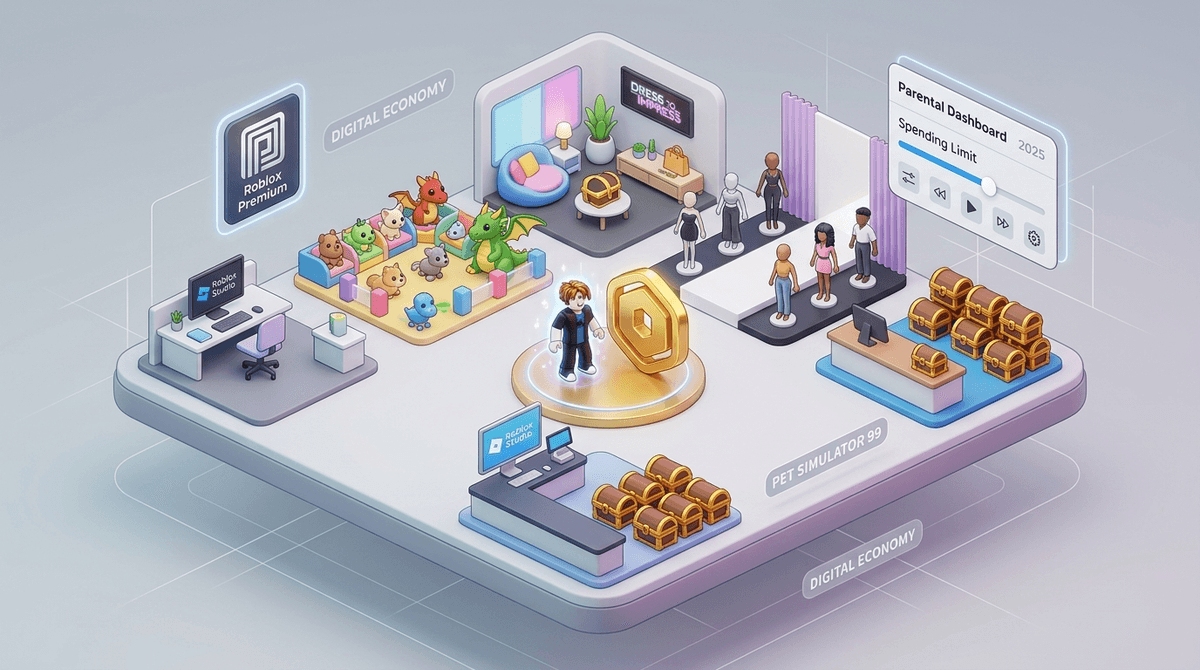
TL;DR: Roblox isn't just a game; it’s a digital economy. Robux is the currency, and Roblox Premium is the subscription that unlocks the "pro" features. While it can teach basic budgeting and digital creation, for most kids, it’s a social pressure cooker designed to encourage spending. The good news? New 2026 updates give parents way more control over spending limits than we ever had before.
Learn more about setting up Roblox parental controls Check out our guide on teaching kids about digital money
If you’ve spent more than five minutes around a grade-schooler lately, you’ve heard the plea. It usually happens right as you’re trying to get dinner on the table or finish an email: "Can I please, please, please just have 400 Robux? It’s only five dollars!"
To us, it’s $5 for a digital hat that doesn't exist. To them, it’s the difference between being a "bacon hair" (a default, uncustomized avatar) and having "aura." In the world of Roblox, your avatar is your identity, and your Robux balance is your social capital.
But as Roblox evolves, the economy has become significantly more complex. We’re no longer just talking about buying a virtual pet in Adopt Me!; we’re talking about tiered subscriptions, limited-edition item trading, and "developer" mindsets.
Let’s break down how this works in 2026, so you can decide if you're funding a future CEO or just a very expensive digital wardrobe.
Robux is the platform-wide currency. You can’t earn it just by playing (usually); you have to buy it with real-world cash.
The exchange rate is roughly $1 USD to 80-100 Robux, depending on whether you buy in bulk or have a subscription. Kids use it for:
- Avatar Items: Shirts, hair, wings, and animations in the Marketplace.
- Game Passes: One-time purchases that give you "superpowers" or special items within a specific game, like a faster car in Brookhaven.
- Developer Products: Consumables like "potions" or "coins" inside games like Pet Simulator 99.
Roblox Premium is a monthly subscription. If your kid is asking for this, they aren't just looking for a one-time infusion of cash—they want the "status" and the "perks."
There are three main tiers (usually priced at $4.99, $9.99, and $19.99 per month). Here’s what they actually get:
- A Monthly Robux Allowance: They get a lump sum of Robux every month that is slightly higher than what you’d get for a one-time purchase of the same price.
- The 10% Bonus: Whenever they buy more Robux, they get 10% more for their money.
- Economy Access: This is the big one. Premium members can trade items with other players and sell their own creations (like shirts or pants) in the marketplace.
The Screenwise Take: If your kid is just playing Dress to Impress or Berry Avenue to hang out with friends, Premium is overkill. But if they are genuinely interested in the "business" of Roblox—making clothes or learning to code—Premium is the gatekeeper.
Roblox loves to market itself as a launchpad for the next generation of developers. And to be fair, there is some truth to that.
If your child is using Roblox Studio to build games or designing original clothing to sell, they are learning:
- Supply and Demand: Why does a "Limited" item cost 50,000 Robux?
- Profit Margins: Roblox takes a 30% cut of all sales. That’s a harsh, but real, lesson in platform fees.
- Digital Marketing: How do they get other kids to click on their game instead of the millions of others?
However, for 95% of kids, Roblox is not a business; it’s a mall. Most of the "entrepreneurship" involves "trading up" items, which is often just a fancy word for "hoping I don't get scammed by a teenager in a different time zone."

In late 2024 and heading into 2025, Roblox finally listened to the collective screaming of parents worldwide and overhauled their safety and spending systems.
The most important change? Linked Parent Accounts. You can now link your account to your child’s. This allows you to:
- Set Monthly Spending Limits: You can literally cap the amount of Robux they can buy or spend per month.
- Spend Notifications: Get an email every time they buy something. No more "accidental" $100 charges because your credit card was saved to the iPad.
- Visibility: You can see exactly what they are buying. Are they buying educational tools? Or are they spending $20 on "luck boosts" in a gambling-adjacent pet game?
Ages 6-9
At this age, the concept of "digital money" is barely real. They see a cool dragon in Adopt Me! and they want it.
- Recommendation: Stick to a "one-time purchase" model for birthdays or rewards. Avoid the Premium subscription. Set the spending limit to $0 in the parent dashboard so they have to ask you for every purchase.
Ages 10-12
This is the peak "social pressure" age. If their friends have the "Headless" horseman avatar (which costs a fortune), they will feel the sting of being "poor" in the digital world.
- Recommendation: This is a great time for a "digital allowance." If they want Robux, it comes out of their real-world allowance. It’s a low-stakes way to teach them that once the money is gone, it’s gone.
Ages 13+
If they haven't moved on to Fortnite or Minecraft exclusively, they might be getting into the actual creation side of Roblox.
- Recommendation: If they can show you a "business plan" for a shirt they designed or a game they are building, Premium might actually be a valid educational expense.
Where there is money, there are scammers. Roblox is notorious for "Free Robux" scams.
- The Rule: There is no such thing as free Robux. Any website, YouTube video, or in-game chat promising free Robux is a scam designed to steal their account password or your credit card info.
- Trading Scams: Kids often get "socially engineered" into trading a very rare item for a bunch of common ones that "look cool," only to realize they’ve been ripped off.
Instead of just saying "no" or blindly handing over the credit card, try these conversation starters:
- "What does this item actually do in the game? Does it help you play better, or does it just look cool?"
- "I see you want 800 Robux. That’s about $10. Would you rather have that digital shirt, or should we go get a real ice cream after school?" (Comparing digital value to physical value is a huge eye-opener for kids).
- "Show me the 'Top Rated' items in the marketplace. Why do you think everyone wants those right now?"
Robux and Premium aren't inherently "bad," but they are designed by world-class engineers to be friction-less and addictive.
If you treat Roblox like a toy store, your bank account will suffer. If you treat it like a tool for teaching financial literacy—complete with budgets, limits, and "earning" mechanics—it can actually be a pretty decent classroom.
Next Steps:
- Link your accounts. If you haven't done the new 2025 "Parental Tools" setup, do it tonight.
- Audit the "Game Passes." Look at what they've bought in the last month. If it's all "luck boosts" or "consumables," have a chat about why those are "money pits."
- Set a "Robux Day." Instead of constant nagging, pick one day a month where you discuss their digital budget.