

Look, the Nintendo Switch is genuinely one of the best things to happen to family gaming in years. It's portable, it's got an incredible library of games that aren't just thinly-veiled gambling simulators, and it doesn't require a PhD in parental controls to keep your kids safe.
But walking into the Nintendo eShop is like walking into Target—you go in for one thing and suddenly you're $200 deep wondering how you got here. With thousands of games available, figuring out which ones are actually worth your money (and your kid's time) can feel overwhelming.
This guide breaks down the best Switch games by age group, with real talk about what makes them great, what might drive you nuts, and whether they're worth the investment. No BS, just games that actually deliver on being fun, age-appropriate, and not designed to extract every dollar from your wallet through microtransactions.
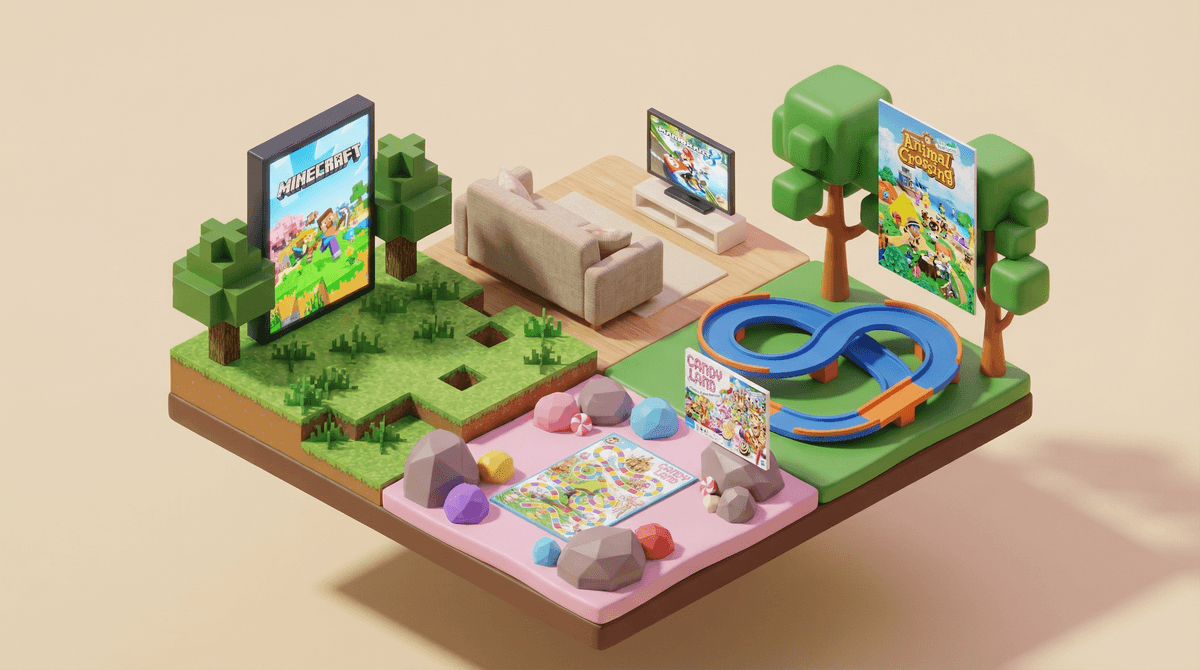
Animal Crossing: New Horizons
This is the game that got adults through 2020, and it's equally magical for young kids. Animal Crossing: New Horizons is basically a cozy life simulator where you build a village, catch bugs, fish, and decorate your house. There's no time pressure, no way to "lose," and the worst thing that can happen is a wasp sting (which is admittedly traumatic for a 5-year-old but recoverable).
The real deal: This game teaches time management, basic economics (those turnip prices!), and delayed gratification. Your kid will learn to save up bells for that perfect couch. The reading level is manageable for emerging readers, and there's genuine creativity in the design aspects.
Parent heads-up: The game runs in real-time, which means if your kid wants to play at 3pm, it's 3pm in the game. Some kids love this, others get frustrated they can't time-travel to tomorrow's events. Also, if you have multiple kids sharing one Switch, know that only the first player gets to be the "island representative" who makes major decisions. This has caused sibling warfare in many households.
Mario Kart 8 Deluxe
Mario Kart 8 Deluxe is the family game night champion for a reason. It's got an auto-steer option that keeps younger kids on the track, so your 5-year-old isn't spending the entire race in a pit of lava while crying.
Why it works: Up to 4 players can race together on one screen, and the skill ceiling is high enough that you won't get bored playing with them. The auto-accelerate and steering assists mean even very young kids can participate and feel successful.
Real talk: Your kid WILL blue shell you right before the finish line and feel zero remorse. This is character building for everyone involved.
Kirby and the Forgotten Land
If you want a 3D platformer that's actually designed for young kids (not just "appropriate" for them), Kirby and the Forgotten Land is it. Kirby is adorable, the difficulty is forgiving, and there's a two-player co-op mode where the second player is basically invincible.
What makes it special: The "Mouthful Mode" where Kirby swallows large objects (cars, vending machines) is hilarious and gives kids different abilities to experiment with. It's creative, weird, and genuinely fun.
Minecraft
Yes, Minecraft is on every platform, but the Switch version is particularly good for this age group. It's portable, you can easily monitor what they're doing, and the controls are intuitive.
The educational case: Minecraft genuinely teaches spatial reasoning, resource management, basic coding (with redstone), and creative problem-solving. Kids learn to plan projects, iterate on designs, and persist through challenges.
The reality check: Your kid will spend 6 hours building a house, then a creeper will blow it up, and there will be tears. This is part of the learning process, but prepare yourself. Also, if they want to play online multiplayer, you'll want to understand how to set up parental controls and maybe stick to realm servers with known friends.
The Legend of Zelda: Breath of the Wild
This is the game that makes kids (and adults) fall in love with gaming. Breath of the Wild is an open-world adventure that rewards curiosity and experimentation. You can approach problems in multiple ways, and the game never tells you you're doing it wrong.
Age consideration: The box says 10+, and that's about right. There's combat (not gory, but enemies do disappear in a puff of smoke when defeated), and some puzzles require pretty sophisticated problem-solving. Kids on the younger end of this range might need help with some shrines, but that can be a great co-play opportunity.
Why it's worth it: This game teaches persistence, creative problem-solving, and the joy of exploration. Kids learn that failure is just information—if that approach didn't work, try something else.
Stardew Valley
Stardew Valley is like Animal Crossing's slightly more complex cousin. You inherit a farm and build it up while forming relationships with townspeople, exploring caves, and managing your time and resources.
The learning curve: There's more reading than Animal Crossing, and the game has more complex systems (crop seasons, relationship values, cave combat). But for kids ready for that complexity, it's incredibly rewarding.
Parent perspective: This game is genuinely relaxing and teaches time management and prioritization. Your kid will learn they can't do everything in one day and need to plan. Also, the pixel art aesthetic is charming, not flashy, which is a nice break from the overstimulation of many modern games.
Splatoon 3
Splatoon 3 is Nintendo's take on competitive online multiplayer, and it's brilliant. Instead of shooting bullets, you're shooting ink and trying to cover the most territory. It's colorful, fast-paced, and genuinely strategic.
The online component: Yes, this is online multiplayer, which means your kid is playing with strangers. The good news: there's no voice chat with random players (only with friends), and the community is generally less toxic than other competitive games. The bad news: it's still competitive online gaming, so there will be frustration when teams lose.
Why it's good: This game teaches teamwork, spatial awareness, and strategic thinking. Different weapons require different playstyles, so kids learn to adapt and find what works for them.
Hollow Knight
For kids ready for a challenge, Hollow Knight is a masterpiece. It's a "metroidvania" style game with beautiful hand-drawn art, atmospheric music, and genuinely challenging gameplay.
Content note: The game has a melancholy, sometimes eerie atmosphere. You're exploring a fallen kingdom of bugs, and there are themes of decay and loss. It's not scary in a horror game way, but it's definitely got a mood. Combat involves defeating bug enemies with a nail (sword).
The value: This game costs $15 and offers 40+ hours of gameplay. It teaches persistence, pattern recognition, and the satisfaction of overcoming difficult challenges. Kids who beat Hollow Knight feel genuinely accomplished.
Hades
Hades is rated Teen for good reason—there's combat, some suggestive themes (it's Greek mythology, after all), and occasional mild language. But for mature 13+, it's an incredible game about family, persistence, and growth.
What makes it special: Every time you die (and you will die a lot), you go back to the beginning but keep some progress. The story unfolds through these repeated attempts, and the writing is genuinely excellent. It teaches that failure is part of the process, not the end.
Parent consideration: The Greek gods are depicted in ways that are... let's say historically accurate to their mythology. There's flirtation, relationship drama, and Dionysus is definitely drunk. If you're comfortable with your teen reading Greek mythology, you'll be fine with Hades.
Fortnite
Fortnite is on Switch, and yes, many kids play it. It's free-to-play, which means the game makes money through cosmetic purchases. The battle royale gameplay is intense, and the social pressure to have the latest skins is real.
Real talk: Fortnite isn't evil, but it's designed to keep kids playing and spending. If your kid is playing Fortnite, you need to understand how V-Bucks work and set clear boundaries around purchases and play time.
Roblox
Roblox on Switch is a more controlled experience than on PC or mobile, but it's still a platform with user-generated content, which means quality and appropriateness vary wildly. Some Roblox games are creative and educational; others are just skinner boxes designed to extract Robux.
If you're going to allow it: Set up parental controls, restrict who can contact your kid, and actually look at what games they're playing. Not all Roblox is created equal.
The Switch has an incredible library of games that respect kids' intelligence and don't rely on manipulative monetization. The games on this list range from cozy and creative to challenging and strategic, but they all offer genuine value.
The best part: Many of these games are ones you'll actually enjoy playing with your kids. Mario Kart, Animal Crossing, and Breath of the Wild are legitimately fun for adults too, which makes family gaming time something everyone looks forward to rather than just endures.
Budget tip: Nintendo games rarely go on sale, but they also hold their value. You can buy physical copies and resell them when your kids are done, or use the family sharing features to share digital games across multiple profiles.
The Switch isn't going to teach your kid calculus or make them a better person, but it can provide genuinely enriching entertainment that develops problem-solving skills, creativity, and persistence. And sometimes, it's just nice to race go-karts with your kid without anyone ending up in timeout.
Next step: Pick one game from your kid's age range and try it together. See what they gravitate toward—some kids love the creative freedom of Minecraft, others prefer the structure of Zelda. There's no wrong answer, just different styles of play.