

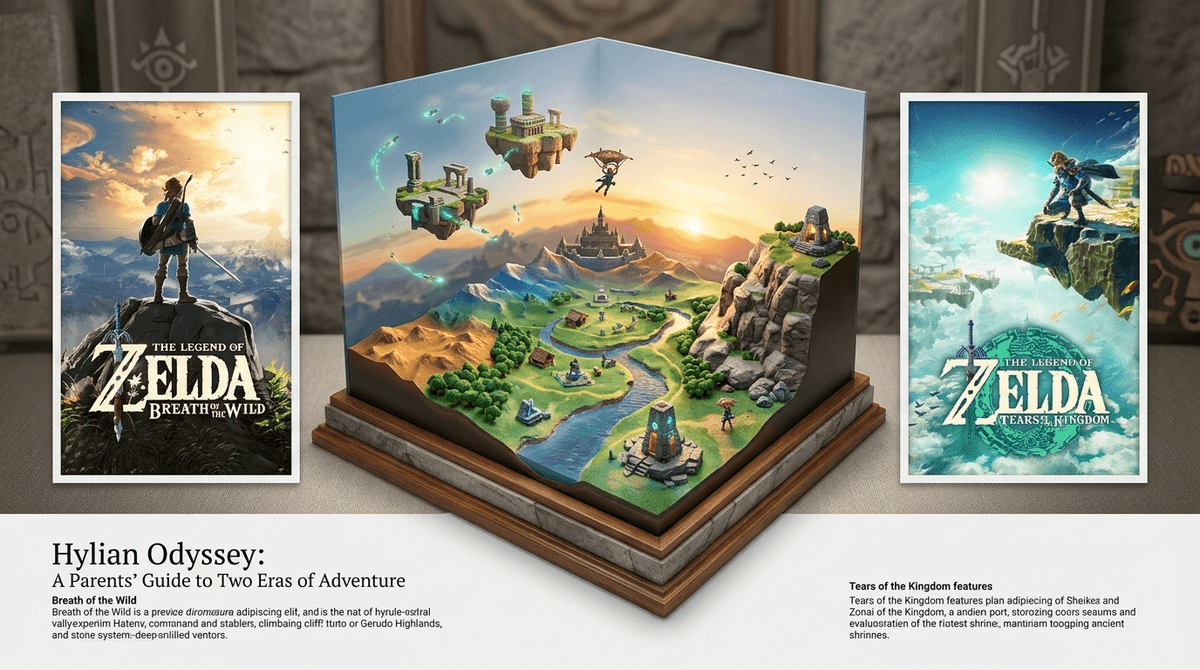
TL;DR: The Legend of Zelda: Breath of the Wild is arguably the best investment you can make for a child’s gaming library. It trades the "brain rot" of endless scrolling and the predatory microtransactions of Roblox for a massive, beautiful world that rewards curiosity, physics-based problem solving, and persistence. It’s rated E10+, has zero online chat (praise be), and is a rare "prestige" game that parents actually enjoy watching.
Quick Links:
- The Sequel: The Legend of Zelda: Tears of the Kingdom
- For Younger Siblings: Animal Crossing: New Horizons
- Similar Creative Vibes: Minecraft
- The "Vibe" Guide: Cozy games for kids
If you’ve been out of the gaming loop since Tetris, here’s the breakdown: Breath of the Wild (often called BotW) is an "open-world" adventure game. You play as Link, a knight who wakes up after a 100-year nap to find the kingdom of Hyrule in ruins. Your job is to explore, get stronger, and eventually take down "Calamity Ganon."
But unlike the linear games of our childhood where you went from Level 1 to Level 2, BotW lets you go anywhere immediately. If you see a mountain in the distance, you can climb it. If you see a river, you can raft across it. It’s less of a digital chore list and more of a digital playground.
Kids are used to games that yell at them. Fortnite is loud and stressful. Roblox is a chaotic mess of "Please buy this!" pop-ups.
BotW is different. It respects the player’s intelligence.
- The "Chemistry" Engine: This is the secret sauce. If it’s raining, surfaces get slippery and you can’t climb. If there’s a thunderstorm and you’re wearing metal armor, you’ll get struck by lightning. If you drop an apple near a fire, it cooks. Kids love testing these "what if" scenarios. It’s basically a stealth physics lesson.
- Total Freedom: In a world where kids are told what to do every minute of the day, BotW says, "Do whatever you want." They can spend three hours just gathering ingredients to cook "Mighty Simmered Fruit" or trying to tame a skeleton horse.
- The "Shrines": These are mini-puzzles scattered throughout the world. They aren't about fast reflexes; they’re about logic. Watching a 9-year-old figure out how to use magnets and gears to open a door is a genuine "proud parent" moment.
We talk a lot about "digital wellness" and "intentional parenting." Usually, that means setting timers or blocking apps. But digital wellness is also about quality.
BotW is the "slow food" of gaming. It’s not designed to give a dopamine hit every five seconds. It requires focus. It requires the ability to fail, lose your equipment, and try a different path. When your kid says something is "lowkey mid" or "so Ohio," they’re usually talking about low-effort content. Zelda is the opposite of that. It’s high-art, high-effort, and high-reward.
Read our guide on identifying high-quality games vs brain rot
Exploration and Discovery
The game doesn’t use a "map" in the traditional sense. You have to climb towers to see the land and mark points of interest yourself. This encourages spatial awareness and planning.
Creative Combat
Yes, there is combat. Link uses swords, bows, and shields. But because weapons break (a controversial feature that teaches resource management!), kids often have to find creative ways to win. Can they roll a boulder onto the enemies? Can they set the grass on fire and let the wind carry the flames toward the camp?
Cooking and Crafting
There is a surprisingly deep cooking system. You collect mushrooms, meat, herbs, and insects. Different combinations give you different buffs (like cold resistance or extra health). It’s a great introduction to "crafting" mechanics found in more complex games like Stardew Valley.
Official Rating: E10+ (Everyone 10 and up) Screenwise Recommended Age: 8+ (with some help), 10+ (independent)
At this age, the combat might be a little frustrating. Some of the "Guardians" (giant robot spiders with laser beams) are genuinely scary and have intense music. However, younger kids often love just exploring the starting area and "helping" a parent or older sibling cook.
This is the sweet spot. They are old enough to handle the puzzles and the "perma-break" weapon system without a total meltdown. They’ll also start to appreciate the story, which is told through "memories" found throughout the world.
Teens will likely fly through the main story but might enjoy the challenge of finding all 900 "Korok seeds" (collectible hidden puzzles) or completing the "Master Trials" DLC.
Check out our guide on gaming maturity and age ratings
This is the best part for us parents: There is no online component.
- No Chat: No 30-year-old strangers calling your 10-year-old names.
- No Microtransactions: Once you buy the game, you own the game. There is no "Zelda-currency" to buy with your credit card. No "skins" to flex on friends.
- No Loot Boxes: Everything you get in the game is earned through play.
- Privacy: Since it’s a single-player, offline experience, there are virtually zero privacy concerns beyond the standard Nintendo account data.
The only "danger" is the time suck. Because the world is so big, "just five more minutes" can easily turn into two hours.
The Weapon Breaking Mechanic
Your kid will complain about this. In BotW, swords and shields break after a certain amount of use. It feels "unfair" to kids used to keeping their gear forever.
- The Lesson: It teaches them not to get too attached to "things" and to always have a Plan B. It forces them to try new tools.
It’s Not "Easy"
Unlike many modern games that hold your hand, BotW will let you walk right into a boss fight you aren't ready for. Link will die. A lot.
- The Lesson: Resilience. The game saves frequently, so they never lose much progress, but they have to learn from their mistakes.
The "Blood Moon"
Every so often in the game, the sky turns red and enemies respawn. It has a creepy cutscene. Some sensitive kids might find it a bit spooky the first time, but it’s just a game mechanic to reset the world.
Get advice on managing gaming frustration and rage-quitting
If you want to engage with your kid while they play (without sounding like a "narc"), try these prompts:
- "What’s the coolest thing you’ve cooked so far?"
- "I saw you fighting that giant rock monster—what was your strategy?"
- "How are you planning to get to that tower? It looks really high."
- "Wait, did you just use a leaf to blow that boat across the water? That’s actually smart."
By focusing on their process rather than just the "win," you’re validating the creative thinking the game encourages.
The Legend of Zelda: Breath of the Wild is the "Gold Standard" for a reason. In an era of digital junk food, this is a five-course nutritional meal. It’s safe, it’s intellectually stimulating, and it’s a shared cultural touchstone that actually deserves its hype.
If you’re looking to transition your child away from the more toxic corners of the internet—like YouTube rabbit holes or the "pay-to-win" grind of mobile apps—giving them a Nintendo Switch and a copy of Zelda is a fantastic "pivot" move.
- Check the Price: It rarely goes on sale (Nintendo is stingy like that), but it’s worth the $60.
- Set Boundaries: Use the Nintendo Switch Parental Controls app to manage time.
- Watch Together: Sit down for 20 minutes and let them show you Hyrule. You might find yourself wanting to take the controller.
- Explore More: If they finish BotW, check out our guide on The Legend of Zelda: Tears of the Kingdom.