

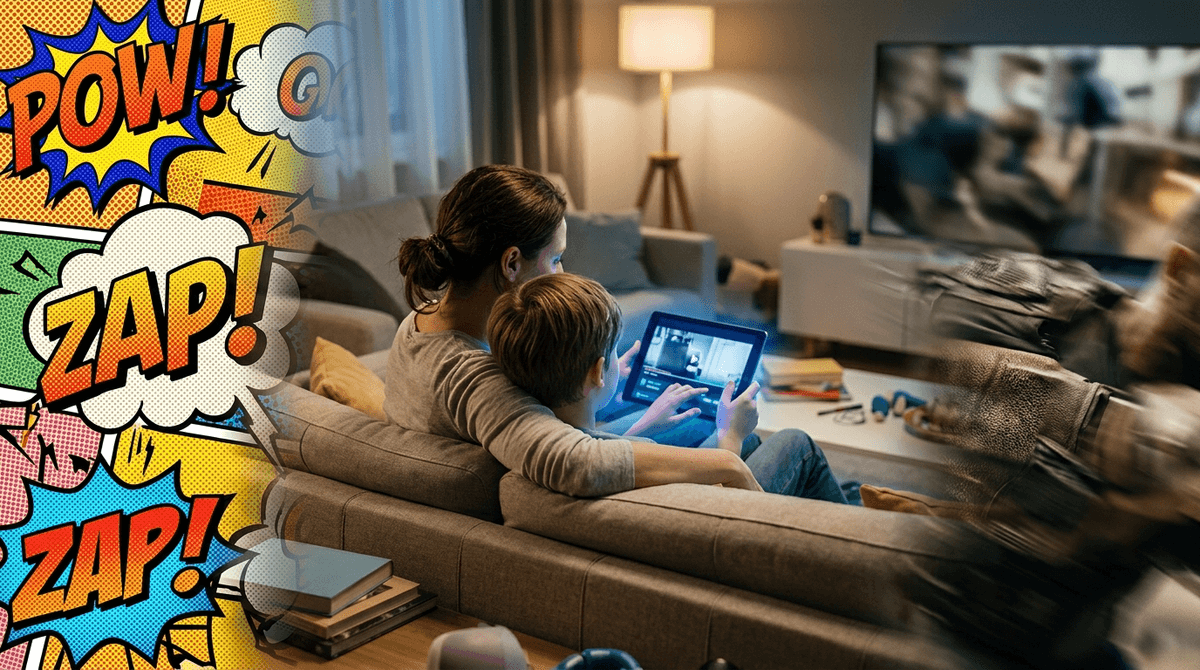
TL;DR: Media violence has evolved from pixelated "POW!" bubbles to hyper-realistic 4K combat and "edgy" viral clips served by engagement-hungry algorithms. The goal isn't to live in a bubble, but to help kids process what they see without losing their empathy.
- Top "High-Impact" Media to Watch Out For: Grand Theft Auto V, Call of Duty, and the "brain rot" intensity of Skibidi Toilet.
- Better Alternatives for Action-Seekers: The Legend of Zelda: Tears of the Kingdom, Hades, and Spider-Man 2.
- Empathy-Building Media: The Wild Robot and Spiritfarer.
If you’ve spent five minutes on YouTube lately, you know that "violence" in 2026 doesn't just mean a guy with a cape punching a villain. It’s everywhere. It’s in the "Ohio" memes that get weirdly aggressive, it’s in the jumpscares of Five Nights at Freddy's, and it’s in the "prank" videos where someone gets publicly humiliated for clout.
As parents, we're often playing a game of Whac-A-Mole. We block Grand Theft Auto V only to find our ten-year-old watching a "realistic" war recreation on TikTok. It’s exhausting. But here’s the reality: we can’t block every pixel. What we can do is give our kids the internal software to process the violence they encounter so it doesn't just become background noise to them.
We have to talk about why our kids see so much intense stuff in the first place. It’s not necessarily because they’re "bad kids" looking for trouble. It’s because of the engagement loop.
Platforms like Instagram and YouTube Shorts are built on one metric: watch time. Nothing grabs human attention faster than conflict, a loud noise, or a physical shock. When a kid watches one "Skibidi" video where a head pops out of a toilet to scream, the algorithm notes that they didn't scroll away. It then feeds them something slightly more intense. Before you know it, their "For You" page is a chaotic mess of Fortnite eliminations and "fails" where people actually get hurt.
This creates a "desensitization curve." When the baseline for entertainment is a high-speed car chase or a tactical reload, a quiet book or a slow-paced show like Bluey feels "boring." We’re not just fighting the violence; we’re fighting the dopamine spike that comes with it.
Not all violence is created equal. To have a real conversation with your kids, you have to know the difference between "cartoonish" and "gratuitous."
In these worlds, violence is usually "reductive." You hit a blocky zombie, it disappears into a puff of smoke or a red tint. The stakes are low. However, the social violence in Roblox is often worse than the gameplay. "Bully stories" and "breaking up" roleplays can be emotionally violent for younger kids. Check out our guide on navigating Roblox social dynamics
Fortnite and Brawl Stars (Ages 10-13)
This is "competitive violence." The goal is to win, and "killing" is just the mechanic to get there. There’s no blood, but the intensity is high. This is where kids start using phrases like "I absolutely cooked that guy," which sounds aggressive but is just gamer-speak for winning. The concern here is the normalization of constant combat as the only way to interact with others online.
Call of Duty and The Last of Us (Ages 15+)
Now we’re in the "visceral" category. These games and shows use violence to tell a story or provide a "realistic" thrill. The Last of Us on HBO is incredible storytelling, but the violence is heavy and carries emotional weight. Call of Duty, on the other hand, often treats high-level military violence as a sport.
See the difference between tactical shooters and realistic violence
If you walk into your kid's room and say, "That game is too violent, turn it off," they’ll likely roll their eyes and find a way to watch it at a friend's house. Instead, try being a "curious observer."
1. Ask about the "Why"
When you see something intense on their screen, ask: "Why is that character doing that? Did they have another choice?" In games like Spider-Man 2, the violence is defensive and focused on saving people. In Grand Theft Auto V, the violence is often for personal gain or just "because." Helping them see the difference in intent is a huge step in media literacy.
2. Connect to Real-World Empathy
The biggest risk of media violence isn't that a kid will go out and recreate it—it's that they’ll stop caring when they see real people suffering. If a viral clip shows someone getting hurt and your kid laughs, don't lecture. Just say, "Man, imagine being that person’s mom watching that. That would actually suck." You’re re-attaching the "human" element to the digital pixel.
3. Discuss the "Physics" of Violence
Movies and games often skip the "aftermath." No one goes to the hospital; no one deals with the trauma. Pointing out the unrealism can actually make the violence less "cool." "It’s wild how he just jumped off that building and walked away. If that happened in real life, the movie would be over because he’d be in a cast for six months."
If your kid craves high-stakes action but you’re tired of the mindless shooting, there are amazing options that prioritize skill, story, and even empathy.
- It’s fast, it’s combat-heavy, and it’s stylish. But it’s also a deep story about family dynamics and Greek mythology. The "violence" is stylized and serves a much bigger narrative.
- This is the gold standard. It’s an epic adventure with combat, but the focus is on creativity and problem-solving. You’re building machines and exploring, not just "eliminating" enemies.
- If you want to reset their empathy meter, read this book (or watch the movie). It deals with the "violence" of nature, but it’s handled with such tenderness and heart that it’s the perfect antidote to the "Skibidi" chaos.
- A "cozy" game that deals with the ultimate consequence—death—but through the lens of caretaking and saying goodbye. It’s the opposite of a "shooter."
Learn more about the best cozy games for kids who need a tech break
- Ages 5-8: Stick to fantasy violence where the "bad guys" aren't human (monsters, robots). Avoid "realistic" sounds (screaming, bone-crunching). PBS Kids is your safe harbor here.
- Ages 9-12: This is the peak age for YouTube "brain rot." Monitor the "Shorts" feed. This is a great time to introduce "superhero" violence where the moral compass is clear.
- Ages 13-15: They will see Call of Duty. Use it as a bridge to talk about history, the reality of war, and how media can sometimes "game-ify" tragedy.
- Ages 16+: Focus on critical thinking. If they're watching something like The Boys (which is incredibly violent), talk about the satire and the critique of power.
We can't scrub the world clean for our kids, and honestly, trying to do so usually backfires. The goal is to move from protection to preparation.
When your kid sees something "weird" or "violent" or "Ohio" (which usually just means cringey/strange in kid-speak), don't panic. Use it as a data point. It’s an opportunity to ask: "What are you seeing, how does it make you feel, and do you think the person who made this cares about the people in it?"
If you keep the conversation open, you’re not just a parent with a block-list—you’re a mentor helping them navigate a very loud, very intense digital world.
- Audit the "Shorts": Sit with your kid for 10 minutes and just watch what their YouTube or TikTok algorithm is serving them. No judgment, just observation.
- Swap one "Shooter" for one "Creator": If they spend all Saturday on Fortnite, suggest 30 minutes on Scratch or Minecraft creative mode.
- Check the Wise Scores: Before buying that next "M" rated game, check the Screenwise media page to see what other intentional parents are saying about the specific type of violence involved.