

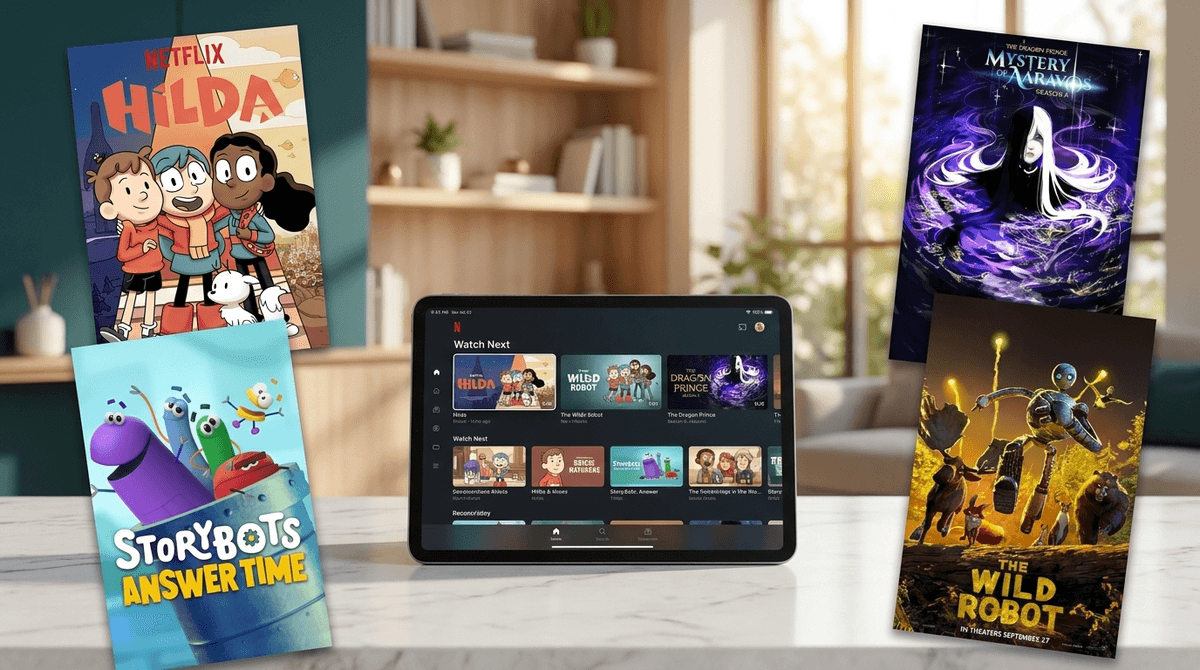
TL;DR: Your elementary schooler is likely aging out of Bluey and looking for something with a bit more "edge" (or at least more fart jokes). If you want to avoid the "brain rot" of endless YouTube scrolling, point them toward high-quality storytelling like Hilda, The Dragon Prince, or The Wild Robot. Be wary of the new "Ad-Supported" tiers on Netflix and Disney+, which often bypass your carefully curated filters to show junk food and toy commercials.
We’ve all been there: you finally get the Bluey theme song out of your head, only to realize your seven-year-old is now asking why everything is "so Ohio" or trying to explain the lore of Skibidi Toilet.
The elementary school years (ages 6-11) are a massive transitional period for digital media. This is when kids move from "passive consumers" of whatever you put on the screen to "active seekers" of what their friends are talking about at recess. According to Screenwise community data, by 3rd grade, over 65% of kids are navigating streaming menus entirely on their own, and about 40% have started asking for their own YouTube accounts.
The challenge? The streaming landscape has changed. It’s no longer just a library of movies; it’s a battleground of "attention economy" tactics, YouTube stars migrating to the big screen, and ad tiers that make "safe" apps feel a lot more predatory.
Netflix is the undisputed heavyweight, but it’s also the most chaotic. Their algorithm is designed to keep your kid watching anything, which is why the "Top 10" is often a mix of high-budget masterpieces and low-effort "brain rot" that looks like it was generated by an AI having a fever dream.
- The Good: Their parental controls are the best in the business. You can block specific titles (goodbye, CoComelon) and set hard maturity ratings.
- The Bad: The "YouTube-ification" of the platform. Shows like Blippi and MrBeast specials are taking over, bringing that high-octane, short-attention-span energy to your living room.
Disney+ used to be the "safe" vault, but with the integration of Hulu content, it’s now a sprawling ecosystem.
- The Good: It’s the home of Marvel and Star Wars, which are the primary social currencies of the elementary playground.
- The Bad: The "Ad-Tier" trap. If you’re on the cheaper plan, your kid is being bombarded with ads for sugary cereals and the latest Roblox toys, which essentially turns their downtime into a 22-minute commercial.
If Netflix is the wild west and Disney+ is the mall, Apple TV+ is the boutique bookstore.
- The Good: They have a "quality over quantity" approach. Almost everything they produce for kids is thoughtful, beautifully animated, and doesn't rely on screaming for attention.
- The Bad: The library is small. Your kid might blow through the good stuff in a month.
Don't let the "Trending Now" section decide what your kid watches. Here are the shows and movies that actually offer something of value—whether it’s emotional intelligence, genuine humor, or a spark of creativity.
For the Story-Lovers (Ages 7-10)
- This is arguably one of the best kids' shows ever made. It’s about a blue-haired girl exploring a world of giants, trolls, and spirits. It’s cozy, adventurous, and treats kids like they have a brain. It’s the perfect "step up" from preschool animation.
- If your kid is starting to get into Dungeons & Dragons or fantasy novels, this is the play. It features complex characters, diverse representation, and a serialized story that actually rewards paying attention.
For the Science & Nature Geeks
- It’s exactly what it sounds like, but narrated with enough charm to keep adults interested too. Great for winding down before bed.
- Even older elementary kids can get a kick out of this. It explains complex topics (how do lasers work?) in a way that isn’t condescending.
For the Movie Night Win
- Based on the The Wild Robot by Peter Brown, this movie is a visual masterpiece. It deals with heavy themes like survival, motherhood, and technology in a way that will actually spark a conversation.
- It’s stylish, fast-paced, and funny. It’s a "heist movie" for kids that doesn't feel like it's talking down to them.
Check out our full list of "Non-Brain Rot" shows for 8-year-olds
You might notice that Netflix is starting to look a lot like YouTube. Platforms are buying up "creator content" because it’s cheap and kids already recognize the faces.
Here’s the "no-BS" take: Most of this content is garbage. Shows like Blippi or the various "unboxing" style shows are designed to trigger dopamine hits through bright colors, fast cuts, and high-pitched voices. They don't require any "narrative transport"—the mental work of following a story.
If your kid is obsessed with MrBeast, they’ll probably find his Netflix specials. While MrBeast is "clean" in terms of language, his content is fundamentally about consumption and spectacle. It’s okay in moderation, but it’s the digital equivalent of eating a giant bag of Skittles for dinner.
In 2026, the biggest risk in streaming isn't necessarily "stranger danger" or even inappropriate content—it’s the advertising.
Most streaming services now offer a cheaper tier with ads. For adults, it's a minor annoyance. For elementary kids, it's a problem because:
- Ads bypass filters: You might set a profile to "TV-Y," but the ads shown during that show might be for a PG-13 horror movie or a high-sugar snack.
- Data Tracking: These tiers often collect more data on viewing habits to serve "targeted" ads to your kids.
- The "Gimme" Factor: Elementary kids are the prime target for toy marketing. A 30-minute session on an ad-supported tier can result in a two-hour argument about why they can't have a $100 LEGO set.
Pro-Tip: If it’s within your budget, the extra $5-8 a month for the "No Ads" tier is the single best digital wellness investment you can make for an elementary-aged child.
Your kid will encounter weird stuff. They’ll hear about Skibidi Toilet or "Sigma" memes. Instead of banning it—which just makes it "forbidden fruit"—talk about it.
Ask them:
- "Why do you think that video is so popular?"
- "How do you feel after watching 30 minutes of those short clips versus watching a movie like The Wild Robot?"
- "Do you notice how that YouTuber screams a lot? Why do you think they do that?"
Helping them develop a "critical eye" now is the only way they’ll survive the middle school years when you have even less control over their screens.
Streaming in the elementary years is about transitioning from control to mentorship. You can't hover over the remote forever, but you can curate a "digital pantry" that is full of high-quality options like Hilda and StoryBots, while keeping the "junk food" (YouTube stars and ad-heavy tiers) to a minimum.
Next Steps:
- Audit your tiers: If you're on an ad-supported plan, consider upgrading or strictly limiting "solo" viewing time.
- Set a PIN: Ensure your kid can’t hop over to your "Adult" profile to watch Squid Game just because they saw a meme about it on Roblox.
- Diversify: If they’re bored of TV, suggest a high-quality website like Scratch to let them create rather than just consume.
Check out our guide on moving your kid from YouTube to high-quality streaming