

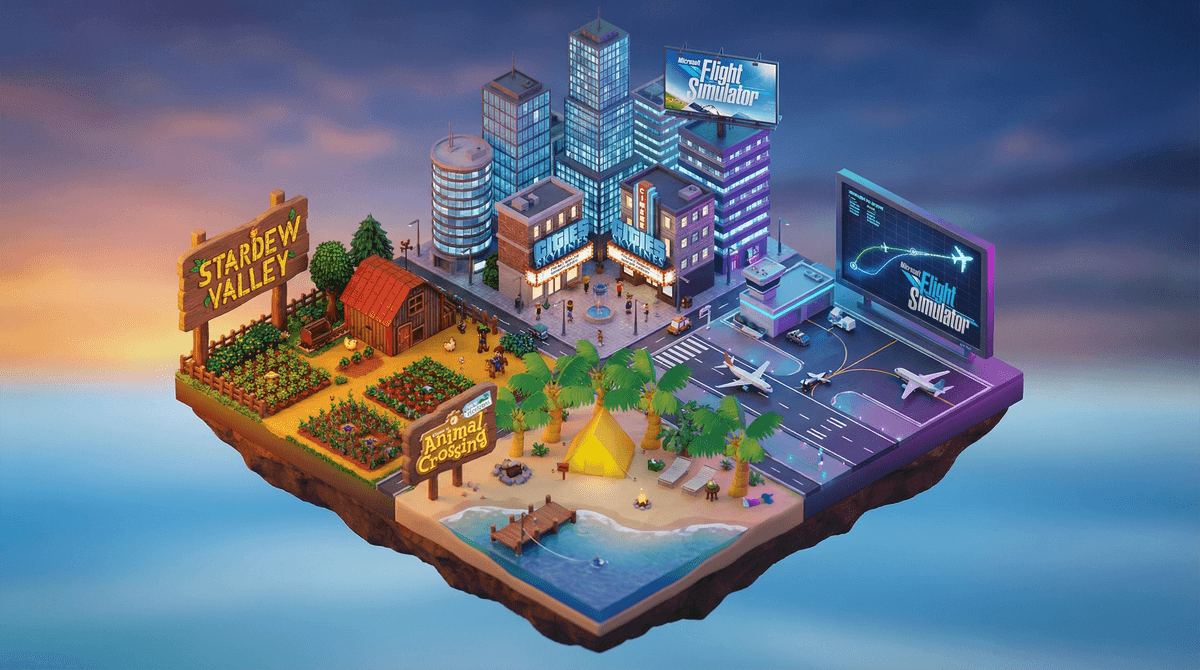
Simulation games let kids run virtual versions of real-world activities—managing a farm, flying a plane, building a city, running a restaurant, or even living an entire digital life. Think Stardew Valley, The Sims, Animal Crossing, or even Roblox experiences where kids build theme parks or manage pet shops.
Unlike action games where you're racing against time or battling enemies, sim games are about planning, managing resources, and seeing the consequences of your decisions play out. Your kid plants crops, waits for them to grow, sells them for profit, then reinvests in better seeds. They design a house, manage a budget, balance work and leisure. They run a zoo and learn that if you don't hire enough staff, the bathrooms get disgusting and visitors leave angry.
The appeal is obvious: kids get to do grown-up things without actual consequences. But here's the thing—these games can genuinely teach valuable skills, or they can become elaborate time sinks that feel productive but are really just digital busywork.
Control and autonomy. In real life, kids are told when to wake up, what to eat, when to do homework, and when to go to bed. In simulation games, they're the boss. They make the rules. They decide if their Sim becomes a chef or an astronaut, whether their farm focuses on crops or livestock, if their city prioritizes parks or industry.
Low-stakes experimentation. Want to see what happens if you spend all your money on decorations and none on food? Go ahead. Your Sim will be hungry and cranky, but nobody actually suffers. It's a safe space to make mistakes and learn from them.
Progression and mastery. These games reward patience and planning. Start with a tiny plot of land, gradually expand into a thriving empire. That sense of building something from nothing is genuinely satisfying, especially for kids who don't get many opportunities to see the long-term results of their efforts.
Creative expression. Whether it's designing the perfect house, creating elaborate outfits, or building a theme park with a specific aesthetic, sim games let kids express themselves creatively within structured systems.
Let's be clear: simulation games can actually teach useful skills. Not "this will get them into college" skills, but real cognitive and planning abilities:
Resource management. Understanding that you have limited money/time/energy and need to prioritize. Your 9-year-old playing Stardew Valley is genuinely learning opportunity cost when they choose between buying seeds or upgrading their watering can.
Delayed gratification. Many sim games reward patience. Plant crops that take three days to grow but sell for more. Save up for expensive equipment that makes future tasks easier. This is the opposite of the instant-gratification dopamine hits that concern us about other games.
Systems thinking. Good simulation games teach kids that actions have ripple effects. Pollute your river in a city-building game, and health problems increase. Neglect your animals in a farming sim, and productivity drops. This is genuinely sophisticated thinking.
Reading and math. Many sim games involve a lot of reading (quest descriptions, item stats, character dialogue) and math (calculating profit margins, comparing costs, managing budgets). Kids are doing this voluntarily because it's embedded in something they care about.
Entrepreneurship basics. Games like Roblox that let kids create and sell content, or tycoon-style games where they run businesses, introduce basic economic concepts. Some kids are learning about supply and demand, pricing strategy, and reinvestment before they hit middle school.
Here's where we need to be honest: not all simulation games are created equal, and even good ones can become problematic.
Time sinks disguised as productivity. Some sim games create artificial urgency through daily tasks, limited-time events, or crops that wither if not harvested on schedule. Suddenly your kid "needs" to check their farm every few hours or they'll "lose" their progress. This isn't teaching time management—it's creating compulsive behavior.
Microtransaction traps. Many mobile sim games (Hay Day, Township, various tycoon games on Roblox) are designed to frustrate you into spending real money. Wait 6 hours for this building to finish, or pay $2.99 to complete it now! This isn't teaching patience—it's teaching kids that money solves problems .
.
The grind. Some sim games become repetitive busywork. Clicking the same actions over and over isn't teaching anything—it's just occupying time. If your kid is zoning out while playing rather than actively thinking, that's a red flag.
Social pressure. Multiplayer sim games can create FOMO and comparison anxiety. Other kids have better farms, fancier houses, rarer items. Some games let players visit each other's spaces, which can be fun or can become a source of stress about keeping up.
Ages 5-7: Simple, gentle sims with no time pressure or failure states. Animal Crossing: New Horizons is perfect here—you literally cannot lose, there's no combat, and it's designed to be played in short sessions. Ooblets is another great option with a similar vibe.
Ages 8-10: Games with more complexity but still forgiving. Stardew Valley is the gold standard here—deep enough to stay interesting, but you can play at your own pace. Slime Rancher combines simulation with exploration in a delightful way. On Roblox, games like "My Restaurant" or "Theme Park Tycoon 2" can work well with parental involvement.
Ages 11-13: More sophisticated sims that introduce real complexity. The Sims 4 (with appropriate content filters), Cities: Skylines, Planet Zoo. These games have enough depth that kids can genuinely sink their teeth into systems and strategy. Flight simulators like Microsoft Flight Simulator can be amazing for kids interested in aviation.
Ages 14+: Pretty much anything goes, though you'll still want to watch for predatory monetization and time-sink mechanics. Farming Simulator has a dedicated teen fanbase who genuinely love the complexity. Business sims like Game Dev Tycoon can be both fun and educational.
Check the monetization model. Premium games you buy once (Stardew Valley for $15) are almost always better than free-to-play games with in-app purchases. If it's free, assume it's designed to frustrate your kid into spending money.
Watch for time pressure mechanics. Games that punish you for not playing frequently (crops that die, buildings that decay, limited-time events) are red flags. The best sim games let you play at your own pace.
Co-play when possible. Simulation games are actually great for parent-child bonding because they're not twitchy or competitive. Sit down together and plan out a city, discuss farm layouts, or help design a house. You'll get insight into how your kid thinks about planning and priorities.
Use them as conversation starters. "Why did you decide to focus on crops instead of animals?" "What's your strategy for making money?" "How do you decide what to buy first?" These games create natural opportunities to discuss decision-making, trade-offs, and planning.
Set boundaries around "checking in." If your kid feels compelled to check their game every few hours, that's a problem. Help them understand that it's okay to let virtual crops wither—they're not real, and the game will still be there tomorrow.
Simulation games occupy a weird space in the kids-and-screens landscape. They're not mindless—many require genuine thought and planning. They're not violent or inappropriate. They can teach real skills. But they can also be massive time sinks that create compulsive behavior disguised as productivity.
The key differentiator is agency. Is your kid actively making decisions and learning from consequences? Or are they just clicking through repetitive tasks because the game told them to? Is the game respecting their time, or is it designed to keep them hooked?
The best simulation games are the ones you can walk away from without anxiety, return to at your own pace, and feel like you've actually built or learned something meaningful. Games like Stardew Valley, Animal Crossing, and Slime Rancher fit this description. Many mobile and free-to-play sims do not.
Your job isn't to ban simulation games or even to limit them more than other screen time. It's to help your kid understand the difference between a game that's teaching them to think strategically and a game that's training them to click compulsively. And honestly? If your kid is deeply engaged in building a thriving virtual farm, making plans, solving problems, and learning from mistakes—that's not the worst way they could be spending screen time.
Want to explore specific simulation games? Check out our guides on Stardew Valley, Animal Crossing, The Sims, and Roblox tycoon games.
Concerned about Roblox specifically? Learn how to set up parental controls and understand how Robux actually works.
Looking for alternatives to screen-based sims? Physical games like Catan and Ticket to Ride teach similar resource management and planning skills with built-in family time.