

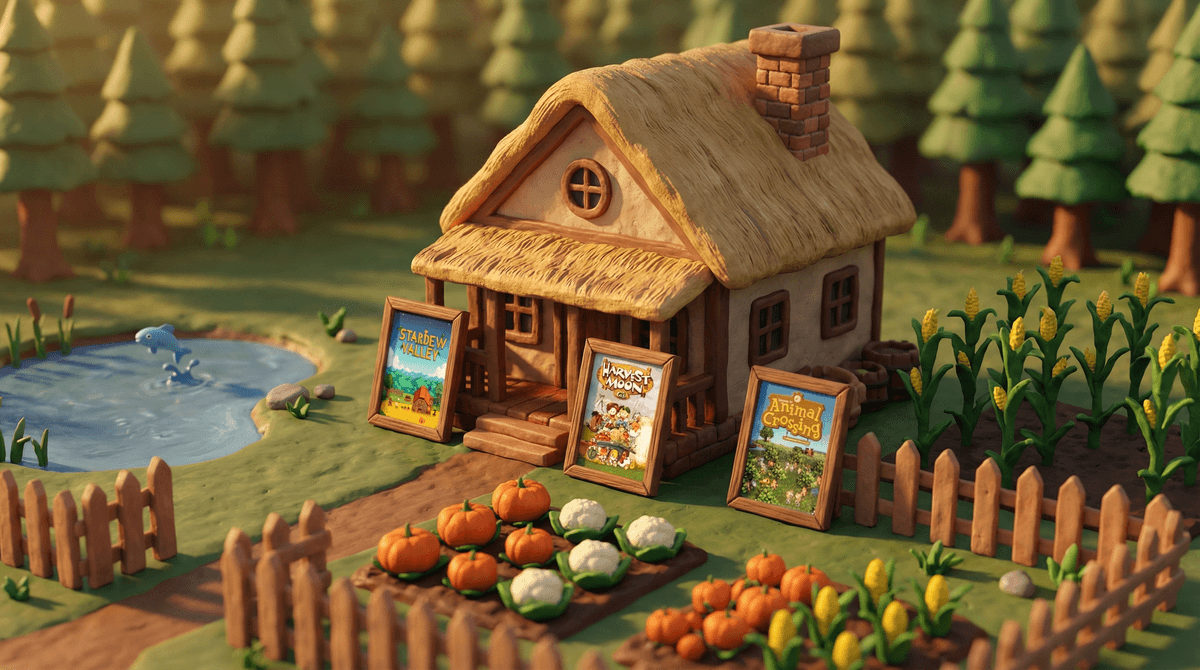
Stardew Valley is an indie farming simulation game where players inherit their grandfather's old farm plot and work to restore it to its former glory. Created by a single developer (Eric Barone, aka ConcernedApe) over four years, it's become a phenomenon since its 2016 release—and for good reason.
The gameplay loop is deceptively simple: plant crops, tend animals, mine for resources, fish, forage, and build relationships with townspeople. But beneath that cozy exterior is a surprisingly deep game about resource management, planning, and yes—consequences. Unlike many games kids gravitate toward, Stardew Valley doesn't have microtransactions, battle passes, or predatory mechanics. It's a one-time purchase that respects both your wallet and your kid's attention.
Think of it as Animal Crossing meets Harvest Moon, with a pixel art aesthetic that somehow feels both nostalgic and timeless.
There's something genuinely therapeutic about Stardew Valley's rhythm. In a digital landscape dominated by games designed to trigger dopamine spikes every thirty seconds, Stardew asks players to slow down and think ahead. Your crops take real in-game time to grow. Your relationships with villagers develop gradually through repeated, meaningful interactions. Your farm improvements require planning and saving.
The game teaches delayed gratification without feeling like homework.
Kids love the freedom to play their own way. Want to focus entirely on raising chickens and making artisanal mayo? Go for it. Prefer to spend your days in the mines fighting slimes? That works too. There's no "wrong" way to play, which is refreshingly different from the achievement-hunting culture of many modern games.
The game also has genuine stakes without being punishing. If you pass out from exhaustion in the mines, you lose some items and money—but you're not starting over. If you forget to water your crops, they won't grow that day, but they won't die. It's consequence-based learning with training wheels, which is honestly perfect for the 8-14 age range.
Let's talk about the elephant in the room: screen time. Our community data shows kids are averaging about 4.2 hours of screen time daily, with 55% of families reporting regular gaming. Stardew Valley can absolutely eat up hours if left unchecked—not because it's manipulative, but because it's genuinely engaging.
The good news? Unlike Fortnite or Roblox, Stardew Valley has natural stopping points. Each in-game day lasts about 12-15 real minutes, and the game auto-saves at night. This makes it much easier to enforce "one more day" limits than "one more match" in competitive games.
Content-wise, Stardew Valley is remarkably clean. The ESRB rates it E10+ (Everyone 10 and up), and that feels right. There's mild fantasy violence (fighting slime monsters in caves), and some adult themes if you dig deep—villagers deal with depression, alcoholism, and broken relationships. But it's all handled with remarkable maturity and nuance. Nothing graphic, nothing inappropriate.
One thing to know: there's a social/relationship system where your character can date and eventually marry NPCs. It's all very wholesome and PG, but some younger kids might not be interested in that aspect. The game never forces it on you.
I'm not going to oversell this as "educational software," but Stardew Valley genuinely teaches valuable skills:
Time management and planning: You have limited energy each day. Do you water crops, talk to villagers, or explore the mines? Kids learn to prioritize and plan ahead for seasonal changes.
Basic economics: The game has a functioning economy. Kids learn about profit margins (is it worth processing tomatoes into sauce?), opportunity cost, and long-term investment vs. quick cash.
Consequences and systems thinking: Everything connects. Neglect your relationships, and you miss out on helpful gifts and recipes. Ignore community center bundles, and you limit your progression. Learn more about how games can teach systems thinking .
.
Reading comprehension: There's a LOT of text in Stardew Valley. No voice acting. Kids who play it are reading constantly—dialogue, item descriptions, quest instructions.
Ages 8-10: Great introduction to the game with parental support. Younger kids might need help understanding some systems or reading certain dialogue. Consider playing together initially.
Ages 11-14: The sweet spot. Most kids this age can handle all game systems independently and will appreciate the deeper strategy elements.
Ages 15+: Still engaging, especially for kids who enjoy slower-paced, creative games. Many teens use it as a stress-relief game during homework breaks.
The game does have a multiplayer mode (up to 4 players), which adds a social element. Multiplayer is only available through direct connection—no random matchmaking—so you control who your kid plays with.
Here's what actually works:
Use the in-game day as your unit. "You can play three more days, then we need to leave" is much clearer than "ten more minutes" when kids are deep in their farm planning.
Leverage the seasons. Each season in Stardew Valley is 28 in-game days (about 5-7 real hours of gameplay). Some families let kids "finish the season" on weekends as a natural boundary.
Make it a family activity. The game is genuinely fun to watch and discuss. "What are you growing this season?" is a great conversation starter that shows you're interested, not just monitoring.
Consider the multiplayer farm option. Playing together on one farm can be a genuinely bonding experience and gives you natural oversight.
In a gaming landscape that often feels designed to exploit rather than entertain, Stardew Valley is a genuine breath of fresh air. It's not perfect—it can still consume hours, and some kids might find it too slow-paced—but it's one of the healthiest gaming habits your kid could develop.
The game costs $15 on most platforms (PC, Switch, PlayStation, Xbox, mobile), with no additional purchases required. Ever. In a world of $20 Fortnite skins and Roblox's confusing Robux economy, that's genuinely refreshing.
If your kid is currently deep in the Minecraft or Roblox ecosystem and you're looking for something different, Stardew Valley is worth suggesting. It might not stick—some kids need more action—but for the right kid, it becomes a genuine passion that teaches patience, planning, and the satisfaction of building something meaningful over time.
- Try it yourself first. Seriously, play a season or two. You'll understand the appeal and know exactly what your kid is experiencing.
- Set clear time boundaries from day one. Use in-game days as your metric.
- Check in regularly about what they're working toward. This shows interest and helps you understand if they're engaged or just zoning out.
- Consider the platform carefully. The Nintendo Switch version is great for portability and natural time limits. The PC version has mod support (which opens other considerations).
Want to understand more about how Stardew Valley compares to other popular games? Check out our guide on game alternatives or explore other cozy games that might work for your family.