

Raising a Lifelong Learner in the Digital Age
Look, I'm not going to sugarcoat it: trying to raise a curious, engaged learner when their device is literally engineered to hijack their dopamine system feels like bringing a knife to a gunfight. But here's the thing—screens aren't the enemy of learning. They're just really, really good at making everything else feel boring by comparison.
The real challenge isn't getting kids off screens (though yes, that matters). It's helping them develop the kind of curiosity and critical thinking that makes them want to learn things, even when those things don't come with achievements, notifications, or a like button.
A lifelong learner is someone who stays curious, asks questions, can think critically, and knows how to find reliable information. They read for pleasure (or listen to audiobooks, or watch documentaries—we're not precious about the format). They get excited about ideas. They can focus on something challenging without immediately reaching for a dopamine hit.
In the digital age, this also means: They can tell the difference between a TikTok that feels educational and actual learning. They understand that YouTube University has its limits. They know that ChatGPT can help with homework but can't actually teach them to think.
Previous generations didn't have to compete with algorithms designed by some of the smartest engineers in the world whose literal job is to make content as addictive as possible. When you were bored as a kid, you picked up a book or went outside because what else were you going to do?
Now? Boredom lasts approximately 3.5 seconds before a device appears.
And here's what makes it tricky: some screen time IS educational. Crash Course genuinely teaches history better than many textbooks. Duolingo actually works for language learning. Minecraft can teach spatial reasoning, resource management, and even basic coding.
The problem is that the same device that hosts Crash Course also hosts infinite TikTok scrolling and YouTube shorts that rot your brain faster than you can say "Skibidi Toilet."
Forget memorizing state capitals. Here's what actually matters:
Curiosity: The ability to wonder "why?" and "how?" and actually care about the answer.
Focus: The capacity to stick with something challenging even when it's not immediately rewarding.
Critical thinking: Can they spot BS? Do they know that not everything on the internet is true? Can they tell the difference between a source and a random Reddit comment?
Information literacy: Knowing how to find reliable information, evaluate sources, and learn independently.
Intrinsic motivation: Doing things because they're interesting, not just for grades, rewards, or external validation.
The bad news: Constant context-switching between apps trains brains for distraction, not focus. Algorithmic feeds deliver endless novelty, making slower-paced learning feel boring. And when every question can be Googled in 2 seconds, there's less incentive to actually remember anything or think deeply.
The good news: Digital tools can also be incredible learning accelerators. Kids can explore virtually any topic that interests them. They can learn to code, create art, make music, or dive deep into obscure historical events—all from their bedroom.
The difference is intentionality. Passive consumption versus active engagement. Scrolling versus creating. Entertainment versus education.
Create Space for Boredom
I know, I know. But seriously—boredom is where curiosity lives. If every spare moment is filled with screens, there's no room for kids to wonder about things or pursue their own interests.
Try this: Designate screen-free times (mornings, mealtimes, before bed) and don't fill them with structured activities. Let them be bored. See what happens.
Model Curiosity Yourself
Kids are watching how you engage with the world. Do you look things up when you're curious? Read books? Listen to podcasts? Or do you just scroll Instagram while they do homework?
Try this: Share what you're learning. "I was reading about why sourdough bread works and it's actually fascinating..." Yes, they'll roll their eyes. But it plants a seed.
Make Learning Visible and Valued
In a world of likes and views and subscriber counts, learning can feel invisible and unrewarding. Make it visible.
Try this: Talk about what they're learning at dinner. Not "how was school?" but "what's the most interesting thing you learned today?" Celebrate the process, not just grades. "You worked really hard on that" beats "You're so smart."
Curate Their Digital Diet
Not all screen time is created equal. Bluey and Cocomelon are both "kids shows" but one teaches emotional intelligence and the other is basically visual sugar.
Try this:
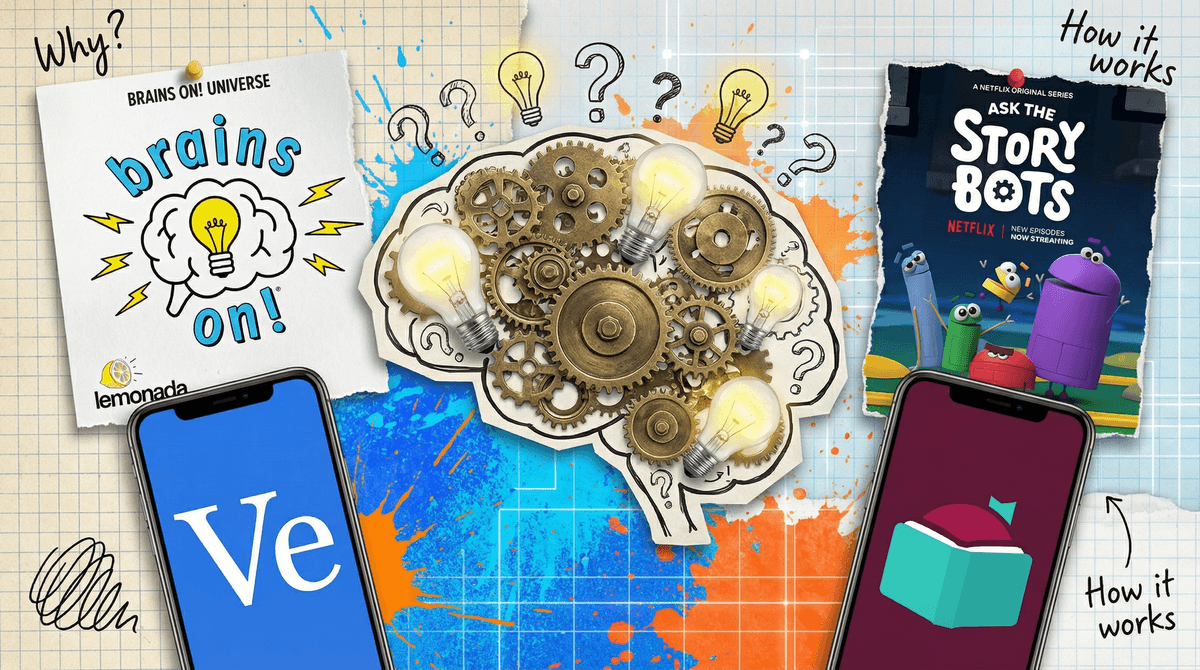
- Ages 3-7: Bluey, Octonauts, StoryBots
- Ages 8-12: Crash Course Kids, Brains On!, Number Blocks
- Ages 13+: Kurzgesagt, Veritasium, actual documentaries
And yes, they can still watch dumb stuff sometimes. We're not monsters.
Teach Them to Evaluate Sources
This is genuinely one of the most important skills for the digital age. A 10-year-old on TikTok will confidently tell you "facts" they learned from a 15-second video with zero sources.
Try this: When they share something they "learned" online, ask: "Where did you see that? Who made it? How do they know?" Not in an accusatory way—just modeling critical thinking. Learn more about teaching media literacy .
.
Let Them Go Deep on Their Interests
Even if their interest is Roblox or Pokémon or some YouTuber you've never heard of. Deep interest in anything builds the neural pathways for learning.
Try this: Support their obsessions. Get them books about it. Find documentaries. Let them teach you about it. The content matters less than the practice of deep engagement.
Use Tech as a Creation Tool, Not Just Consumption
Consuming content is passive. Creating something—even in Minecraft or GarageBand—requires problem-solving, focus, and learning.
Try this: Encourage projects. Build something in Minecraft. Make a stop-motion video. Code a simple game. Create a podcast. The barrier to entry for creation has never been lower.
Protect Reading Time
I don't care if it's graphic novels, audiobooks, or actual chapter books—reading builds vocabulary, empathy, focus, and imagination in ways that video just doesn't.
Try this: Bedtime reading (no negotiations). Audiobooks for car rides. Epic! or Libby for digital access. Whatever works.
Ages 3-7: Focus on curiosity and wonder. Answer their "why" questions (or look up answers together). Prioritize hands-on exploration over screens when possible. When they do use screens, choose genuinely educational content like PBS Kids.
Ages 8-12: This is when they start having their own interests. Support those, even if they seem silly. Introduce them to Khan Academy Kids or Duolingo. Start teaching source evaluation. Balance consumption with creation.
Ages 13+: They're forming their identity now. Help them find their intellectual interests. Introduce them to long-form content—podcasts, documentaries, actual books. Teach them about algorithms and how their feed is curated. Learn about algorithmic literacy.
Yeah, we need to talk about this. ChatGPT can write their essays. It can solve their math problems. It can do their homework better than they can.
Here's the thing: AI isn't going away. Fighting it is like fighting calculators in the 80s. But kids still need to learn to think, write, and problem-solve themselves before they outsource it to AI.
Try this: Teach them to use AI as a tool, not a replacement. "Use ChatGPT to brainstorm ideas, but write the essay yourself." "Use it to check your work, not do your work." The skill isn't avoiding AI—it's knowing when and how to use it responsibly.
You can't compete with TikTok's algorithm. You can't make learning as immediately rewarding as video games. And honestly? You shouldn't try.
What you can do is create an environment where curiosity is valued, questions are encouraged, and learning is part of your family culture. Where boredom isn't immediately medicated with screens. Where books exist and are actually read. Where your kid sees you engaged with ideas, not just content.
Will they still want to watch YouTube sometimes? Yes. Will they occasionally disappear into Roblox for hours? Probably. That's fine. You're not trying to raise a monk. You're trying to raise a human who can think, focus, and stay curious in a world designed to make them do the opposite.
Start small: Pick one thing from this list. Maybe it's screen-free mornings. Maybe it's asking "what did you learn today?" at dinner. Maybe it's just putting some interesting books where they can see them.
The goal isn't perfection. It's progress. And honestly? The fact that you're reading this means you're already doing better than you think.
- Take the Screenwise survey to understand your family's digital habits in context
- Explore educational apps and shows for your kid's age
- Learn how to set up healthy screen time boundaries
- Find alternatives to mindless scrolling
You've got this. And when you don't? That's what we're here for.