

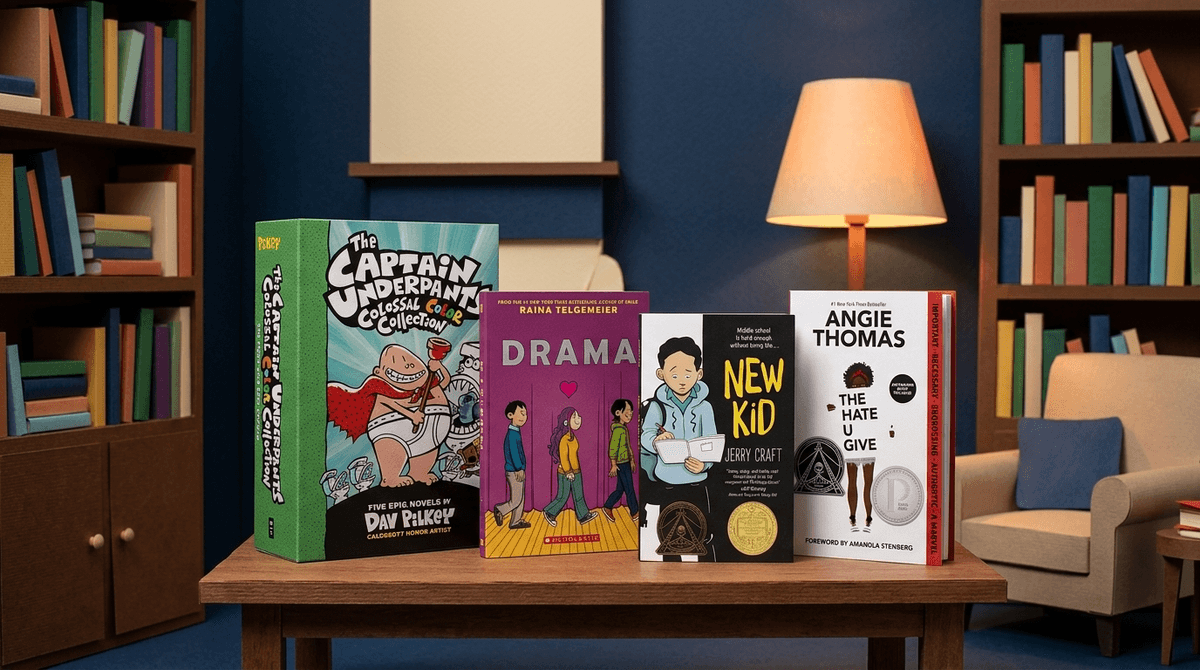
TL;DR: Book bans are hitting record highs, often targeting stories about identity, history, and—weirdly—potty humor. If your local library is thinning out, digital tools like Libby and Epic! are the ultimate workarounds. We’re diving into why Captain Underpants is a target and how to keep your kid's digital bookshelf diverse and accessible.
Find banned books for middle schoolers
If you feel like you’re seeing "book ban" in the headlines every other day, you aren't imagining it. According to the American Library Association, 2023 and 2024 saw the highest number of "challenged" books since they started keeping track.
But let’s clarify the terminology. A challenge is an attempt to remove or restrict materials based on the objections of a person or group. A ban is when that book is actually pulled from the shelves.
The weird part? It’s not just "edgy" YA novels anymore. We’re seeing everything from And Tango Makes Three (a picture book about penguins) to the legendary Captain Underpants getting the boot.
In 2026, the conversation has shifted. It’s less about one concerned parent and more about organized groups pushing for state-level legislation. For intentional parents, this creates a weird friction: we want to protect our kids from "brain rot" content, but we also want them to have the critical thinking skills that come from reading diverse, sometimes uncomfortable, perspectives.
Kids are drawn to the very things that often get books challenged: honesty, rebellion, and humor that feels "theirs."
Take Captain Underpants by Dav Pilkey. It’s been a staple of "banned" lists for years. Why? Because it features "offensive language" (read: toilet humor) and encourages "disruptive behavior."
But let’s be real: if your kid is already obsessed with Skibidi Toilet or watching MrBeast yell for twenty minutes, a book about a principal in his underwear is the least of your worries. In fact, Captain Underpants is often the "gateway drug" that turns reluctant readers into actual book lovers. Banning it doesn't stop kids from liking "gross" stuff; it just stops them from reading.
If you’re looking to build a resilient, empathetic reader, these are the titles that are currently under fire but offer massive value.
Ages 10-14 This graphic novel is a middle-school staple. It’s about a theater crew, crushes, and friendship. It gets challenged constantly because it includes LGBTQ+ characters and a very innocent on-stage kiss. It’s not "adult content"—it’s just a reflection of what middle school actually looks like. Check out our guide on why graphic novels are "real" reading
Ages 8-12 The first graphic novel to win the Newbery Medal. It follows a Black student at a prestigious, mostly white private school. It’s been challenged for "Critical Race Theory," but in reality, it’s a brilliant, funny, and relatable story about trying to fit in when you feel like an outsider.
Ages 14+ A powerhouse of a YA novel about a girl who witnesses a police shooting. It’s frequently banned for profanity and "anti-police" sentiment. It’s also one of the best tools for starting a conversation with your teen about justice, systemic issues, and finding your voice.
Ages 16+ This is currently the most challenged book in the country. It’s an autobiography about being non-binary. While it contains some sexually explicit illustrations that make it a "high school and up" recommendation, the ban attempts often focus on removing it from libraries entirely, even for adults.
Find LGBTQ+ books for elementary school
If your local school or town library has started pulling titles, don’t panic. The internet is the ultimate "un-banner." Digital libraries are harder to censor and easier to access from your living room.
If you have a library card, you need Libby. It’s the gold standard. Even if your local branch doesn't have a physical copy of a book, their digital consortium might. Pro-tip: Some major libraries, like the Brooklyn Public Library, have offered "Books Unbanned" cards to teens nationwide, giving them digital access to their entire collection regardless of where they live.
For the younger set (under 12), Epic! is a massive digital library. It’s great because it’s a controlled environment—you don't have to worry about them stumbling into the "weird" side of YouTube. It features thousands of high-quality books, including many that have faced challenges in conservative districts.
When a book is truly hard to find, the Internet Archive often has digital scans available for "borrowing." It’s a bit clunkier than Libby, but it’s a vital resource for intellectual freedom.
Here’s the thing about banning books: it makes kids want to read them way more. This is called the Streisand Effect. If you tell a 12-year-old they aren't allowed to see what’s inside Captain Underpants, they will find a way to see it.
Instead of letting the controversy dictate what your kid reads, use it as a teaching moment.
How to talk about it:
- "I saw this book was removed from the school library. Why do you think people might be afraid of the ideas in this book?"
- "Just because a book is 'banned' doesn't mean it's bad, and just because it's available doesn't mean it's right for you right now. Let’s look at it together."
- "What do you think about the humor in Captain Underpants? Is it just silly, or do you think it's actually 'disruptive'?"
Not every "banned" book is right for every kid.
- Elementary: Focus on "silly" bans like Captain Underpants or In the Night Kitchen. These are great for discussing how different people have different "rules" for humor.
- Middle School: This is the sweet spot for graphic novels like Drama or New Kid. These kids are navigating complex social hierarchies and identity—they need books that reflect that.
- High School: This is when they should be hitting the heavy hitters like The Bluest Eye or Fahrenheit 451 (the irony of banning a book about burning books is never lost on a teenager).
Check out our guide on navigating mature themes in YA literature
Book bans are often more about adult anxieties than they are about child safety. As intentional parents, our job isn't to shield our kids from every "controversial" idea, but to give them the tools to process those ideas.
If your kid is reading Captain Underpants and laughing, they’re developing a love for storytelling. If they’re reading The Hate U Give and asking questions, they’re developing empathy.
Next Steps:
- Check your apps: Ensure you have Libby or Epic! set up on your kid's tablet.
- Look at the list: Browse the ALA’s most challenged books list and see if any pique your kid's interest.
- Talk about it: The next time you see a headline about a school board meeting, ask your kid what they’re hearing at school. You might be surprised by how much they already know.